Christianity
The Argument from Religious Experience: A look at its strength
 I have written previously about the argument from religious experience. I provided a brief outline of the argument and commented on its usefulness. Now, I turn to the question of the strength of the argument from religious experience.
[Note: Through this post, when I say “religious experience” I am referring to experience generally–that is, numinous, sensory, and the like. I will distinguish when I mean otherwise.]
The Sheer Numbers
Religious Experience is pervasive throughout human history. You can find accounts of it in the Upanishads, the Vedas, the Qur’an, the Torah, the Gospels, and more. Not only that, but recent, systematized studies have found that religious experience continues to be a part of people’s realm of experience.
Consider David Hay’s study, Religious Experience Today. The book is based upon a number of national and community surveys in the UK. For example, one Gallup poll in Britain in 1987 yielded a response rate of 48% of people saying they had had a religious experience as described by the poll. In 2000, another poll in the UK yielded a 36% positive response. Granted that some of this may be due to false positives, one must also realize that there is a kind of repression of expressing religious experience due to embarrassment and/or personal bias, so these numbers may also lean towards the lower end (Hay, 57ff).
One could also look at the sheer number of luminaries throughout all time who have claimed religious experience. Throughout the literature, such experiences are far too numerous to be restricted to a descriptor like “many.”
One can’t help but agree with Richard Swinburne, who wrote, “[T]he overwhelming testimony of so many millions of people to occasional experience of God must… be taken as tipping the balance of evidence decisively in favour of the existence of God” (Is There a God?, 120).
The Balance of the Scales
“The argument from religious experience” (hereafter ARE) is itself somewhat of a misnomer–there are many forms of arguments from religious experience, so it is helpful to clarify when one is in dialog which version one is using. I have noted elsewhere that the ARE comes in two varieties: one which argues for public belief and one which argues for personal justified belief. There are two more variants to introduce here: the broad version and the narrow version.
1. The Broad Version of the ARE presents religious experience as a general proof for either:
A) the existence of some transcendent realm–this being a transcendent aphysical realm. This is the broadest version of the argument.
B) the existence of God. This is a broader version of the argument, but isn’t as generalized as A).
2. The Narrow Version of the ARE argues for the truth of a particular religion based upon religious experience. Note that this is narrow in that many religions could affirm a “transcendent realm” or the existence of God[s], but if the argument is construed in this fashion, only the religion which is claimed to have superior evidence from religious experience is [fully] true. [Other religions could have many truths which could be affirmed through RE, but only one would have the “full” or “realized” truth.]
 The argument from religious experience is much easier to defend if it is presented broadly. As one narrows the argument, one is forced to deal with potential defeaters from religious experiences which do not accord with the argument being made. For example, if one argues that God exists based upon religious experience, one would have to somehow contend with the great amount of evidence for monistic or Nirvanic religious experience.
Think of the argument like as a bridge with a counterbalance or a scale with a counterbalance. The more weight one places on the argument [i.e. saying that it can justify the existence of God] (scale/bridge), the more one must deal with that weight on the other end (counterbalance).
If the argument is presented as a way to prove general transcendence of experience, it is extremely strong and very easy to defend. When one instead uses the argument to try to justify the truth claims of a specific religion, one then must come up with a mechanism for determining how to evaluate competing religious experiences. For example, if I argue that religious experiences prove Christianity to be true because so many people have experienced in sensory ways Jesus Christ as Lord and Savior, then it is my task to also show that the experiences of, say, Shiva as god are unwarranted. Thus, the philosopher’s task increases in difficulty the more narrowly he presents the arguments conclusion.
Consider the following two conclusions from arguments (granting me authorial privilege to assume that readers can plug in the premises): 1) Therefore, religious experience justifies the belief that there is a realm apart from our mere physical existence; 2) Therefore, religious experience serves as powerful evidence for the truth of Christianity. The fact that 2) is much more narrow means that one must do much more to show that the conclusion is justified.
Does this mean that the argument is useless when arguing for a particular religion? Certainly not. There are many who have used the ARE for a defense of Christianity specifically (cf. William Alston Perceiving God and Nelson Pike Mystic Union). What is important to note is that when one uses the argument in dialog they must be very aware of how they formulate the argument. As a “Broad/public” version, it can serve as powerful evidence in part of a cumulative case for Christianity; as a “narrow/private” version, it can be strong confirmation of the justification of one’s faith. These variants can be used together or separately.
The Strength of the Argument
So how strong is the ARE? I hope I don’t disappoint readers when I respond by saying: that depends! As far as my opinion is concerned, it seems to me that the “broad/public” and “broad/private” version of the argument are nearly irrefutable. I think it is an invaluable tool for apologists and philosophers of religion. The “narrow/private” or “narrow/public” versions of the argument are not as strong by necessity: they must contend with more objections as they narrow. However, as part of one’s own faith life, I think the “narrow/private” and “narrow/public” versions can give great comfort and solace.
[Author’s note: The next post on the argument from religious experience will defend the principle of credulity.]
Further Reading
See my “The Argument from Religious Experience: Some thoughts on method and usefulness“- a post which puts forward an easy-to-use version of the ARE and discusses its importance in apologetic endeavors.
The following books are all ones I have read on the topic but do not present a comprehensive look at literature on the subject.
Caroline Franks Davis, The Evidential Force of Religious Experience
Jerome Gellman, Experience of God and the Rationality of Theistic Belief
Paul Moser, The Evidence for God
Richard Swinburne, Is There a God?
There are a number of other fantastic books on the topic as well. Swinburne’s The Existence of God
William Alston’s Perceiving God
Keith Yandell’s The Epistemology of Religious Experience
Kai-man Kwan’s Rainbow of Experiences, Critical Trust, and God
Nelson Pike provides a unique look at the phenomenology of RE and a synthesis of theistic and monistic experiences in his work Mystic Union
SDG.
——
The preceding post is the property of J.W. Wartick (apart from citations, which are the property of their respective owners) and should not be reproduced in part or in whole without the expressed consent of the author. All content on this site is the property of J.W. Wartick and is made available for individual and personal usage. If you cite from these documents, whether for personal or professional purposes, please give appropriate citation with both the name of the author (J.W. Wartick) and a link to the original URL. If you’d like to repost a post, you may do so, provided you show less than half of the original post on your own site and link to the original post for the rest. You must also appropriately cite the post as noted above. This blog is protected by Creative Commons licensing. By viewing any part of this site, you are agreeing to this usage policy.
Shoulders of Giants? -Philosophy and Science in Context, or, “Lawrence Krauss jumps off!”
If I have seen further [than other scientists/philosophers] it is by standing on ye sholders of Giants.- Isaac Newton
We act as if they’re [philosophers without current knowledge of science] authorities about something; they knew nothing!- Lawrence Krauss
Lawrence Krauss recently appeared on the English [UK] radio show “Unbelievable?” In this radio program, Krauss and Randy Holder, a Christian, were in dialog about “A Universe from Nothing?” [not necessarily Krauss’ book, but the subject in general]. The dialog, unfortunately, showed that Krauss continues in his ignorance of the importance of philosophy to his own subject, as well as his own flippant dismissal of generations of scientists.
At one point in the program (around the 26:00 mark), Krauss says the following:
I don’t [indiscernible–he may say “also”] care about what Mr. Leibniz said… we refer to philosophers who wrote at a time when we didn’t know that there were a hundred billion galaxies. [So?] Who cares what they say? We act as if they’re authorities about something; they knew nothing!- Lawrence Krauss
Really?
 I can’t think of a more galling statement for a contemporary cosmologist to make. Gottfried Wilhelm Leibniz, for those who don’t know, happened to be one of the men who discovered infinitesimal calculus. He also (among countless other contributions to mathematics, science, social sciences, engineering, and philosophy) developed a calculator, contributed to the development of binary language, was one of the first to posit that space was relative, and developed the principle of sufficient reason (which supports all scientific investigation).
Yet, according to Krauss, because he lived in a time before we know how large the universe was, he “knew nothing!” You see, Krauss, and some other scientists and thinkers with a scientistic/physicalist bent, too often throw out the very basis of their thought. How far do you think Krauss could get in his cosmological research without infinitesimal calculus? How would Krauss go about investigating the causes of various natural phenomena without the principle of sufficient reason?
The answer is pretty simple: he wouldn’t get anywhere.
Krauss, like those before him, stands on the shoulders of giants. But, unlike those who are humble enough (or who know enough about philosophy and history?) to admit it, Krauss says “We act as if they are authorities about something, they knew nothing!”
Really, Krauss? Let’s see how well your next research project goes if you throw out all the contributions they made to your methodology. Next time you do an experiment, try to do it without parsimony or inference to the best explanation. Write to me how that goes!
What’s happened with people like Krauss, and I can think of others (like Stephen Hawking, Richard Dawkins) who do the same thing, is that in their gusto for the marvels of modern science, they have forgotten the very basis for their methods, their research, and their rationality.
Without philosophy, there would be no way to infer causes from effects; without the principle of sufficient reason, there would be no reason to think that causes even have effects; without a well developed notion that what will happen can be inferred from what has happened, these scientists could not even get going. But then they have the absurd tendency to turn around and reject philosophy. They say things like the quote Krauss fired off above.
Here’s the thing: science is utterly dependent upon philosophy to survive. If we didn’t have philosophy–if we didn’t have the developed notions of rationality, inference, and the like–there would be no science. Other theists (and philosophers) have contributed things like parsimony/Occam’s Razor to the wealth of philosophical methodological backbone which makes the scientific enterprise possible. In fact, there is still debate over whether we can reliably make inferences from science (for one example philosophically defending scientific inference, see Wesley Salmon, The Foundations of Scientific Inference). Some scientists have now apparently become those who sit in the ivory towers, blissfully ignorant of how their own research depends upon others’ outside of their field.
I suspect a multifaceted problem behind the motivation of those who throw philosophy out the window once they’ve embraced full-fledged empiricism. First, many of these thinkers have demonstrated they don’t actually know what empiricism means as a–that’s right–philosophical system. Apart from Krauss and Hawking, one could cite the recent example of Richard Dawkins admitting that he doesn’t know what “epistemic” means. Note to those who embrace that philosophical system of Krauss et al.: without epistemology, you would not even be able to justify inferences to best explanation. How’s that for a dose of reality?
Second, there is a kind of blatant ignorance of–or even intentional trampling on–the historical development of scientific inquiry. I hesitate to say that philosophy makes a “contribution” to science, because that’s not what it is. A simple study of schools of knowledge reveals that science, by its very nature, is utterly dependent upon epistemological research. Without such development, there would be no scientific method.
Third, these scientists constantly make philosophical claims, apparently in complete ignorance of the fact that they are philosophical claims. For example, in the same dialog Krauss argues that “the universe certainly doesn’t care what I like…” and throughout the discussion points out that it doesn’t matter what we think, the universe is revealed in a certain way by research.
He apparently seems utterly oblivious to the fact that that, in itself, is a philosophical position. One could take a rival position and argue that the appearances of nature don’t actually determine reality because everything is mind-dependent (idealism, solipsism, or other schools). It’s not enough to just point at nature and say “see, this is how things are!” because if that’s all one does, then someone could say “Your ideas about how things are are dependent upon your mind and ideas, and therefore don’t have any access to reality.” No scientific research could rebut such an argument, only a philosophical position in which nature can give us a reliable record for rationality can ground science.
Krauss dismisses philosophy very nonchalantly. It seems as though he (and others like him) is oblivious to the fact his entire system is philosophical. Consider the claim that “science can examine reality.” How does one go about proving it? One could argue that one could simply make a test and show that over and over again in circumstances y, x result happens, so we are justified that when we assert that if y, then x. But of course we would have to justify that a test can be connected to reality; we’d have to figure out what it means to have “justified” belief; we have to show that our scientific method is trustworthy; we have to assume that mathematical truths are true; we have to operate within a rational perspective; etc. All of these are philosophical positions. Some of them are debates within philosophy of science, in fact. The bottom line is that whenever someone does science, they are utterly reliant upon philosophy. By simply taking the empirical world as something which can be explored, they have made a number of philosophical assumptions, whether realized or not. Scientists take much of the philosophical development as a given before they even start their research. And then, some of them, like Krauss, have the gall to turn around and dismiss philosophers as though they “know nothing.” Suddenly, he has undermined his own system of thought, without even acknowledging that it is a system of thought.
Frankly, some of these scientists are just confused. Thankfully, many scientists operate with a system that respects the contributions of philosophy to science and encourage the interplay between the fields of knowledge.
Here’s the bottom line for those scientists who agree with Krauss: your entire field of research can only proceed if you grant over a thousand years of philosophical development. One major contribution was made by Leibniz, whom people like Krauss casually dismiss. But without the theistic philosopher with the awesome wig, scientists would have nothing. Thanks, philosophy! Thanks again, Christianity!
SDG.
——
The preceding post is the property of J.W. Wartick (apart from citations, which are the property of their respective owners) and should not be reproduced in part or in whole without the expressed consent of the author. All content on this site is the property of J.W. Wartick and is made available for individual and personal usage. If you cite from these documents, whether for personal or professional purposes, please give appropriate citation with both the name of the author (J.W. Wartick) and a link to the original URL. This blog is protected by Creative Commons licensing. By viewing any part of this site, you are agreeing to this usage policy.
Book Review: “7 Truths that Changed the World” by Kenneth Samples
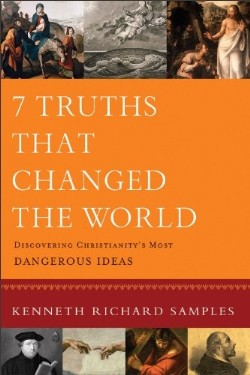 Kenneth Samples’ latest book, 7 Truths That Changed the World
Samples presents 7TC as a kind of investigation into the “dangerous ideas” that are central to Christianity. These dangerous ideas are:
- Not all men stay dead. In this section, Samples defends the historicity of Jesus’ resurrection. Christians who are actively involved in reading apologetics will find that the argument is the fairly well-known “minimal facts” style, but Samples does manage to give some uniqueness to the argument in the next chapter, wherein he examines various objections to the argument for the resurrection. Particularly unique was the fact that Samples takes the time to offer critiques of some of the more outlandish objections, like the twin brother theory (38).
- God walked the earth- Here, Samples puts the “dangerous idea” squarely in the context of religious pluralism. Not all religions can be true (48ff) and if Jesus was God on earth, then Christianity is true. Interestingly, rather than simply presenting arguments for Jesus’ Godhood, Samples offers a few theories of the incarnation and only then moves towards Biblical evidence for Jesus’ deity (50-53; 53ff). Again, Samples engages with some little-known but often abused objections, including the notion that Jesus was a guru (69-70) or even an alien (70-71).
- A fine-tuned cosmos with a beginning- Samples then engages in an argument from cosmic fine-tuning. Again, Samples puts the argument into a context rather than simply throwing it out to be fielded. Throughout the book, Samples grounds the arguments he makes within the broad theological history that surrounds the ideas. For this argument, he points out the historical doctrine of creation out of nothing through the Bible and church history (78-80). He also points out the “weighty theological implications” of the fine-tuning argument (82-83). He then argues that Christian theology helped ground the emergence of science (91ff).
- Clear pointers to God- Explanatory power is one way to evaluate worldviews, and Samples weighs atheistic naturalism against Christian theism. Samples offers a method by which people can evaluate worldviews. Essentially, this is a summary of his excellent work, A World of Difference, which I comment on in my post “Can We Evaluate Worldviews? How to navigate the sea of ideas.” Throughout this section, Samples offers a number of arguments in favor of the notion that God exists and can best explain the universe we observe.
- Not by Works- One of the core tenets of Protestantism, and indeed of evangelicalism (and in many ways, more modern Roman Catholicism) is salvation by grace. The fact that Christianity offers salvation as a gift provides another way to analyze it in light of other worldviews (134ff). All humans feel an urge to try to work for salvation, but this is mistaken. Ultimately, we cannot do it by ourselves (136ff). Sin is a predicament in which we find ourselves, it is a condition (137-138). Thus, Christianity offers a “way out” by salvation through grace in Christ.
- Humanity’s Value and Dignity- Humans have value. Most humans realize that it is wrong to cause harm or suffering and that certain virtues are good. However, without theism, there is no basis for human values (167ff). Some atheists have realized this and rejected meaning (163-166), but their worldviews dim in comparison to the light Christianity brings.
- The Good in Suffering- The problem of evil is the most oft-trumpeted argument for atheism, and Samples responds to it mostly by utilizing the “greater good” theodicy (theodicy means, basically, a defense from the problem of evil). First, he points out that it is not logically incoherent to suppose God is all powerful and all good while still believing evil exists (196-200). Then, he argues that God can have good purposes for evil and suffering (205ff). While we may not come up with a specific reason for every single evil that occurs, God’s sovereignty ensures that good will triumph and that all things work for His purposes (209ff). I don’t tend to favor the “greater good” theodicy because I’m not sure I can swallow the notion that every evil has a greater good–but I think that when applied to evil generally it may be more powerful. Samples does a good job introducing the reader to the basics on the problem of evil and a theodicy here.
While much of the material in 7TC goes over things the avid reader of apologetics will have encountered, the novelty of some of the arguments as well as the answers to some infrequently-considered objections makes the book worthwhile even to “veterans.” It is also very helpful to have some of the background in historical theology that Samples gives to contextualize many of his points. These kinds of extra details with the overall argument give readers a level of background knowledge that not all introductory apologetics books can provide.
Moreover, the format makes it work well as the kind of book to hand to a skeptic or a believer with doubts. It presents the core doctrines of the Christian faith in their broad contexts and defends them admirably. While hardened skeptics may laugh a book like this off, for those with open minds the arguments will be compelling enough to start conversations. Due to the effort to make the book readable for a general audience, it is clear that Samples can’t touch on every objection, but it will get readers thinking.
Overall, 7 Truths That Changed the World
Disclosure: I received a copy of the book for review from the publisher. I was not asked to endorse it, nor was I in any way influenced in my opinion by the publisher. My thanks to the publisher for the book.
SDG.
——
The preceding post is the property of J.W. Wartick (apart from citations, which are the property of their respective owners) and should not be reproduced in part or in whole without the expressed consent of the author. All content on this site is the property of J.W. Wartick and is made available for individual and personal usage. If you cite from these documents, whether for personal or professional purposes, please give appropriate citation with both the name of the author (J.W. Wartick) and a link to the original URL. This blog is protected by Creative Commons licensing. By viewing any part of this site, you are agreeing to this usage policy.
Ken Ham, honesty, and AiG’s Reformation- A lesson in careful reading and hermeneutics
I recently responded (Ken Ham on “Compromise” and Stand to Reason) to a blog post–really a rant–by Ken Ham, young earth creationist. Well, Ken Ham apparently took issue with my own posts (and others’–see links at the end), and has offered another response. All block quotes are from Ken Ham’s post “To Help Bring Reformation” and all credit goes to him for the writing of said quotes. For a shorter response to Ham’s latest post, check out Unrecognized Agreement and Unity.
First, it is worth noting that Ham doesn’t cite any specific sources for the views he attacks, so it may be difficult to draw out all the points. To be fair, it seems that at least a few of his points respond directly to my own blog post. I will try my best to draw out Ham’s points while offering another critique.
In my initial post on the topic, I pondered the notion that AiG is seeking to start a reformation. I mean, Ken specifically stated such in his blog. To whit:
Thus, as part of the mission of AiG, we believe we have been called to challenge the church to return to taking God at His Word from the very first verse—we liken this to helping bring in a new Reformation. -Ken Ham
Leaving aside the hidden assumption that any view which is not exactly the same as AiG’s position is, by implication, not “taking God at His Word”… I wondered what exactly it was that Ken Ham and AiG is seeking to do with a reformation–is it a reformation simply pressing YEC or is it a comprehensive, whole-church reformation. Ham responded:
A few Christians reacted to my comments with blogs falsely accusing me (and AiG) of equating such “Reformation” as getting people to believe in young-earth creationism. That is not our motive—and never has been (despite the numerous times we have been accused of such). Really, believing in a young earth is a consequence of believing God at His Word in Genesis. In other words, our efforts are not directly to get people to believe in a young earth, but to get God’s people to take God at His Word in Genesis. -Ham
That’s fair. Ken Ham–and many other young earth creationists–tend to argue that if one takes the Bible at “its Word,” then one will end up as a YEC as well. But how is it that Ham and others assert their position is the position at which one will arrive if one takes the Bible as true? Well, clearly, it is through a specific hermeneutic. In fact, Ham cites it himself as part of the AiG mission statement:
We relate the relevance of a literal Genesis to the church and the world today with creativity. -AiG Mission statement as cited by Ken Ham
Right! Well then it is part of the mission of the group to endorse, legitimize, and put forward as the truth the hermeneutic of reading a “literal Genesis”–by which it is meant a Young Earth view. But of course others read a “literal Genesis” and have no problems with old earth positions and indeed see absolutely nothing in the account as contradicting an old earth position. So, it seems that if YEC is supposedly a consequences of the position AiG holds, then YEC is absolutely part of the “reformation of the church” that AiG is trying to bring about. It is a consequence of their hermeneutic.
But then there is the question of whether or not their are readings of Genesis which allow for or even call for an old earth position. Other inerrantists like C. John Collins or G.K. Beale argue that the passages do not necessitate a young earth position. Thus, it seems like, without argument, we once more have a YEC dismissing other positions as against “believing God at His Word.” This is the kind of subtle ad hominem attack that people who can sense logical fallacies will react against. Notice the dichotomy that is set up: if you “believe God at His Word” you will hold the same position as AiG; but if you don’t hold the young earth position, you therefore do not believe God at His Word. One can’t make a worse accusation against other evangelicals than this.
But hey, why stick with subtlety?
These bloggers and others who falsely accuse us of being focused on young earth creationism are themselves undermining the authority of the Word of God, for which they will be held accountable before the God of creation. -Ken ham
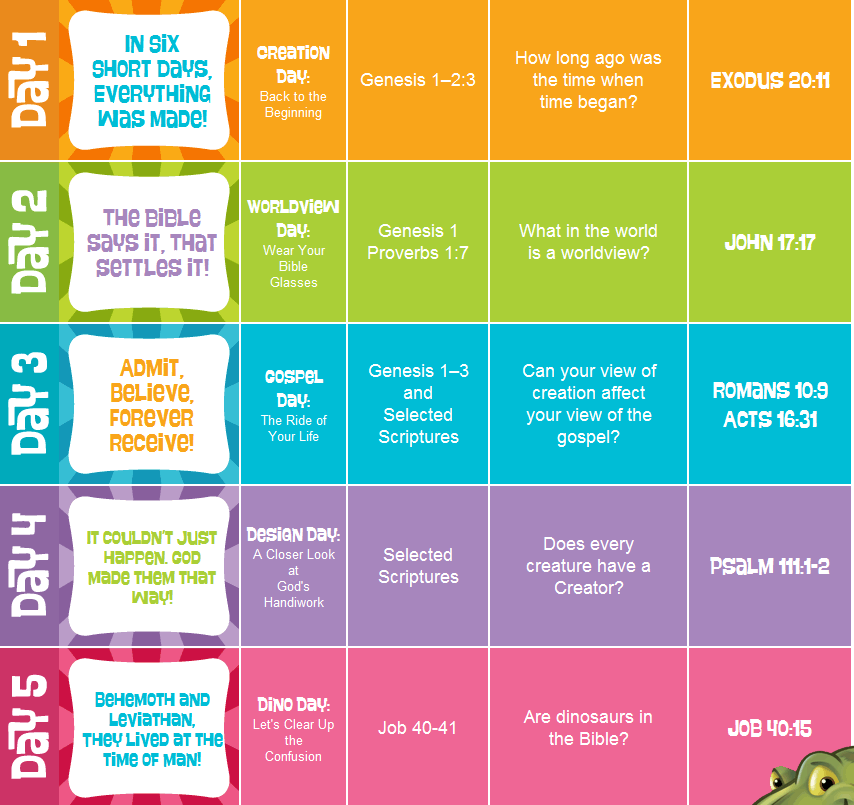 Yes, that’s right. Apparently I (and others) falsely accuse a group named “Answers in Genesis” which actively promotes young earth creationism through books (including children’s books), a magazine, a research journal, and even a VBS program [image on right all credit to answersvbs] (notice that the entire curriculum is focused on Young Earth Creationism: day 1 is in six short days, everything was made; day 2 is the bible says it, that settles it [and note that in Ham’s other post he argued we should teach our children how to think, not what to think–or at least in addition to ‘what to think’]; day 3’s main question is “Can your view of creation affect your view of the gospel?”; day 4 is on intelligent design [admittedly this doesn’t specifically mean young earth]; day 5 is going to teach children there are dinosaurs in the Bible) of focusing on a young earth.
Seriously, you did read that right. I and others are accused of falsely stating that Answers in Genesis is focused on young earth creationism.
Look, I’m not saying it’s a bad thing to have your ministry focused on a specific area. In fact, I think that Christians who are strong in science, the arts, philosophy, and other areas of knowledge need to step up and do what they’re best at for the glory of the Lord, whether that means making new discoveries in a lab or going and working at a retail job. Do it well! The problem is that Ken Ham is saying we’re falsely accusing Answers in Genesis of being focused on young earth creationism. Sorry, but they are.
Moving on:
Thus it is obvious that millions of years is incompatible with God’s Word. And one does not get millions of years from the Bible—it comes from fallible man’s interpretation of the past.- Ken Ham
Honestly, this has to be the favorite line YECs use: “man’s fallible __________” or some variant. Again, all it does is subtly poison the well. Isn’t it equally possible that man’s fallible interpretation could lead to a young earth view? Let me answer the question: YES. People are fallible, and they make hermeneutical mistakes, science mistakes, and other mistakes. Thus, one could equally say: “It is obvious that the young earth position is not necessitated by the text. To say that it is necessitated is to use man’s fallible interpretations of Scripture.”
Suddenly YEC looks like it is the evil “compromiser.” But I’m not going to take that route. Rather, I want to consider arguments, not attacks on character; I want to consider the text, and not bring eisegesis into it by assuming my position is the only possible interpretation.
Moving on:
I would also be prepared to say that those church leaders who condone “gay” marriage will have compromised Genesis! – Ken Ham
Another classic YEC scare tactics. I pointed it out in my last post responding to Ken Ham. Basically, you take the position you want to refute and then associate it with anything people who already agree with you will think is bad. For example, you could say “Hugh Ross believes in an old earth, just like evolutionists.” Suddenly, the people who read things like AiG’s website know that Hugh Ross is evil.
Here’s the problem: Hugh Ross isn’t evil. The statement is no argument. It’s guilt by association. It’s poisoning the well, and it’s unChristian.
Hey look, he does it again:
Those in the church who compromise Genesis with millions of years and evolutionary ideas are really saying that man’s word is infallible, and God’s Word is fallible! It is the other way round!- Ken Ham
Scare words abundant throughout. No argument, just assertions.
So no, the “Reformation” we are calling the church to is not (as some critics have been recently claiming) to get people to believe in a young earth— it’s having them accept the full reliability of the Bible. Believing in a young earth is a consequence of accepting God at His Word in Genesis.- Ken Ham
Honestly, this is the best piece of the entire blog post. It sums up Ham’s position well. Basically, he goes in with the assumption that the young earth is the only possible reading of Genesis. Thus, if anyone does not hold to a young earth position, they do not “accept God at His Word.” Now, what he’s saying is that it’s not that the reformation is young earth creationism; rather, the reformation is to re-evangelicalize the church: sola Scriptura! Amen!
Here’s the problem: a young earth is not the only possible reading of Genesis, and by putting it forth as such, and explicitly stating that it must be a consequences of “accepting God at His Word,” Ham and others who make similar claims have therefore put their views as God’s views. Their view is, in fact, a consequences of an ultra-literal hermeneutic which they espouse. The text itself does not warrant it. The fact that there is almost limitless reading from authors who argue that the Genesis account is Ancient Cosmology; or that it lines up with one week as part of creation; etc.; alone speaks to the fact that AiG’s position is not necessarily a consequences of the text, but of their hermeneutic: it’s a consequences of their method, not the source.
Bottom Line: Let’s focus on the issues involved in Genesis and the world that God has revealed to us, which is a reliable guide to truth (Psalm 19). The only reason I spend time responding to Ken Ham and others like this is because I do not want such statements to go unchallenged. When a Christian goes around accusing other Christians of being “compromisers” or other scare-words simply because they differ in their interpretation of a passage of Scripture, that Christian needs to carefully rethink the issues and realize “In essentials, unity, in non-essentials, liberty.” Stop throwing out the accusations. Focus on the issues.
Frankly, I pray this will happen, but I doubt that it will. As long as one holds one’s own methodology and hermeneutic is the only way to do it, there can’t really be thoughtful dialog. I hope I’m wrong, and I hope that maybe Ken Ham and AiG will be willing to work with others who have different views but still hold to inerrancy of Scripture in order to bring about a whole-church reformation towards inerrancy. But that would require AiG dropping the position that only they are right.
Links to Other Responses to Ken Ham’s “Compromise” Posting
Ken Ham on ‘Compromise’ and Stand to Reason– my response to Ham’s initial post.
Compromising the Kingdom– Faithful Thinkers offers a really in-depth critique of Ham’s use of emotional and ad hominem attacks.
A Brief Word on Ken Ham, Stand to Reason, and the OEC/YEC Debate– two really good points raised in this post. How do our attitudes drive people away?
SDG.
Really Recommended Posts 5/11/2012
 Owl Post edition. If you get it, I like you even more. As usual, I don’t necessarily agree with everything in the posts I recommend, but I do think they are all worth reading (and probably agree with much of their content, so there!).
A very interesting video in which a pastor, Voddie Baucham, addresses the problem of evil.
Altar to a Well-Known God– One of my favorite apologetics sites, No Apologies Allowed is a site which largely features comics that draw out discussion about various issues. This one, I thought, was particularly striking.
Lawrence Krauss on God and Morality– an analysis of Krauss’ views on the moral argument with a thoughtful critique.
How to Refute Christianity: A Handy Guide– A tongue-in-cheek process to show how one could go about refuting Christianity. I found this very thought-provoking.
A young Christian comes out to talk about pornography and its addictive qualities. Not a victimless endeavor.
Reflections on a lyric by 3 Doors Down– very interesting cultural apologetics related to the 3 Doors Down song, “When I’m Gone.”
A Brief Word on Ken Ham, Stand To Reason, and the OEC/YEC Debate– Young Earth Creationist Ken Ham recently wrote a rant about the apologetics group Stand to Reason. This link discusses the strangeness of Ham’s litmus test method for theology. I have also posted my own reaction.
Ken Ham on “Compromise” and Stand to Reason
Ken Ham recently released a rant about compromise in the church. Rather than evaluating any single point, I’m just going to go through a short, point-by-point response. Quotes from the article are in block quotes.
…a big part of our mission is to bring reformation to the church, so of course we expect opposition to our efforts. Sadly, the worst opposition from my perspective is from within the church, since we should expect opposition from the world.- Ham
I would like to know what the “reformation” is that Answers in Genesis (hereafter AiG) hopes to bring about. I suspect it is a reformation of young earth creationism, but that seems to be a fairly major position within the average church anyway. A “reformation” is never restricted to just one point, however, so one must wonder what theology it is that AiG hopes to bring to the forefront.
Stand to Reason states its mission as teaching people “not just what to think, but how to think.” Sadly, their supposed teaching people “how to think” is actually teaching them to think in terms of millions of years and evolutionary ideas. -Ham
Ken next turned to an attack on the ministry group, “Stand to Reason.” Note that the reason it is under attack is because the group is teaching “to think in terms of millions of years and evolutionary ideas…” I found this quote particularly strange, considering that Stand to Reason is a specific and vocal advocate of Intelligent Design. The group goes so far as to offer Intelligent Design as “a scientific alternative to evolution.” As far as “millions of years,” one may say that this is indeed part of teaching people “how to think.” Let’s investigate the evidence. Let’s come to our own conclusions. Let’s think about it.
It seems particularly strange to see an AiG person complaining about others teaching “how to think” because anyone who disagrees with the AiG position on the age of the universe is labeled, ironically, a “compromiser.” Only if you hold the position AiG desires you to hold are you someone who knows “how to think.” Seems like a very strange way to teach “how to think,” doesn’t it?
Hugh Ross believes in an old earth and promotes the day-age and progressive theories of creation. He says God created over millions of years in the same basic order as the secularists claim life evolved (in reality, this is a form of theistic evolution). -Ham
Hugh Ross is a favorite target of groups like AiG. Why? I suspect it is because Ross doesn’t focus exclusively on scientific evidence (which young earth creationists tend to reject as “a different interpretation of the same evidence”) but instead offers alternative theological interpretations.
That aside, this quote from Ken Ham is factually incorrect. It makes me wonder whether he has interacted with Ross’ works on a thoughtful level. Ross certainly doesn’t hold the position outlined above. Ross does believe the timeline science has uncovered matches up with the Biblical account. The important distinction is that Ross leans towards progressive creationism (in the writings of his I have read); in other words, God created species over time. When one species passed away, God brought forth a new one. Initially it may seem that this is how Ham described Ross’ position, but note the last clause in which Ham says this is a form of theistic evolution. That is absolutely incorrect. I know of no theistic evolutionist who would agree that God brings forth new species over time in special creative events. None. Rather, it seems Ham is just using the scare word “evolution” and associating it with any position he disagrees with (see Stand to Reason above).
[Skipping over a number of point-counterpoint rebuttals in Ham’s post.]
They [Stand to Reason/other groups like them] can try to modify things all they want, but what they are doing is compromising man’s ideas of millions of years with the Bible and reinterpreting the clear text of Scripture, thus undermining the authority of the Word of God. They do believe in evolution—it’s just that they just don’t accept the naturalistic neo-Darwinian view but modify their beliefs to suit their purposes of having God create but over millions of years. -Ham
Another juicy quote. Let me break it down. First, Ham is tugging the standard YEC line that anyone who disagrees with their interpretation of Scripture is “compromising” by using “man’s ideas.” Essentially, if you are a Christian who doesn’t believe the universe is 6000-10,000 years old, you are compromising Scripture. Never mind a huge amount of exegetical evidence to the contrary (one thinks of C. John Collins’ study of Genesis; Hugh Ross’ own theological work; Sailhamer; Walton’s important study of Genesis in light of ANE cosmology; etc.), if you disagree, you can’t possibly take Scripture seriously. I have run into this personally a number of times. If you disagree, your position simply cannot even have any merit. Never mind if you offer a reading of Genesis which more closely matches the theological/cultural/historical aspects of the text, you’re just wrong.
Moving on, Ham, in baffling fashion, wrote that Stand to Reason does “believe in evolution.” Again, this is a simple misrepresentation of STR’s position. In fact, Young Earth Creationists “believe in evolution” in the abstract too. What? It’s true. Consider the research YECs do in journals of their own publication. Not only that, but even the “Answers in Genesis Research Journal” does a study of “kinds” in the Bible and asserts, “the Bible’s description of created kinds implies an information model which uses variables. The findings in this paper show that a model which uses variables forms a stronger basis for true scientific understanding of biology and, by implication, the Bible provides a superior foundation for scientific investigation.” Wow, looks like AiG believes in microevolution through variables too! I should therefore reject the site as “compromise.”
The problem is that, as is typical in these types of discussions, such a rejection would be an unfair reading of the opposition. Ham and others put scare words like “evolution”; “compromise”; and “man’s ideas” in the context of their opposition. The tactic is highly rhetorical and has little, if any, substance. The fact remains that Ham is cherry-picking ideas from the opposition, putting them in context with scare words, and then declaring victory.
Overall, one must wonder about a few things based simply upon this recent article. 1) What kind of theology is a group like AiG trying to “reform”? Is their perspective limited only to the age of the universe, or do they have a broader vision? 2) Did AiG inaccurately represent their opposition? 3) No matter what side we take in this debate, should we not try to be fair and honest about the other side’s view? 4) Was Ken Ham fair and honest?
Source: “Compromise Being Spread” Ken Ham, http://blogs.answersingenesis.org/blogs/ken-ham/2012/05/08/compromise-being-spread/.
A Christian Look at “The Avengers”
 The Avengers is a huge blockbuster film. Reviewers are raving about it. It’s a cultural phenomenon now. How should a Christian take the movie? Is there anything of value to it, or is it just another action flick? Here, I’ll offer less a review [short review: it was amazing, probably my favorite hero movie other than “The Dark Knight”] than a survey of some thinking points Christians can use to engage with the culture as they interact with the movie. There will be spoilers.
I Need a Hero
Consider the overall theme of The Avengers. Earth is in trouble from outside (alien/demigod) forces. But, in a way, the humans brought this plight upon themselves (they messed with powers they should not have–this theme is found throughout the entirety of the film). How can we be saved? We must look to our hero(es) and utterly rely upon them. Think about it. That is exactly the human condition now. We need a hero. I can’t help but channel that song by Skillet, “Hero.” We aren’t superhuman, we aren’t superheroes. Ultimately, we have to rely on someone else.
The overarching theme of The Avengers is therefore very reminiscent of the Christian story. Christianity holds that we have a plight: we’re under assault from our own sinfulness, into which we were tempted by Satan. We tried to mess with that which we should not have attempted: sin. And now, because of that, we are under assault. We have no way to save ourselves. We need a hero. We can’t escape from it ourselves. Like the civilians on the streets of the cities as they come under attack in the film, we must rely utterly upon that hero. We are powerless.
Yes, I do think that this theme resonates deeply with Christianity. Jesus Christ is our hero. He gave his life for us, willingly. He rose again. He came despite having no need to do so, and saved us from that from which we cannot save ourselves.
Another way to look at this theme is the deep human need for help. We realize we are floating in this gigantic universe and we feel insignificant. What meaning is there? We look to heroes–we fictionalize them and make them into “superheroes.” Even the previews before the movie showed two more hero flicks coming up: The Dark Knight Rises and The Amazing Spiderman. We are obsessed with this theme. Yet the real story of Christianity is even more compelling: we’ve already been saved. God has already acted. He sent us our hero, when we needed Him most. Death itself has been defeated. The human urge to look for a hero, to look beyond ourselves for help, is satisfied poignantly in Christ Jesus our Lord.
God Doesn’t Wear That
One of my favorite lines in the entire movie came from Captain America: “There is only one God, ma’am, and I’m pretty sure He doesn’t dress like that.” [Author’s note: I found several references to this quote and they all varied slightly, however if my memory serves me, this is the correct version.]
What can Christians think about this? Well clearly just saying there is “one God” doesn’t do much, but what is interesting is the context he says this in. Captain America has just met Thor (a demigod/superhero), yet he still affirms there is “only one [true] God.” Sure, Thor can play with lightning, but ultimately he is not God. There is but one God, and He’s infinitely greater than Thor or any of the other “gods” who turn out to be little more than powerful beings from Asgard.
More importantly, I think a Christian could use this pop culture reference in a dialog as one notes the importance of anthropomorphic language about God. God “doesn’t dress like that!” Too often, when we speak of God, we have this picture of some old guy with a beard. But God “doesn’t dress like that.” He’s transcendent, beyond. Yet He chose to come into the flesh to save us (see “I Need a Hero” above)! I found this quote very thought-provoking.
The Beyond
Another theme of The Avengers is the fact that we aren’t alone. Humanity is thought of by some in the movie’s universe as a helpless, defenseless planet which will certainly fall at the slightest attack. Humans are but one amongst many powers in the universe, and not the most powerful.
Again, this theme resonates with Christianity. We aren’t the most powerful beings in the universe, and we are not alone. There are angels and demons, gods, and God. I can’t fully develop the layers of meaning in the Bible in regards to all the powers of the universe, but a great discussion can be found in Gerald McDermott’s God’s Rivals
Conclusion
The Avengers was a fantastic flick. It has everything a huge summer blockbuster needs. It’s worth seeing for the action alone, but the story resonates deeply with our strongest urges. It informs us of our need for a hero/savior. It affirms that we are not alone. I can’t help but say I strongly encourage Christians to see the movie and take note of the themes which resonate with our worldview; they are there in abundance. As we seek to engage with the culture, we can point out how our own story–the True Story of Jesus Christ–satisfies the needs felt in the movie, and more.
Links
The Avengers: Sin, Salvation, and Jonah– There are even more themes in the movie that I think really resonate with the Christian worldview. Check out my other post on the topic.
Please check out my other writings on movies and books. For starters, if you liked The Avengers you may want to check out John Carter.
Drew Zahn also raves about Christian themes in The Avengers. [Major spoilers at this link.]
SDG.
——
The preceding post is the property of J.W. Wartick (apart from citations, which are the property of their respective owners) and should not be reproduced in part or in whole without the expressed consent of the author. All content on this site is the property of J.W. Wartick and is made available for individual and personal usage. If you cite from these documents, whether for personal or professional purposes, please give appropriate citation with both the name of the author (J.W. Wartick) and a link to the original URL. If you’d like to repost a post, you may do so, provided you show less than half of the original post on your own site and link to the original post for the rest. You must also appropriately cite the post as noted above. This blog is protected by Creative Commons licensing. By viewing any part of this site, you are agreeing to this usage policy.
Book Review: “Think Christianly” by Jonathan Morrow
 Jonathan Morrow’s new book, Think Christianly
Central to the work is the notion that “Due to the unprecedented influence and availability of constant media… the thoughts, attitudes, perceptions, convictions, values, and lifestyles of those inside the church are rapidly growing indistinguishable from… those outside the church” (19). The key is to see how to help Christians “think Christianly” about every aspect of life. The Christian life is not “Sunday only” or “in church only” but rather it is an every day, every second, every interaction life. Morrow, throughout the book, seeks to touch upon nearly every area of Christian interactions with culture, providing brief introductions along with recommendations for a way forward in each area.
Part one of Think Christianly focuses on our own culture and the need to equip the next generation to interact with the issues brought up around them. Morrow provides a survey of ways people try to avoid interacting with Christianity (54ff) and suggests a threefold way to engage with our youths so they do not fall victim to the challenges to our faith. This threefold engagement is composed of 1) mentors, “people to learn from and imitate in the faith” (57); 2) peers, “people to run the race with and to spur us on” (57); and 3) a robust Christian worldview, a challenge to youths to explore what they believe and why it matters (58). Conjoined, these help provide a valuable base for youths to explore their faith among their peers and mentors who can guide them towards resources and answer questions.
Part two provides ways to integrate the Christian worldview into every aspect of one’s life. Chapter four discusses three worldviews- naturalism, postmodernism, and Christian theism. These are the worldviews pervasive currently in western cultures, and Morrow provides several ways to interact with the competing views and analyze them. Chapter five provides ways to “cultivate a thoughtful faith” and chapter six provides some ways to be confident about engagement (along with a helpful discussion of forgiveness and breaking away from anger on pages 98-99). Part Two continues with a couple chapters about living like Jesus, which are extremely insightful–we need to be sure we think of Jesus as who He was and is: the Lord of all professions, master of all crafts. Finally, part two wraps up with what may be the most important chapter of the book: “Can We Do That in Church?” Morrow argues that we must see “The local church” as “God’s vehicle to reach the world with the good news… it is also the primary place where Christians are to be equipped for the ministry” (130). By utilizing some small portion in time in church to equip believers to engage, Christian leaders can radically change the perception of Christianity as a “Sunday only” venture. If believers do not get equipped, where will they be equipped? The truth is they’ll “google it” and find people without good credentials or intentions and learn from them instead (not saying there’s nothing good online–plenty of scholars and wonderful teachers are out there, but sifting through the muck can be difficult). This chapter, I think, is the most important in the whole book and provides a number of insights that church leaders must take to heart.
Part three provides a number of areas in which Christians need to engage and ways to engage with them. For example, taking the Bible seriously is a top priority and Christians need to know how to interact with the text. Of particular importance are the chapters on sex–which talks about porn addiction and same-sex attraction; and Christianity in the public square.
Morrow has peppered the book with brief interviews of leading Christian thinkers on a number of topics. While short, these interviews provide a number of great insights and will lead readers to explore many issues in greater detail. They range from “Leveraging the Internet to Make God Known” (with Randall Niles) to “Jesus Among World Religions” (with Craig Hazen), and beyond. Another helpful aspect are the lists of resources for further study, included at the end of each chapter. These include a list of books, DVDs, and websites for interested readers to explore.
There are few books that span as broadly as Think Christianly while also giving solid background discussions of each topic touched. Morrow continually provides valuable insights at a basic level which Christians can apply right now to start to “Think Christianly” about every aspect of life. If our churches and the members therein embrace many of the suggestions found in Morrow’s important book, we will be able to grow and positively impact the world in a major way. The book comes very highly recommended–it is the kind of book anyone involved in the church must have on their shelf and seek to apply to their lives.
I received a review copy of the book from Zondervan publishers. My thanks to Zondervan for the opportunity to review the book. I was not asked to write anything positive or negative about the book.
Think Christianly
Shells and the Biomass of Earth: A serious problem for young earth creationists
 Imagine an earth covered with 15 creatures per square foot. And no, these creatures are not merely bacteria; rather, they are animals which can produce shells. The sheer amount of biomass would be so great that none of the creatures could survive. Their food would all be gone and their habitat insustainable. Over at Naturalis Historia, the Natural Historian has written a compelling article about how just the fossilized shells in one portion of the Midwest lead to extreme problems for the Young Earth position.
The author of that post did a brief survey of fossils over a 300×500 mile section of the Midwest from West Virginia to Eastern Missouri and from southern Kentucky to the middle of Indiana and Ohio. Utilizing samples and several calculations which were based off of these samples, he decided to try to calculate how thick a layer would be of fossils if just this area (totally covered in fossils) were spread out over the surface of the entire planet. He was able to conclude that “15 shells per square foot are estimated…” over the surface of the earth just from this sampling. Readers should note that in his article he utilized the lower end on his estimates in order to avoid tilting the scale in favor of an old earth position.
What is the point of this discussion? Who cares? Well this fact actually presents young earth creationism (YEC) with a few major difficulties:
…even 15 shells trying to live within the space of a square foot at the same time would have trouble. One also has to consider several other things:
1) Not all the surface of the earth was ocean before the flood, if we say that 50% of the surface was land then that would mean there were 30 shells per square foot in the ocean.
2) In addition, most organisms that produced these shells likely could only live in shallow water along coasts not in the deep ocean so unless the whole ocean were very shallow (and I think some claim that it was, although that presents some other very perplexing problems) then that would also dramatically reduce the space in which these shells could have grown and died.
3) The shells are not sorted at all by size, as very small (<1cm) to large (>4cm) shells are always found mixed with one another.
Each of these is presents a different difficulty with YEC. For, as the author noted, the shells he surveyed is only one small sample of untold amounts of these deposits across the surface of the earth (see below for my own samples and some analysis). Now if YEC is correct, then all of these creatures would have had to live over the course of around 10,000 years (or fewer). Think about that for a moment. I know from personal experience that the area covered with these shells is about twice as large as estimated in the numbers already referenced above, and so we are then talking about 30 creatures per square foot over the surface of the earth. But then consider that these types of formations can be found across America and across the earth. I have no way to estimate the numbers, but ultimately we’re talking about a simply astounding amount of life living on the surface of the earth in that short of a time span. It would be physically impossible for the sheer weight of living creatures to survive at the same time. If the Earth were only about 10,000 years old, then we would have been knee deep or even buried in shell-producing creatures over the course of our lives.
Not only that, but these creatures would have been competing for resources like food and air (think about how much oxygen these creatures would have sucked up all at once!). And again, it’s not like the entire surface of the earth would have been habitable–these creatures live only in shallow waters. It doesn’t seem unreasonable to think that if all these creatures lived over the course of 10,000 years then the oceans would have overflowed with them.

The image I have linked to the right shows a pair of stones discovered in limestone in Kansas. There were literally dozens of feet of fossils just like these as far as the eye could see in the Castle Rock formation in Kansas. One could just walk up and pick a rock up off the ground and it would be like the picture to the right. There are places one can’t walk without stepping on large numbers of fossils. The picture that is at the beginning of this post is a picture I took while in this formation. It is not just the author of the article above who has observed the seemingly unending supply of fossils throughout the Midwest. I myself have observed limestone formations with fossils like these across Kansas for hours and hours of interstate. Not only that, but I grew up in northwest Indiana and observed massive limestone formations there as well. Here in Minnesota, one can also observe limestone along cutouts of the highway and elsewhere. One can go to areas along the Mississippi here in Minnesota and pick up fossilized shells along the riverbed.
So imagine that the estimates listed above by the Natural Historian are correct on the low end. Now imagine that all of Kansas is covered with these shells–I can attest to it. Imagine further that more portions of the Midwest are covered with other types of limestone which also would have added to the biomass of earth. Again, the numbers are staggering.
How in the world did all of this biomass get here within a few (10?) thousand years? That is the question which young earth positions must deal with. Note that the argument and evidence in this post do not rely upon any dating system, any background knowledge, or other scientific dating systems YECs tend to denigrate. Note that the argument only shows what is observable and asks a question: how did it get here? YECs would have to come up with some way to plausibly explain how all these creatures could have had their lives condensed into about 10,000 years.
God is not a liar (Numbers 23:19). The natural world attests to Him (Psalm 19). These conjoined Biblical points tell us that when we go outside and observe that the life we can observe in the past could not have all lived within 10,000 years, then it did not. Those who claim otherwise seemingly must either introduce a third option (some plausible explanation for these creatures’ lives–and note that it must be more plausible than the argument that they lived and died at the same rate they do now and that the world is simply old enough to have had that much life and death over the course of time) or they fall victim to a dilemma involving the cited verses: either the natural world does not attest to the Truth or God is actively deceiving us. The bottom line is that this is just one more hole in the Young Earth position. YEC is, simply put, false.
Appendix 1: A response to one objection
There have already been a few responses to this post on places other than this site. One response argued that the samples which I and/or Natural Historian took were not representative of the fossil record. Here is my brief response:
Take a trip through the Midwest sometime and look at the cuts through the highways. Every single time you pass through one in Kansas it is absolutely filled with limestone and fossil-rich rock. The same happens through most of Missouri, Illinois, Indiana, etc. I could literally walk up to a wall of shells and pull out a huge sampling of them.
Now suppose this isn’t representative. Suppose that it just so happened, at random, that the roads were set up in such a way that they only hit the most fossil-rich deposits out there. What does that mean?
Not very much. We can observe these same deposits all over the world. The sheer amount of these deposits means that we could very easily produce the number of fossils Natural Historian estimates over just the Midwest.
Again, to clarify, I’m saying let’s assume that Natural Historian overestimated several thousand(milliion?)-fold and so the number of fossils he estimates for the midwest can only be gathered if we collect them from all over the earth, and only from those highway cuts or other points of exposure where such deposits have observed (again, making the extreme assumption that only those places which have happened to get hit by highways or erosion are those with these deposits). But in that case, we can still gather enough fossils to say the entire surface of the earth could be covered by about 15 fossils per square foot.
But wait–these fossils don’t occur in deep oceans or on land. They only occur in shallow oceans. Suddenly we’re up to about 30 per square foot if we assume they occurred in water anywhere (including riverbeds, deep oceans, and the like). But eliminate the places these types of fossils do not occur and the number of fossils increases even more.
Suddenly we find that the exact problem I raised above remains a problem–even if we only take those fossils which are exposed now (and again note that this is a huge underestimate and requires extreme blind faith that there are no other fossils under the ground anywhere, not to mention the fact that there may be even more fossils that are exposed which could drive that number up exponentially). There has been simply too much life on earth to maintain a young earth position.
SDG.
——
The preceding post is the property of J.W. Wartick (apart from citations, which are the property of their respective owners) and should not be reproduced in part or in whole without the expressed consent of the author. All content on this site is the property of J.W. Wartick and is made available for individual and personal usage. If you cite from these documents, whether for personal or professional purposes, please give appropriate citation with both the name of the author (J.W. Wartick) and a link to the original URL. If you’d like to repost a post, you may do so, provided you show less than half of the original post on your own site and link to the original post for the rest. You must also appropriately cite the post as noted above. This blog is protected by Creative Commons licensing. By viewing any part of this site, you are agreeing to this usage policy.
Really Recommended Posts 4/26/2012
 There are a ton of great Christian blogs out there. Here I’ve highlighted only a few great posts. Check out my blogroll for more excellent blogs! This week I’ve featured posts discussing Christian Memes (one extremely important post!), how some secondary issues can be extremely important in apologetics, a beautiful sculpture and a discussion about it, an apologetic comic, Richard Carrier, and more.
By the way, as you read these posts I’d like to know what you think of them, so feel free to drop a comment here or at the posts themselves and let bloggers know you’re reading. Our best encouragement is you!
What Memes Mean: Avoiding Scumbag Apologetics– I have seen this same problem occurring in many places. I really appreciated this relevant post about the use of memes (often pictures with captions) and Christianity.
Debate in Apologetics: Secondary Issues of Primary Importance– This thoughtful post notes how some issues, like Young Earth Creationism, can potentially be harmful to the faith and the defense of the faith.
‘Heart-rending’: Young Slovakian sculptor captures post-abortion pain, mercy, and forgiveness– Beautiful artwork and pro-life discussion as we remember that it is not just one innocent life harmed by abortion.
Web Traffic for Reformed and Creationist Sites– A post which provides some insights into how people on the internet are consuming theology.
Constitution of the Divine Foot-in-the-Door Resistance Army– No Apologies Allowed constantly puts out great comics which allow for Christian engagement. This one is no different. Thought-provoking and insightful.
Compassion Wins: A Longtime Atheist Becomes Christian– Demonstrating a life like Jesus’ can be the best witness.
Richard Carrier on the Resurrection: Part 2– A lengthy and engaging post which shows some of the problems with Richard Carrier’s attacks on Christianity and miracles.

 J.W. Wartick - Reconstructing Faith