complementarianism
Really Recommended Posts 4/25/14- Dean Koontz, egalitarianism, “Cosmos,” and more!
 Here, I have a list of great reads for you to browse, from Easter errors to Dean Koontz, from marriage to atheism. Check them all out, and let me know what you thought!
Five Errors to Drop from Your Easter Sermon– Check out this read on common mistakes made when talking about Easter.
Tie-Breaker– What happens when married couples come to a point where they are at an impasse? Does there need to be a marital tie-breaker grounded in notions of hierarchy of genders? Check out this thought-provoking post on the topic. For my own thoughts on the topic, check out my post “Who’s in Charge?” over at CBE.
Dean Koontz’s “Innocence”– From the author (links removed), Anthony Weber, “Dean Koontz is perhaps the most famous Christian author alive today. He has sold over 450,000,000 books, with 17,000,000 added each year. He’s sold more books than Stephen King…” That’s why you should care about the guy. Check out this look at a recent book from Koontz.
What I Needed to Hear as an Atheist (And How I Needed to Hear It)– Approach matters! Check out this fantastic post on how we may approach atheists who are wondering about the faith.
Cosmos Scrubs Religion’s Positive Influence from the History of the Scientific Revolution– The TV series “Cosmos” has seemingly purged any notion of the positive influence of religion from the history of scientific development. Check out this insightful article which explores some of this history and the way “Cosmos” has distorted it.
Really Recommended Posts 4/11/14- submission, creationism, and apologetics!
 I’m really itching for a game of Ultimate Frisbee. Seriously, can the snow please melt? Anyway, this week I’m presenting for your reading pleasure a slew of high quality posts on the (non-)tasks of the apologist, submission, “street epistemology,” presuppositionalism, and young earth creationism. How’s that for a lineup? Let me know your thoughts in the comments! I love to read what you think. Have a link to share? Drop it here with your own thoughts on it, and I may include it next time!
What an Apologist’s Job is NOT– Melissa Cain Travis offers some extremely sound advice on things to avoid as an apologist. This is a very practical post and a most read for those of us involved in apologetics. Read it!
On Submitting to One Another– What does it mean to submit? How does the notion of submission to one another play out in the church? Check out this thoughtful post by Paul D. Adams on these topics.
On Interacting with Street Epistemologists– Nick Peters has spent some time interacting with “street epistemologists” trained by atheist Peter Boghossian. Here, he shares some of his insights gained from this task. If you’re unfamiliar with the Boghossian, I highly recommend you check out “Peter Boghossian, Atheist Tactician.”
Picture Charades: Do you know your presuppositional apologists?– A fun activity of identifying key presuppositional thinkers. I take an integrative approach to apologetics, so I think it is important to read evidentialists, presuppositionalists, classical apologists, and yes, even fideists.
An Ancient and Alien Forest Reconstructed: A Challenge for young earth creationism– How might the forests of the past present difficulties for young earth creationism? Well, read the post to find out! It’s well worth it.
Really Recommended Posts 3/21/14- egalitarian marriage, the Bible and murdering children, inerrancy, and more!
 Well we got snow again here (about 3 inches). If it’s anything like last year, we’ll be seeing snow in May. Alas. Given that we’re stuck inside, I am pleased to present a number of excellent posts here for your perusal. The posts address the notion that egalitarian marriage is less satisfactory, apologetic interaction in social media, a recent meme about murdering children in the Bible, and more!
Gender Roles in Marriage (Part 1): Couples in Traditional Roles Have More Sex, Study Finds– I have seen several people sharing the results of a study in which it was found that couples in traditional roles have more sex. Some have trumpeted this as proof that traditional marriage is actually superior to egalitarian marriage. (Here, realize that “traditional marriage” is referring to a complementarian relationship wherein the man is in charge of the household.) However, apart from the problem that the number of instances of sex in a month is perhaps not the best indicator of marital stability and happiness, it seems there are other difficulties with this study and those drawing conclusions about the superiority of complementarianism. Check out this article on the topic.
How to Murder Children: Bible Style – Debunked– There’s a meme rolling around the internet about how the Bible has murdering children in it. It’s constructed without commentary and seems to be slanted towards the view that the Bible is evil. Check out this debunking of the meme (it includes the original). Very good work here, and I really think you should check it out!
What Christians can learn from skeptics– Certainly not an exhaustive list, this is actually more specifically looking at how skeptics are using Wikipedia to slant opinion on religious issues. How might Christians use this as a way to increase confidence in the faith?
Errors of Inerrancy– An interesting post on how to avoid some pitfalls when thinking of the doctrine of inerrancy. The list of errors includes both mistakes made by both critical scholarship and evangelicals regarding the text of Scripture.
One Christian Apologist’s Advice on Using (Anti-)Social Media– Some good advice here on how to become more effective via social media. Though I personally think Facebook is actually a better way to do apologetics than described in this post.
Back-Alley Abortions, Apologetics, Male Hierarchy, and more! – Really Recommended Posts 10/18/13
 I have given you, dear reader, this edition of “Really Recommended Posts” which is simply bulging at the seams with great content. Herein, you shall discover the myth of the back alley abortion, an analysis of male rule, sociology and religion’s impact on society, Augustine and the creation/evolution debate, and more! Check ’em out. Let me know what you think!
Is Male Rule a Biblical Ideal?– Here, Mimi Haddad confronts some of the common arguments for male rule in the church and home. These arguments include the fact that Jesus was male, that the 12 disciples were male, etc.
Sociologist Rodney Stark discusses whether religion is good for society– A highly interesting post in which a sociologist takes on claims that religion could be bad for society. Looking into the actual statistics and facts of the matter makes an extraordinary difference to one’s perception.
Pro-Choice “Facts”: Illegal Abortion Deaths– One of the very common arguments for abortion is that we need to keep such things safe. After all, if women will get abortions anyway, we should try to keep them safe. This article examines the myth of the back-alley abortion and exposes it for what it is: a fraud.
The dangers of apologetics– My wife linked me to this article which I think makes some extremely valuable points regarding the nature and practice of apologetics. I particularly liked that the author did not throw apologetics out the window but rather offered pieces of advice for apologists and what to avoid as an apologist. What are your thoughts?
Augustine’s Origin of Species– Within the creation/evolution debate, many continue to allege that one cannot consistently be a Christian and hold to certain views of the age of the universe or the origin of species. Here, Alister McGrath analyzes these claims alongside the wonderful Christian theologian, Augustine.
Signs that the New Atheist Movement May be Collapsing– A post which examines the intellectual collapse of the New Atheism. I think the most fascinating point is the third, that New Atheists are suppressing intellectual dialogue.
John Loftus Exits in Infamy– Speaking of the New Atheists, David Marshall analyzes his own recent dialogue with John Loftus, a[n] [in]famous atheist. The way the dialogue proceeded is highly telling.
Really Recommended Posts 3/15/13
I have found another round of excellent posts around the internet, and I will share them with you! This week, we look at zombies, complementarianism, moralistic therapeutic deism, Faith, video games, and Oz. As always, drop a comment about what you liked!
Warm Bodies: Exhuming Humanity– Anthony Weber looks into both the book and movie “Warm Bodies” to find a too-true account of humanity, with some confusing messages along the way.
How Complementarian is the Bible? (video)– Philip Payne, author of Man and Woman, One in Christ (my review is linked), offers a presentation on the Bible’s view of women and whether it entails complementarianism–the view that women are to be subordinate to men.
What is moralistic therapeutic deism?– A fascinating post outlining the state of beliefs in contemporary Christianity. The post also goes into “debunking” this position. This is well-worth the read because we have essentially an entire generation of children who hold this position growing up in our churches.
Hebrews 11:1-3- Defining Faith– Edgar Andrews has a fantastic post up on how we define faith, in contrast to many modern notions and distortions. Edgar Andrews is the author of what I think is one of the greatest introductions to apologetics available: “Who Made God?”
Review: Of Games and God– I found this post on a book about video games and Christianity pretty interesting. I appreciated the notion that the issue is much more complex than some people paint it: “The simple truth is that those not significantly invested in the world of video games often lack a point of reference to understand and interpret this artistic culture. Rather than condemning those who have genuine concerns about this new medium, however, Schut takes the time to work through what they may have missed—as well as the places where their impressions may be correct.” Check out this interesting review.
Recommending Viewing: DIsney’s “Return to Oz” (1985)– One of my new favorite sites (and podcasts!) is “The Sci-Fi Christian” (readers know this is for good reason: I LOVE science fiction). Check out their excellent look at a 1985 Disney movie on Oz, which offers a different look into the world than either the new movie or the old classic.
Mulan Among Us: Disney’s “Mulan” and Womanhood
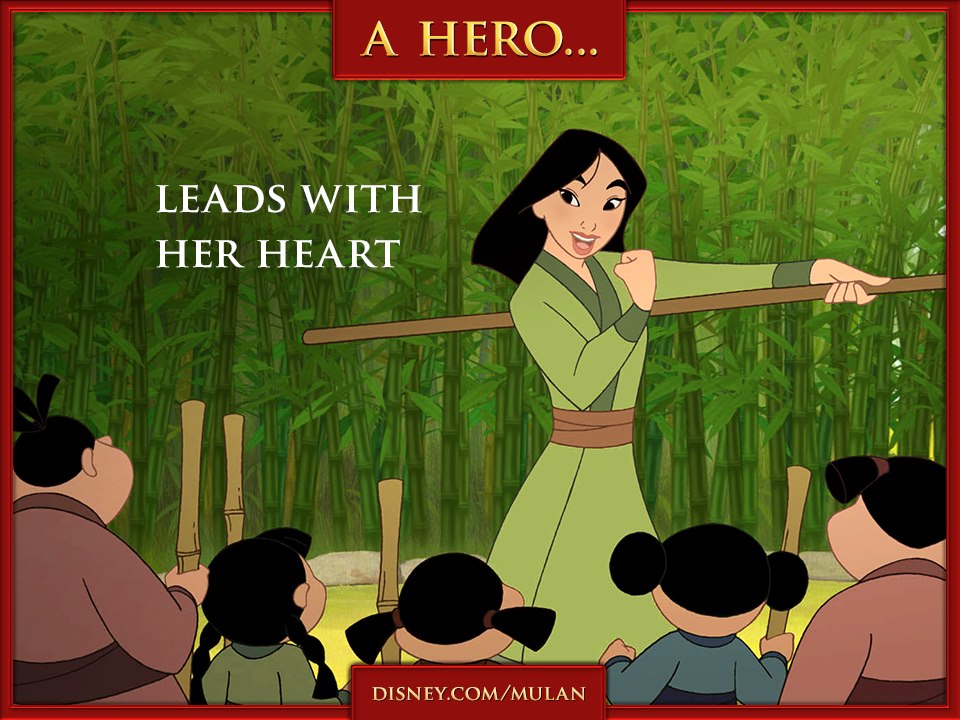
Disney’s “Mulan
Warning: There are spoilers for Disney’s Mulan in the following discussion
Mulan and Cultural Expectations
Mulan is a warrior. She is powerful, capable, and determined.
Oh, and I forgot: she is a woman.
It is that “shocking” pronouncement which is the focus of the Disney’s Mulan
Mulan is challenged at numerous points throughout the movie. She does not fit into her society’s gender ideals. She is expected to be clean, quiet, submissive, and “womanly.” And she tries to fit into these expectations. The culture wants her to be a good wife, so she tries to match what her culture’s idea is in order to become a good wife. Those who have seen the movie knows she fails miserably. When she visits the matchmaker, she recites, in a stumbling way, the right sayings: “Fulfill your duties, calmly and respectively. Reflect before you… Act!” She lacks grace, poise, and ultimately ends up comically ruining the whole scene, setting the matchmaker on fire and dousing that fire with hot tea, running the matchmaker’s makeup and earning the pronouncement that she will never fit society’s expectations for her.
Yet this reveals another cultural shock: it is the very fact that Mulan is placed into a one-size-fits-all box to take on roles which do not match her abilities that leads to her triumph. It is not that she should be trying harder, or that she is wrong; instead, the fact is that it is her culture’s expectations which are wrong. Mulan destroys those expectations. She saves China, and the Emperor himself honors her. Thus, the expectations are shattered, and Mulan remains “true to herself.” Her abilities destroyed the cultural norms that people had tried to apply to her.
“So what!?” you may be asking. “I already knew this, though I may not have outlined it like this.” After all, telling women to be submissive and arguing that there are very specific roles that they should fit into is a thing of the past.
Is it?
Have you never heard the phrase “she wears the pants in that family”? That speaks to a division of roles that is still at least unconsciously acknowledged in our culture. What about “make me a sandwich” or “get in the kitchen”? What of more subtle distinctions? “I would never vote for a woman president.” “A man is in charge of the family.”
Moreover, some theological traditions continue to argue that there are very explicit roles for man and woman in leadership and the home. It is to that concept that we will turn to, with a focus on Mulan.
Mulan and Theology
The shock of Mulan’s story may seem almost comical to us, but the fact remains that there are women whose talents are not being acknowledged. They do not fit the mold. It is said within some branches of contemporary theology that women are to submit to their husbands. These theologians teach that women have very specific roles: that of “helper,” servant, or anything but “leader” or “teacher.” According to these views, women can teach other women and even male children, but when it comes to man, she is always subordinate. Consider the following passage, from a book endorsing this view (“Recovering Biblical Manhood and Womanhood
[I]t is simply impossible that from time to time a woman not be put in a position of influencing or guiding men. For example, a housewife in her backyard may be asked by a man how to get to the freeway. At that point she is giving a kind of leadership… But we all know that there is a way for that housewife to direct the man that neither of them feels their mature femininity or masculinity compromised. (John Piper, 50, cited below)
Moreover, women, on this view, must be careful about how they give their advice; they must remember that they are to be submissive:
A wife who ‘comes on strong’ with her advice will probably drive a husband into passive silence, or into active anger (Ibid, 52)
I can’t help but think of the scene from Mulan just before she saves the Emperor when she is trying to get people to listen to her about the great danger of the Huns in the Imperial City. They pull away from her forcibly, ignoring what she says. Finally, her trusty sidekick, Mushu, points out that “You’re a woman.”
Such is the way in which manhood and womanhood is supposed to play out within those branches of contemporary theology which lean towards complementarianism–the view that men and women are to occupy different “roles” in the church and the home. Women are to be submissive, even when they try to give directions to a man. Mulan, in this view, perhaps came on “too strong” in her insistence that the Emperor was in danger. If she had only been more submissive, then she would not have provoked “passive silence” or “active anger.”
The absurdity of this notion can be found in the fact that it is the victim who is blamed for the abuse. “Passive silence” can be just as harmful as “active anger.” Is it really acceptable to say that a woman, by offering advice, “provokes” the man? Moreover, is it really honorable to men to turn us into seething machines, who, if the right button is pressed, turn into active aggressors or passively-aggressive “victims”? Again, the movie “Mulan” has presented a more balanced approach: there are women who transcend society’s–and religion’s–expectations.
There are Mulans among us. There are women who challenge this perceived view of manhood and womanhood. There are women who are gifted greatly to be leaders, not followers. There are women with the gift of teaching. There are women whose very existence shatters the notion that woman’s role is to be submissive. Their talents and abilities call us to use them, not to force them to singular submission. The Bible calls us to mutual submission, not a singular silence from one gender. These Mulans are powerful missionaries, leaders, teachers, yes, even pastors: gifted and called by God to take on roles that their cultural milieu often wants to deny to them.
I pray that more of these women would arise and use their gifts for the church. Many women have already done so, but our church’s culture has too often tried to silence women. Instead, we need to acknowledge the Mulans we know.
Check the links below for more discussions of women and the church. For all my posts on the topic, check out my egalitarianism category (scroll down for more posts).
Links
Be sure to check out my looks at other movies. If you like Mulan, what about Brave?
For information on egalitarianism–the view that the Bible teaches us women and men should fill equal roles–check out “Christians for Biblical Equality.”
Women in the Ministry: The philosophy of equality and why complementarianism fails– I argue that the position in which women are excluded from church leadership entails inequality of being.
Book Review: “Good News for Women” by Rebecca Groothuis– I review an excellent book on the issue of gender equality in the Bible.
Religious Dialogue: A case study in science fiction with Bova and Weber– I take a look at how science fiction has dealt with theological topics, with a particular focus on dialogue about religion and women.
I discuss the notion of having my expectations of women shattered here.
Sources
John Piper, “A Vision of Biblical Complementarity: Manhood and Womanhood defined According to the Bible” in Recovering Biblical Manhood and Womanhood
Mulan
Image Credit
The image used in this post is credited to the Mulan Facebook page.
SDG.
——
The preceding post is the property of J.W. Wartick (apart from citations, which are the property of their respective owners, and works of art as credited) and should not be reproduced in part or in whole without the expressed consent of the author. All content on this site is the property of J.W. Wartick and is made available for individual and personal usage. If you cite from these documents, whether for personal or professional purposes, please give appropriate citation with both the name of the author (J.W. Wartick) and a link to the original URL. If you’d like to repost a post, you may do so, provided you show less than half of the original post on your own site and link to the original post for the rest. You must also appropriately cite the post as noted above. This blog is protected by Creative Commons licensing. By viewing any part of this site, you are agreeing to this usage policy.
Really Recommended Posts 3/8/13
It really is difficult to keep up with all the excellent posts around the internet. But, I have taken the liberty of doing some of that work for you and found a diverse array of posts on fascinating topics. Read them, love them, comment! This week, we’ll be looking at the prosperity gospel, Calvinism, women in the Bible, Young Earth Creationism, the History Channel’s TV show on “The Bible”, and design flaws in creation.
The Prosperity Gospel Revisted– I found this post about the “Prosperity Gospel” quite fascinating. Dan offers critical interaction with the notion that the Gospel is about empowering us to gain. I also really recommend checking out the entire site, Rockadoodee, which is always thought-provoking.
Jerry Walls: What’s wrong with Calvinism? (Video)- One of the most interesting evangelical scholars writing right now, Jerry Walls, evaluates Calvinism. I found this video quite interesting. I’ve met Walls in person and I find him to be very gracious and thoughtful.
Correcting Caricatures: Women in the Bible [This link appears to be broken now… I don’t know why. Please let me know if you can view it]- Eminent scholar Walter Kaiser looks at several key texts related to women in the Bible. I found this fascinating and enlightening. Whether you are egalitarian or complementarian, it is worth reading.
2013 International Conference on Creationism– The Geochristian outlines a number of interesting discussions at this conference, which is where all the major scholars within the Young Earth Creation movement meet. Alongside this article, you should check out these articles on the state of Young Earth Creationism: The State of Creation Science as Measured by Scholarly Publishing– this one looks at scholarly works by YECs over a recent period of time and evaluates what it means for YEC; The Next Generation of Creation Scientists?– this post looks at who may be stepping in to fill the roles of the major YEC organizations.
The Bible–Night One Review– A look at the theology in the new TV series by the History Channel: The Bible.
If God Designed Humans, How Do We Account for “Design Flaws”?– One of my favorite blogs, “Well-Spent Journey” examines the notion that humans are flawed designs as an argument against intelligent design.
Really Recommended Posts 12/30/12
 Another round of Really Recommended Posts here. Featured are undesigned coincidences, literary and culutral apologetics, egalitarianism/complementarianism, young earth creationism, and the “Gospel of Jesus’ wife.” I hope you’ll check them out and let me know what you thought!
Tim McGrew replies to Ed Babinski’s Critique of his Discussion of Undesigned Coincidences– I recently wrote on one of the [mostly] forgotten arguments for the truth of Christianity- Undesigned Coincidences. Tim McGrew is the best current proponent of this argument, and here he offers a response to some of the standard objections to the argument, along with a general criticism of trying to rebut the argument based on Markan priority. Check out my post, and check out this post to see the excellent defense of the argument.
“Full Dark, No Stars”: Stephen King’s Worlds of Night– An excellent blog that often looks into cultural apologetics, “Empires and Mangers,” Anthony Weber’s Blog takes a look at one of Stephen King’s work from a Christian perspective. It’s a very intriguing read. Anthony Weber is the author of “Learning to Jump Again,” which I reviewed.
It’s About the Bible, not Fake ideas of Progress– NT Wright is one of the most lucid Christian thinkers with whom I have ever interacted. Here, he takes a look at some strategies of those who are both for and against women in the ministry and evaluates the arguments. He offers a way forward in the discussion.
How prestigious evangelical scholars helped debunk the Jesus wife myth– Did Jesus have a wife? Some recent controversy occurred over the alleged finding of a fragment purporting to tell the truth on this exact detail. However, it has come to light that the fragment is almost certainly a fraud. Wintery Knight’s post looks at how evangelical scholars helped to expose this fraud. I have linked to a number of posts about this “Gospel” myself. For those wondering: even if it were not a fraud (which it is), it is a late fragment that doesn’t tell us much other than what some heretics believed at the time.
The Call to Adventure– Why is it that we are so intrigued by stories of adventure? Garret Johnson at Hieropraxis–one of my favorite websites–offers a look into this theme.
Nathaniel Jeanson of the Institute for Creation Research in Montana– I found this post extremely interesting. It is often alleged by young earth creationists that old earth proponents and “secularists” follow a strict uniformitarianism. Unfortunately, this definition of uniformitarianism is outdated by a couple hundred years.The GeoChristian offers a response to this YEC argument. Yes, this is part 3 of a 5 part series, no you don’t have to read them all to make sense of it. But do check out the whole series, because it is interesting!
Nonrandom Mutations Scramble the Case for Common Descent: Reasons to Believe, my favored resource for science-faith discussions, is chock-full of excellent articles like this one, which argues that mutations are not necessarily always random, but rather take place in such a way that reflects design.
My Trip to the Evangelical Philosophical/Theological Society Conference 2012
 Last weekend I had the supreme pleasure of attending the 64th annual meeting of the Evangelical Theological Society and the Evangelical Philosophical Society (there’s a mouthful!). I took over 80 pages of notes (43 front/back) and enjoyed the entire time immensely. I’ll be posting in the upcoming weeks and months on a number of these topics, so for now I’m just going to very briefly outline the talks I went to and give one or two comments each. I encourage readers to browse through these and let me know which ones they’d be interested on me writing on in a bit more depth. Feel free to ask questions as well.
Scripture, Geology, and the Age of the Earth
Readers know that I am very interested in the controversy among Christians over the age of the earth. I’ve written quite a bit on the topic. This session featured Gregg Davidson (University of Mississippi), a geologist, facing off against Andrew Snelling of Answers in Genesis. I have to admit that I was surprised by how much this debate focused on the science. Specifically, Davidson presented two very thorough evidences for an old earth, while Snelling rebutted these and argued that a catastrophic interpretation was perfectly consistent with the record. It was a fascinating back-and-forth. You can read an extended outline/review of this talk in my post: Gregg Davidson vs. Andrew Snelling on the Age of the Earth.
Bioethics – Genetic Enhancement
Gary Alkin(? his name wasn’t in my program) presented a paper on genetic enhancement and whether it is morally permissible. Essentially, his argument was that while as Christians we are obligated to heal diseases and help others, we are not obligated to try to become superhuman, and indeed are perhaps prohibited from doing so. He countered numerous arguments for the notion that we should continue to try to ‘enhance’ humanity. It was an interesting paper. I have since written an extended examination of his paper here: Genetics and Bioethics: Enhancement or Therapy?
Whose Moral, Which Axiom- The Transforming Virtue of Sub-Creation in J.R.R. Tolkien’s Mythology
Thomas Provenzola presented a mind-stretching paper on how Tolkien’s use of myth helps us to think about care for creation. It was a fascinating look into philosophy and literature.
The Metaphor of Divine Repentence
Rob Lister of Talbot School of Theology presented a paper in which he argued that we must understand language about God both literally and analogically. He argued that open theists often err too far towards creating an anthropocentric concept of God, rather than understanding passages about God’s repentance in light of clear statements about His being. I was so fascinated by this talk that I went and got his book on the topic afterwards. I look forward to reading it.
Other Voices in Interpretation Panel Discussion: An Evangelical Statement on the Trinity, Part 2: Application to the Ongoing Discussion on the Trinity
Kevin Giles (Victoria, Australia), Steve Tracy (University of New Brunswick), Mimi Haddad (Christians for Biblical Equality), and David Malick (CBE) participated in a panel discussion on the evangelical statement on the Trinity. I was surprised to see how contentious this talk was, but unfortunately there are people who are undermining the Trinity by eternally subordinating GOD the Son. This discussion went beyond an egalitarian/complementarian debate and essentially touched on how we must not distort the Trinity for our own purposes.
The Stars Will Fall From Heaven: Cosmic Catastrophe in the Synoptic Gospels
N.T. Wright, who needs no introduction, presented a paper arguing that the cosmic language used for the destruction of the temple is not so much due to an end of the space-time universe as it is because the Temple was the center of the universe for Judaism.
The Orthodox Doctrine of the Trinity
Kevin Giles presented a paper arguing that orthodoxy on the Trinity does not subordinate the persons. Rather, the distinctions made between persons according to the orthodox faith are made according to generation (the Son is begotten by the Father, and the Spirit proceeds from the Father and Son). He stressed the importance of drawing implications of the Trinity from the Godhead and not from humanity.
An Examination of Jesus’ View of Women through Three Intercalations in the Gospel of Mark
David cogently argued that we can look at the narratives in the Gospels to see what Jesus’ view of women was. Because we can see with clarity how Jesus elevated women’s roles to that of equal to men, he argued that we should interpret hard passages in light of the clearer passages. This paper was very clearly argued and extremely compelling. I hope more work is done in this area, because the argument was very tight, and there is much development to come from it.
Complementarians, Egalitarians, and Unicorns: What are they, and do they exist?
Walker argued that the categories we are using to identify people in the gender debate reflect a genus/species fallacy which essentially drains them of all meaning. It may be helpful to develop new terms to make the distinctions more clear.
Biblical Theology and Creation Care
I must confess that I only went to this one because there weren’t any others going on. I’m very pleased I did, because this plenary talk proved to be one of the most interesting discussions that I attended. Moo argued decisively that we must not cause Christianity to lose credence due to clinging to faulty science. Furthermore, he argued that it is our duty to take care of creation. He traced an interpretive strategy through Scripture and argued very convincingly for the use of the hermeneutic he was pressing for looking at Christianity and the environment. I wrote an extended post on this paper and the following panel discussion: Caring for Creation: A dialogue among evangelicals.
Panel Discussion on Creation Care
Following Moo’s plenary talk, there was a panel discussion with Moo, E. Calvin Beisner, Russell Moore, and Richard Bauckham. This panel discussion was highly contentious and the audience clapped for their favored party numerous times. Beisner seemed to be the odd man out, as he did not deny climate change, but rather argued that we don’t yet know conclusively that it is anthropogenic (caused by humans). The other panelists argued that the science is convincing and that we do cause people to look with wariness upon Christianity. It was a very invigorating debate.
Body-Soul Interaction and the Theism-Naturalism Divide
Ryan West presented a paper arguing that many of the arguments raised against substance dualism are essentially faulty once one grants theism. He further argued that naturalistic dualists (of which there are few!) would be better off embracing theism, for their view is in extreme tension given the arguments he presented. It was a brief paper that was very well argued. The Q+A was great.
How Much Evidence to Justify Religious Conversion? Some Thoughts on Burden and Standard of Proof vis-a-vis Christian Commitment
The great apologist John Warwick Montgomery presented his paper on religious conversion. Essentially, the argument was that given certain benefits and a low price of commitment, people should commit to Christianity assuming the standard of proof has been carried. It was a fascinating paper, and Montgomery’s presentation style was both engaging and endearing. It was a huge pleasure to get a chance to talk to him briefly after the talk.
Taking a Stand Against Rand: A Biblical Evaluation of Ayn Rand’s Capitalism
I’m not very interested in Rand, but this paper by David Kotter was interesting enough to get me interested in the topic. He noted both good and bad portions of Ayn Rand’s philosophy and argued that ultimately, her perfect man has come to fulfillment in Christ. He presented a critique of a number of her views, while arguing that some things are worth looking at for Christians and the government. A truly engaging paper.
Miscellaneous Extras
Throughout the conference I had numerous pleasures of running into fellow bloggers, friends, and huge names in philosophy and theology. I enjoyed lunch with Matt over at Well Spent Journey and stayed with Kurt over at Real Clear Apologetics. I was so delighted to meet Holly Ordway from Hieropraxis and engage with her in some great discussion. Other examples include running into Hugh Ross from Reasons to Believe, socializing with William Lane Craig, however briefly, and bumping into numerous others (Jerry Walls, David Baggett, Nabeel Qureshi, and more). I also enjoyed interacting more with David Malick of CBE. What a blast!
SDG.
——
The preceding post is the property of J.W. Wartick (apart from citations, which are the property of their respective owners, and works of art as credited) and should not be reproduced in part or in whole without the expressed consent of the author. All content on this site is the property of J.W. Wartick and is made available for individual and personal usage. If you cite from these documents, whether for personal or professional purposes, please give appropriate citation with both the name of the author (J.W. Wartick) and a link to the original URL. If you’d like to repost a post, you may do so, provided you show less than half of the original post on your own site and link to the original post for the rest. You must also appropriately cite the post as noted above. This blog is protected by Creative Commons licensing. By viewing any part of this site, you are agreeing to this usage policy.
Book Review: “Good News for Women” by Rebecca Groothuis
 The debate over women’s roles in the home and in the church rages on. A large part of the debate has focused upon the Bible verses that either side raises in defense of their view. Little of the debate has focused on the philosophical implications of either position. Rebecca Groothuis’ Good News for Women
Groothuis first turns to a Biblical case for the equality of men and women. She bases this notion on several Biblical texts. She refers to God’s creation of both male and female in the image/likeness of God (21ff). Her argument also goes into Galatians 3:26-28 and notes how it again draws out the equality between male and female. Regarding the discussions of women’s silence in the churches, Groothuis parallels these passages to those about slaves submitting to their masters:
[T]he strategy of the New Testament church was to tolerate the social subordination of slaves and women so as not to risk alienating non-Christians from the gospel, and yet to modulate and moderate these customs, and ultimately to point beyond them to God’s original intention for human relations. Today, however, when non-Christians are not likely to be offended by an equalitarian gospel, but are likely to find a hierarchical gospel offensive, we have no reason to perpetuate the cultural practices that were intially intended for Christians living in patriarchal societies (25).
Groothuis concludes that throughout the Bible, there is a pattern in which male and female are equal in being. They are, in other words, ontologically equal. Neither is more valuable than the other.
It should be noted that most complementarians today are willing to grant this case. They agree that women and men are indeed created equal and should have equal rights. Groothuis then turns to a series of philosophical arguments which seek to demonstrate that the complementarian position cannot consistently hold that women are equal to men while holding that they are excluded from the ministry. Her argument, therefore, goes deeper than an exegetical challenge. Instead, her argument undermines the theological core groundings of complementarianism.
The very core of Groothuis’ argument is that complementarianism is grounded upon an ontological difference between male and female. The reason she holds that complementarinism must hold this position is “[b]ecause a woman’s traditionally inferior status follows necessarily from the single fact of her essential, female nature, her status is itself a function of her ‘being’ [ontology]; it is determined by what she is, not by what she can do” (53). Complementarians hold that women cannot hold certain offices of the church due only to the fact of her femininity. It is not based upon a functional subordination in which the female chooses to take up a role that is subordinate (62ff); instead, it must be grounded upon the female’s nature as a female. There is nothing about the female which limits her from being a pastor, on most contemporary complementarian positions (that is, those which no longer hold that women are excluded from the ministry simply because she is not as smart or gifted as men in general). Instead, it is exclusively her feminine nature which determines her role as subordinate. Therefore, it is part of her essential nature. I have argued this point myself elsewhere: “Women in the Ministry: The philosophy of equality and why complementarianism fails.”
Grothuis continues with extensive argument to rebut the notion of servant leadership (78ff). She also deals with various analogies complementarians use to attempt to ground equality and hierarchy, such as the Trinity (55ff–it should be noted that grounding subordination in the Trinity undermines the doctrine of the Godhead). It should become immediately apparent as to how this leads to a problem for complementarians. Biblically, they are forced to concede that women and men are, in fact, equal. However, their position undermines this Biblical position of the equality of men and women. Therefore, it seems their position fails.
Groothuis then turns to a number of strategies that complementarians have used in order to try to tie the subordination of women in to patterns of the Godhead. Unfortunately, many of these strategies end up making God into a gendered creature rather than a transcendent Creator. Some complementarians, such as C.S. Lewis, actually go so far as to make God male (93). Groothuis points out that this gendering of God cannot be affirmed based upon the Bible. One difficulty is that both male and female language is used of God (93-94). Yet she insists that the debate must not become a simple adding up of verses on either side to see how God illustrates either gender. That would turn God into a “God who suffers from some gender identity confusion” (93). Instead:
The view that God is both masculine and feminine confuses and distorts the image of God in humanity. It requires that the divine image be divided between women and men, such that women image God’s feminine aspects and men image God’s masculine aspects. This sexualizing of spiritual attributes renders men and women spiritual ‘opposites,’ creating a need to compartmentalize aspects of spiritual life and ministry into separate masculine and feminine quarters. (98)
Groothuis also spends some time dealing with some of the odd–and frankly, pagan–ideas used by some complementarians. For example, some argue that God must act as a male in the creation event: one who gives so much, while the created world merely receives. To be blunt, they describe God’s creative act as a sexual act, with no Biblical support. Groothuis rightly points out that this idea is little more than paganism dressed up in theism, but goes on to note that “It seems a good deal of imagination and determination is required in order to characterize the strenuous effort required of a woman’s body in nourishing, growing, and delivering a child as ‘overwhelmingly passive,’ while depicting the male role of standing around watching it happen as ‘active’!” (95). Another abuse of gender in the Godhead involves some complementarians arguing that because Jesus was a man, only men can be priests (109ff). Groothuis points out that “If we are to regard maleness as essential to who Christ is as Christ, not only must we question whether Jesus Christ can represent women as fully as he can men… we must also view women as essentially inferior to men. Women lack the Christlike attribute of maleness that renders men best qualified to represent Christ…” (113). Interestingly, then, complementarians who utilize this argument essentially undermine the doctrine of the atonement: for Christ’s maleness is emphasized to the point that Jesus is not an adequate representation of humanity. He is essentially male.
The second half of Good News for Women focuses upon an evaluation of the texts used to support complementarianism. These texts are examined in light of the theological points already established. Namely, women and men are created equally as imagers/likenesses of God; and that any attempt to ground hierarchy ultimate fails because it undermines this Biblical concept of equality. A full presentation of Groothuis’ analysis of these texts would probably triple the length of this review, and I don’t see any way to sum up these arguments adequately in a few sentences, so I unfortunately must leave it to those interested to read the book to see these analyses.
Finally, it would be remiss to go without mentioning the outstanding contribution Groothuis gives to the discussion of egalitarian marriage. Groothuis discusses marriage in detail for over 40 pages of the book. What is astonishing is how lucidly she lays out the principles of egalitarian marriage. She illustrates the nature of marriage and how it is a give-and-take with both persons involved as opposed to one ruling over the other. She also discusses in detail how such an egalitarian system can work without having anyone to have a vote to “trump” the other’s vote. Frankly, the book is worth reading just for her discussion on marriage.
Groothuis’ most important contribution here is in the first part of her book, which establishes a strong theological and philosophical case for the equality of men and women in teaching roles in the Church and equal roles in marriage. However, there are numerous important insights throughout the text, both into specific verses and into overarching themes in the debate from both the complementarian and egalitarian positions. Groothuis’ discussion of egalitarian marriage provides a way forward for discussion on the roles of men and women in marriage and also helps to give insight into the Biblical view of marriage. Overall Good News for Women
Links
See my other writings on egalitarianism on my theology page (scroll to the bottom).
I argue that certain complementarian arguments undermine the Trinity.
I review a book which focuses entirely upon exegetical issues related to egalitarianism: Man and Woman: One in Christ.
Source
Rebecca Groothuis, Good News for Women
SDG.
——
The preceding post is the property of J.W. Wartick (apart from citations, which are the property of their respective owners, and works of art as credited) and should not be reproduced in part or in whole without the expressed consent of the author. All content on this site is the property of J.W. Wartick and is made available for individual and personal usage. If you cite from these documents, whether for personal or professional purposes, please give appropriate citation with both the name of the author (J.W. Wartick) and a link to the original URL. If you’d like to repost a post, you may do so, provided you show less than half of the original post on your own site and link to the original post for the rest. You must also appropriately cite the post as noted above. This blog is protected by Creative Commons licensing. By viewing any part of this site, you are agreeing to this usage policy.

 J.W. Wartick - Reconstructing Faith