J.W. Wartick
Book Review: “The Reformation Study Bible”
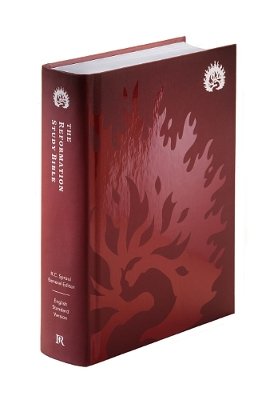 A few months ago I was sent a review copy of The Reformation Study Bible. Given the title, I kind of expected there to be study notes from Luther, Calvin, Zwingli, and the like. I mean, it’s the “Reformation” Study Bible, right? What it actually is is a Reformed Study Bible. I’ll be reviewing it from that perspective as well as I can, but I wanted to be sure readers wouldn’t be confused, as I was.
The Bible is extremely robust, with notes often taking up half or more of the actual pages of the text. Each book has a brief introduction that does a good job outlining key details and theological themes. There are extensive maps and additional notes found throughout the text. Notes range from theological exposition to apologetics-oriented. At times they focus on a pastoral perspective or draw out inter-canonical readings of the texts. There is little that passes without comment.
I received the edition pictured here. The cover is beautiful and also very solid. The binding clearly will hold up quiet well under lengthy use. There are, of course, other bindings available including leather. The pages are extremely thin, however, and it is easy to see the text through the page. The font is small, though readable. As with most other modern study bibles, there is very little space in the margins for writing notes (apart from sections of biblical poetry).
The extent to which readers will enjoy this Bible is going to be almost entirely based on how much they align with Refromed theology. In some places (such as interpretation of Genesis 1), there is leeway granted in the notes for a spectrum of views. In others (such as the discussion over men and women in the church), a specific perspective (complementarianism) is heavily endorsed. Discussions of sacraments, foreknowledge, predestination, election, and the like are all explicitly Reformed in their perspective. This is not a strike against the study Bible–it is, after all, effectively a Reformed Study Bible–but readers must realize that they will get exactly that.
In order to write this review, I went through several books in their entirety, along with reading the notes and the like. These included Ruth, Genesis, John, and 1 Corinthians. In addition, I read selections from every other book. The tone and notes are consistent throughout. As already noted, the notes are also fairly extensive.
The bottom line is that you’re going to get out of The Reformation Study Bible exactly what you would expect from a conservative Reformed study Bible. It is excellent in that regard–and could even serve as a resource if you are interested in researching Reformed perspectives on various passages–but if that is not what you want, you should look elsewhere for a study Bible.
The Good
+Extensive notes with deep discussion of inter-related texts
+Good format
+Readable introductions with inter-canonical perspective noted
The Bad
-Confusing title
-Lots of notes will be largely disregarded if you have a different theological bent
Disclaimer: I was provided with a review copy of this book by the publisher. I was not obligated to write any specific kind of feedback whatsoever.
Adhering to the Book of Concord: “In So Far As” or “Because” it agrees with Scripture?
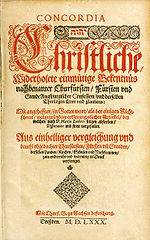
A title page of the Book of Concord
Lutheran theology is derived from and reflective upon not just Martin Luther but also the Lutheran Confessions, as found in the Book of Concord. Within Lutheranism, there is much debate over exactly how tightly one must adhere to the Book of Concord. On one side, there are those who insist we must affirm the Book of Concord “because” it agrees with the Bible. On the other side, others maintain we should affirm it “in so far as” it agrees with the Bible.
Because it Agrees
Representative of the view that one must agree with the Book of Concord because it teaches what the Bible teaches is the following:
Authentically Lutheran churches insist on a subscription to the Confessions [The Lutheran Confessions/Book of Concord are used interchangeably] because they agree with the Bible, not merely in so far as they agree with Scripture. Otherwise, there would be no objective way to make sure that there is faithful teaching and preaching of God’s Word. Everything would depend on each pastor’s private opinions, subjective interpretations, and personal feelings, rather than on objective truth as set forth in the Lutheran Confessions. (Book of Concord (.org) FAQ)
Note some important aspects in this quote. First, the Book of Concord just does agree with the Bible. That is insisted upon. Second, the Book of Concord is said to be “objective truth” as opposed to the “subjective interpretations” of the individual. These considerations frame what I’d like to comment on regarding those who hold to the view that we must agree with the book of Concord “because…”
Because?
I’ll start with the second aspect noted above. There are, of course, all kinds of increasingly detailed issues people on either side of the debate might raise here. For example, how are “objective” and “subjective” being here defined? I’m going to set that kind of issue mostly aside and focus on a few difficulties I see.
The first is that one cannot simply read the words off the pages of the Book of Concord without going through the necessary step of interpreting them. That is, I as a reader of the Book of Concord must try to make sense of the words I am reading, and thus I am participating in the act of interpreting the Book of Concord. If, as the quote above states, the problem is the individual’s subjective nature, then the problem is completely unavoidable. Indeed, even if we grant that the Book of Concord is “objective truth” in its entirety, all we’ve done is moved the problem of subjective interpretation one step back. Now the reader must interpret the Book of Concord in order to get to the objective truth about Scripture found therein.
Another difficulty with this objective/subjective distinction is that it assumes the writers of the Lutheran Confessions were themselves either not subjective (which seems impossible) or explicitly guided by the Spirit to write out objective truth only. I would not dispute that the Holy Spirit could bring about a completely faultless writing, but the question is whether those who affirm the “because” position would like to argue this. The first thing we should do if they do want to argue this would be to see whether the writers of the Book of Concord assert the Holy Spirit did bring about such a completely objective, 100% correct work.
In the Preface to the Book of Concord, we can read:
Finally, with invocation of God Almighty and to his praise and glory and with careful deliberation and meticulous diligence through the particular grace of the Holy Spirit, they wrote down in good order and brought together into one book everything that pertains to and is necessary for this purpose. (Preface, 12)
Later, the Preface makes clear (15) that this Book was “the correct, Christian understanding of the Augsburg Confession…” In the closing of the Preface, we read (23) that those who signed on to it that they “are minded not to manufacture anything new… nor to depart in either substance or expression… from the divine truth… by the grace of the Holy Spirit we intend to persist and remain unanimously in this truth and regulate all religious controversies and their explanations according to it.”
These are all strong statements, and they clearly called upon God the Holy Spirit for guidance in the composition of the various works that make up the Book of Concord. But does it follow that they were explicitly, inerrantly inspired and guided by the Spirit to never once get a single thing wrong in this book? Those who affirm the “because” position must answer yes. There is no wiggle room.
But a close reading of the Preface seems to suggest that although the writers certainly believed everything in the Book of Concord to be without theological error (otherwise they would not have it regulate all controversies, etc.), I have yet to find anywhere that a claim could be made that the book is explicitly inerrant. It would have to be, however, for the “because” position to be true. This human composition would have to be 100% correct in every single minute detail down to the last proof text cited in order for it to be acceptable to affirm that we must agree with it “because” it agrees with Scripture.
Among other things, what follows from that is that anyone who subscribes to the Book of Concord “because” position must have read the entirety, looked up every citation, and assured themselves that every single interpretation, doctrinal position, and the like is 100% correct, lest they be saying that it is a human-made book without error on God’s Word without actually knowing every detail it contains.
The first issue raised above will be addressed in the section named “A Case Study,” below.
In So Far As
A supporting argument for the “In So Far As” position is that we should always only affirm that which is true. If we can agree that the Bible is true in all it teaches, then we should only agree with other writings about the Bible so far as they agree with the Bible. This seems like an obvious conclusion, but the whole debate centers on whether this argument is sound. It is difficult for me to figure out how to support this argument, not because I think it is a poor argument, but because it seems just intuitively clear.
It may help to use an analogy. Historians have debated how to write history and whether writers of history can ever fully get at the “true” history as it happened. Yet very few would deny that there is such a thing as a “true” history. There must be some absolutely correct sequence in which events occurred such that if we had a complete set of writings that simply reported those events, that would be the “true” history. Thus, there is an objectively true history, against which historians can be measured. Granting some of the hand waving involved in this thought experiment, suppose we had a book, The True History of the World, and we looked up the John F. Kennedy assassination therein. We would then have the objectively true report of that hotly-debated historical event as it really did happen. Now suppose I wanted to write a book about the JFK assassination based upon The True History of the World. However careful a historian I am, however excellent and detailed my mind is, however much guidance I may have had, would it be reasonable to say that you agree with my book, The Objective JFK Assassination “because” it agrees with The True History of the World or “in so far as” it does? It seems that the reasonable conclusion would be “in so far as” it does, because we know that The True History of the World is objectively true.
Though imperfect, this analogy gets at the argument written above. We can agree the Bible is inerrant. Thus, if I were to write a book entitled The Objective Bible, I think we can agree that we should only agree with my book so far as it agrees with the Bible, right? No matter how detailed I am, no matter how meticulous, no matter how large a group of thoughtful interpreters I got together to vet my work, it would be entirely reasonable to only affirm agreement with my book so far as it is biblical. Then why would such a standard not also apply to the Book of Concord? I see no reason why that standard would not.
Indeed, to argue against those who affirm the Book of Concord only “in so far as” it agrees with the Bible would mean that one would have to assert that the caution and respect for God’s word implicit in that position–that I would not want to affirm anything, even by mistake, as biblical if it is even possibly in error anywhere–are mistaken. That the care and caution necessary to say “I will only agree with any book in so far as it agrees with the Word of God” is mistaken, and that that the Book of Concord must also be included under the umbrella of books against which all others must be judged.
For the “because” position ultimately, unswervingly leads to the conclusion that we should only affirm any other book “in so far as” it agrees with the Book of Concord. After all, if it is true that the Book of Concord is affirmed because it agrees with Scripture, then it follows that the authority of the Bible is effectively equivalent to the authority of the Book of Concord. The Bible is God’s word, and the Book of Concord is the objective teaching of God’s word without even possible error. That is not simply rhetoric; it is what must follow from the “because” position. Any interpretation of the Bible must be judged against the Book of Concord; hence, any reading of the Bible must also be judged against it.
A Case Study
Finally, we are in position to ask whether the Book of Concord does indeed have any error therein. That is a crucial question, of course, and one not easily resolved by those who remain faithful Lutherans. If, however, there is even one incorrect use of a proof text in the Book of Concord, the “because” position fails.
In the Apology of the Augsburg Confession, Article XXIII (XI) on the Marriage of Priests, section 25, we read:
Therefore this law concerning perpetual celibacy is peculiar to this new pontifical despotism. Nor is it without a reason. For Daniel 11:37, ascribes to the kingdom of Antichrist this mark, namely, the contempt of women.
Daniel 11:37 reads (ESV) “He shall pay no attention to the gods of his fathers, or to the one beloved by women. He shall not pay attention to any other god, for he shall magnify himself above all.”
The whole passage is difficult to interpret given its prophetic message about the Kings of the North and the South. I’m not going to enter into whether this is specifically referencing “Antichrist” or “the kingdom of Antichrist” or anything of the sort. Instead, the issue is with the reading as “contempt of women.” The Reformers were obviously not using the ESV or anything in English. But older English editions like the KJV might support this text as a proof for contempt of women: “Neither shall he regard the God of his fathers, nor the desire of women, nor regard any god: for he shall magnify himself above all.”
But the problem is that critical editions of the Old Testament don’t support a reading as contempt of women. Without going into depths of detail, and because I’m not a Hebrew scholar by any measure, I would just point out that the Hebrew does seem to clearly state “the one desired by women.” So if we are to read 11:37 as a proof text for contempt of women, it doesn’t seem to be a right reading. It’s a minor difficulty, but one nevertheless. Did the citation above from the Book of Concord properly exegete the Bible? I would assert that the use of this proof text is mistaken. If we are to take “paying no attention” as “contempt”–itself a move that could be disputed, then the subject remains “the one desired by women” not “women.”
Now, if the Book of Concord should be agreed with because it agrees with the Bible, then how are we to take this? I don’t know. It seems to me that this is more an example of the way people read the Bible at the time and used proof texts–often stripped of context–in defense of their positions. A single dispute over a citation is not a paradigm shift; indeed, I think that the authors of the Apology were correct on this notion about the marriage of priests. But that doesn’t mean everything they wrote is correct.
Conclusion
I agree with and affirm the Book of Concord in so far as it agrees with Scripture. I think it is correct on a huge amount of the things it teaches. I am currently re-reading it (slowly) and checking citations as I go. I have found it to be edifying and a source of profound theological insight. But it is not the Bible, and I do not think that to be Lutheran–or even a confessing Lutheran–I need to affirm that the Book of Concord is without possible error.
Source
Robert Kolb and Timothy J. Wengert, eds. with Charles P. Arand, translator, The Book of Concord.
Links
Be sure to check out the page for this site on Facebook and Twitter for discussion of posts, links to other pages of interest, random talk about theology/philosophy/apologetics/movies and more!
SDG.
——
The preceding post is the property of J.W. Wartick (apart from quotations, which are the property of their respective owners, and works of art as credited; images are often freely available to the public and J.W. Wartick makes no claims of owning rights to the images unless he makes that explicit) and should not be reproduced in part or in whole without the expressed consent of the author. All content on this site is the property of J.W. Wartick and is made available for individual and personal usage. If you cite from these documents, whether for personal or professional purposes, please give appropriate citation with both the name of the author (J.W. Wartick) and a link to the original URL. If you’d like to repost a post, you may do so, provided you show less than half of the original post on your own site and link to the original post for the rest. You must also appropriately cite the post as noted above. This blog is protected by Creative Commons licensing. By viewing any part of this site, you are agreeing to this usage policy.
“The Martian” – Hope, Humanity, and God- a Christian look at the film
 The Martian is receiving some excellent reviews from critics, and for good reason. It is a stirring story about humanity and our capacities and drive to survive. Here we will look at the worldview htemes found in the film. There will be SPOILERS in what follows. I will not be summarizing the plot, but a summary can be found here.
Hope and Humanity
A major theme of the movie is that of hope. Mark Watney, the astronaut left behind on Mars, becomes the center of hope of the entire world. All eyes were following as he continued to fight against the unforgiving Red Planet. When the mission to rescue him finally comes to a climax, there is a scene of people around the globe watching in anticipation and hope. They celebrate merely hearing his voice.
I can’t help but think about the hope of the shepherd in a certain story told be a Jew in Galilee, in which the celebration over but one lost sheep was immense. There is an inter-connectedness that humans experience as we seek to help others and exult in the triumphs even of strangers in need.
Perhaps the central theme in the movie is that of the very, well, human-ness of humanity. We need companionship, and the poignancy of that is found throughout the film. Mark fights against the loneliness he feels by fighting one problem after another. But simply hearing someone’s voice is enough to send him celebrating, and when the rest of his mission team come to rescue him–and he can hear his commander’s voice for the first time, the overwhelming sensation of emotion he feels leads him to tears.
Humanity was not made to be alone.
God?
By no means does this film offer much related to worldview issues about God, but there are a few moments worth mentioning. The first is when Mark has to whittle a crucifix in order to get some material to burn for making water. He looks at the figure of Christ on it and says that he thinks that Jesus wouldn’t mind him using it to save his life. Though this never develops beyond a joke, it is interesting to see how it ultimately is a kind of salvation through the cross–this time in a very literal sense.
Prayer is hinted at when the head of NASA asks the head of the Mars projects whether he believes in God. The answer that came was unexpected: with a Baptist mother and Hindu father, “I believe in several.” The response? “We need all the help we can get.” Again, this joking moment does reveal a hint of truth: that God is the one who provides help. Of course, not the many gods of Hinduism, but the true God is the one who saves.
Conclusion
“The Martian” is a great film. It explores the human need more than most films ever even touch on. These needs reflect deeply ingrained desires that mesh well with the Christian worldview. Only in Christ can we ultimately find the consummation of hope.
Links
Be sure to check out the page for this site on Facebook and Twitter for discussion of posts, links to other pages of interest, random talk about theology/philosophy/apologetics/movies and more!
Andy Weir’s “The Martian” A Christian Look at the Book: Humanity, Community, and Hope– I look at the the worldview themes found throughout the book on which the film was based.
Also see my other looks into movies (scroll down for more).
SDG.
——
The preceding post is the property of J.W. Wartick (apart from quotations, which are the property of their respective owners, and works of art as credited; images are often freely available to the public and J.W. Wartick makes no claims of owning rights to the images unless he makes that explicit) and should not be reproduced in part or in whole without the expressed consent of the author. All content on this site is the property of J.W. Wartick and is made available for individual and personal usage. If you cite from these documents, whether for personal or professional purposes, please give appropriate citation with both the name of the author (J.W. Wartick) and a link to the original URL. If you’d like to repost a post, you may do so, provided you show less than half of the original post on your own site and link to the original post for the rest. You must also appropriately cite the post as noted above. This blog is protected by Creative Commons licensing. By viewing any part of this site, you are agreeing to this usage policy.
Book Review: “Owen on the Christian Life” by Matthew Barrett and Michael Haykin
 Owen on the Christian Life provides a broad-spectrum approach to John Owen’s theological insights into the Christian life. It is part of the “Theologians on the Christian Life” series from Crossway (see my other reviews in this series here).
John Owen was a Puritan. Yes, one of “those people.” The word “puritan” has something of a bad connotation nowadays, but the theological movement was actually remarkably broad. Moreover, many insights can be gleaned from reading through the works of these theologians who emphasized a Christian life lived.
The authors outline Owen’s theology through a number of chapters that build on each other, including chapters on the Trinity, penal substitution, justification, and more. Readers also learn about Owen’s transition towards congregationalism, discussions about church and state, and more.
Central to Owen’s theology are the Trinitarian relations, which can help us to learn about divine-human and human-relations as well. Owen emphasized the importance of religious experience for the Christian life. This experience was never taken to trump the authority of the Bible–far from it. Instead, it was taken to be a bulwark in times of doubt and need. Justification in Owen’s view provides a way to be assured of one’s salvation, for God completes that which God has set out to do. Sanctification is where I believe Owen’s main contributions might be found, though I will outline that more below.
The primary critique I have of the book is that it doesn’t seem to focus on Owen’s specific views of the Christian life as the other works in the series have. As I outlined above, there are chapters emphasizing various aspects of Owen’s theology, but these only get tied into the Christian life in what seems like offhand fashion at times. This makes the book read more like an exposition of Owen’s broader (largely Calvinistic) theology than a specific look at his doctrine of the Christian life. Particularly surprising to me was how Owen’s insights on sanctification and overcoming sin and temptation were lumped in with discussions of the power of prayer and the indwelling Spirit. Perhaps this is at least partially my own bias, having been edified greatly by his works on sin and temptation, but I think that more space dedicated to his work in this area would have been on point in a book on the Christian life.
That said, the authors do a good job summarizing Owen’s approach to overcoming sin and putting it to death in our lives. Owen argues for several steps a Christian can take to battle sin and temptation in their lives. This is a proactive approach which views the Christian life as a Spirit-empowered battle against the temptations we face. Steps Owen describes include the envisioning of the consequences of sin, reflection on the Bible, and realizing the fact of the suffering our sin causes Christ.
Owen on the Christian Life provides insight into the whole of Owen’s theology, with a focus on his theology of Christian living. It’s not necessarily as focused on the topic at hand as some other books in the series, but it is a worthy read that provides an introduction into the thought of this theological giant.
The Good
+Excellent insights into the Christian life
+Provides broad overview of Owen’s work
+Great insights into doctrine of the Holy Spirit, sanctification, and more
The Bad
-Doesn’t seem to focus entirely on the Christian Life
Links
Be sure to check out the page for this site on Facebook and Twitter for discussion of posts, links to other pages of interest, random talk about theology/philosophy/apologetics/movies and more!
Book Reviews– There are plenty more book reviews to read! Read like crazy! (Scroll down for more, and click at bottom for even more!)
Book Review: “Overcoming Sin and Temptation” by John Owen– I review a book from John Owen which has positively impacted my spiritual life in many ways.
Source
Matthew Barrett and Michael Haykin Owen on the Christian Life (Wheaton, IL: Crossway, 2015).
SDG.
——
The preceding post is the property of J.W. Wartick (apart from quotations, which are the property of their respective owners, and works of art as credited; images are often freely available to the public and J.W. Wartick makes no claims of owning rights to the images unless he makes that explicit) and should not be reproduced in part or in whole without the expressed consent of the author. All content on this site is the property of J.W. Wartick and is made available for individual and personal usage. If you cite from these documents, whether for personal or professional purposes, please give appropriate citation with both the name of the author (J.W. Wartick) and a link to the original URL. If you’d like to repost a post, you may do so, provided you show less than half of the original post on your own site and link to the original post for the rest. You must also appropriately cite the post as noted above. This blog is protected by Creative Commons licensing. By viewing any part of this site, you are agreeing to this usage policy.
Andy Weir’s “The Martian”- A Christian Look at the Book: Humanity, Community, and Hope
 There is a lot of buzz surrounding Andy Weir’s novel, The Martian. It’s being made into a movie staring Matt Damon. Here, we will look at the book from a worldview perspective. There will be major SPOILERS in what follows.
The Value of a Human
One of the objections raised in the novel to moving missions around to try to save Mark is the sheer cost of the expedition. Why spend millions or even billions of dollars trying to save just one person, particularly when there are so many others who could be saved?
Towards the end, Mark himself is reflecting on this and he writes “The cost of my survival must have been hundreds of millions of dollars. All to save one dorky botanist. Why bother? …[T]hey did it because every human being has a basic instinct to help each other out. It might not seem that way sometimes, but it’s true… Yes, there are [expletive]s who just don’t care, but they’re massively outnumbered by the people who do. And because of that, I had billions of people on my side.”
The appeal to basic goodness of humanity is not without a number of assumptions. For example, how is it that the basic goodness of humanity is established? It isn’t just assumed–the evidence cited is that the overwhelming majority of people have basic instinct built into them to help others. But I wonder whether that evidence is drawn more from the extraordinary circumstances Mark found himself in than from the reality of human nature. It is a fact that women are taught in this country (the United States) to shout “fire” rather than “rape” if they are under assault, because people will answer more readily to cries to help fight a fire than they will try to intervene in an assault. The circumstances often determine how willing we are to go the extra mile to help others.
Thus, the conclusion seems a bit naive. Yes, the world pulled together in this work of fiction to help a man stranded on Mars–and I suspect that all kinds of red tape would, in fact, be cut if this ever happened–but that cannot be applied universally to every situation. The fact that there is so much human suffering happening right now–visible human suffering that can be seen in places that are, for example, attacked by IS, or wracked by storms, and the like–without humanity pulling together to stop it suggests that this notion of universal good will towards all is not as powerful as was suggested.
On the other hand, from a Christian perspective, each and every human life is precious, not because we have some inherent need to help others (though that could arguably be there), but because we share human nature, a nature given to us by God to be the image of God in this universe. Humans are valuable simply because they are humans, and we have an obligation to help those in need.
Humans and Others
It is not explored very deeply, but there is a sense throughout the book that humans are made to be with others. Mark feels a profound sense of loneliness when he realizes he is stuck on Mars, but he ultimately gets to work on trying to survive as quickly as possible. This work helps to distract him from his sense of loss, but at times throughout the book it crops up again. The sense of loneliness is at times crushing for him, but he is always able to get himself moving again, perhaps because he continually has hope that the loneliness will be squashed by being rescued or at least getting contact with Earth.
Humans are made to be people in community. I think this again reflects the Christian concept of the image of God. As God is Triune and in community (speaking here rather metaphorically, of course), we are made to be in community as well. Moreover, God created man but then realized “it is not good for man to be alone” and created a woman. These profound words are often explored from various angles, but I wonder whether they don’t also speak to us from a sense of loneliness. We are not meant to be alone but rather to exist in community. Our existential longing and loneliness ultimately points beyond ourselves to a higher reality–in which we may experience communion with God.
Conclusion
The Martian is an entertaining read. It doesn’t raise as many worldview questions as some other science fiction works do, but it does ask us to consider the value of humanity and shared experience. I’d recommend reading it, but be aware of a large amount of swearing.
Links
Be sure to check out the page for this site on Facebook and Twitter for discussion of posts, links to other pages of interest, random talk about theology/philosophy/apologetics/movies and more!
Popular Books– Read through my other posts on popular books–science fiction, fantasy, and more! (Scroll down for more.)
SDG.
——
The preceding post is the property of J.W. Wartick (apart from quotations, which are the property of their respective owners, and works of art as credited; images are often freely available to the public and J.W. Wartick makes no claims of owning rights to the images unless he makes that explicit) and should not be reproduced in part or in whole without the expressed consent of the author. All content on this site is the property of J.W. Wartick and is made available for individual and personal usage. If you cite from these documents, whether for personal or professional purposes, please give appropriate citation with both the name of the author (J.W. Wartick) and a link to the original URL. If you’d like to repost a post, you may do so, provided you show less than half of the original post on your own site and link to the original post for the rest. You must also appropriately cite the post as noted above. This blog is protected by Creative Commons licensing. By viewing any part of this site, you are agreeing to this usage policy.
Book Review: “Rescuing the Gospel from the Cowboys” by Richard Twiss

Rescuing the Gospel from the Cowboys by Richard Twiss presents a broad, far-reaching analysis of the contact and sometimes conflict between Christianity and Native cultures.
Conflict is a major theme of the book, as Twiss traces the history of interactions between Western Christians and Native peoples. This history involves much wrongdoing, from wanton destruction of Native peoples through disease (which was at some points compared to the plagues on Egypt attacking the Native peoples), to continued missiology that refuses to adapt to new insights from anthropology.
A central question asked time and again through the book is why, in order to be Christian, people must give up all their cultural background and embrace a Eurocentric version of religious practice. The example often used is that of drums in worship. Many argue that this is an example of potentially dangerous syncretism–the incorporation of anti-Christian ideology into allegedly Christian worship. They allege that because drums have been used in spiritual fashions that are non-Christian, they must be tied to non-Christian beliefs. Twiss argues that, instead, it is an example of critical contextualization–integrating the Christian faith by means of cultural expressions. He notes that this is allowed in all kinds of ideas and expressions in Western cultures. He mentions the integration of Platonic and Aristotelian thought into Creedal expressions as one example. Another example could be the general allowance for Christmas trees–themselves once expressions of pagan practices.
Thus, a major aspect of Twiss’ project is to demonstrate that Native peoples must be allowed to develop their own understanding of how to follow the Jesus way. Just as in Western churches, incense, organs, Christmas trees, specific candle lightings, and the like are allowed and even endorsed; so too should Native expressions and critical incorporation of their own practices be allowed in worship. Only then, argues Twiss, can the Gospel be truly integrated into Native life and communities.
Twiss also outlines various ways missions have been done to Native peoples and notes that these have largely changed and adapted in response to new insights from anthropology, but these adaptations have been adapted abroad, not in Native mission fields. This means a continued colonializing is taking place as Native peoples are expected to change everything, without being allowed to keep their own religious expressions. He summons much data to support these claims.
A major chapter in the book features his amalgamation of stories into a fictional sweat lodge ceremony in which nine different Native men are talking about their struggles with following Christ in a Native culture. These provide great insights into the ways in which Native people have worked to integrate their culture and faith together and met enormous resistance.
By the time I finished the book, I realized that I’d had to be fairly introspective and consider my own faults along with all that I had learned. I had, at least in my head, thought of various practices like integrating Native dancing into worship as being some kind of syncretism. I hadn’t thought about how plenty of the things I do (Christmas trees, for example) had sprung from a cultural milieu and come to be accepted in Western Christianity. I had been convicted by Twiss, but also enlightened.
The few critiques I have to offer of the book pale in comparison to its insight, but I’ll note them here. First, there are a couple times in which it seems to repeat the same point more than once–sometimes even with the same quote or citation. I’m sure this is due to it having been finished posthumously, and so the editors drew together works from Twiss’ other materials, but it remains disconcerting at points. Another issue is that there are several points at which Twiss lists a whole slew of relevant scholars and a major work or two from each. It’s the kind of thing that could have been more easily relegated to endnotes in order to clean up the text a bit, but this is a minor nitpick.
The appendices are quite useful, including a list of various words or phrases used to refer to Native American peoples, as well as when they were first used and how they’ve come to be used now.
I recommend Rescuing the Gospel from the Cowboys as highly as possible. It is filled with excellent information, convicting insights, and hope. Pick it up and read it.
The Good
+Touches on a number of important topics
+Deep insights with convicting but guiding words
+Awesome cover
+Excellent use of stories to illustrate important points
+Provides hope and applicable insights
+Useful appendices
The Bad
-Occasionally repetitive
-Large lists of scholars at points with little context
Disclaimer: I received a review copy of this book from the publisher. They did not require any specific kind of feedback whatsoever.
Links
Be sure to check out the page for this site on Facebook and Twitter for discussion of posts, links to other pages of interest, random talk about theology/philosophy/apologetics/movies and more!
Book Reviews– There are plenty more book reviews to read! Read like crazy! (Scroll down for more, and click at bottom for even more!)
Source
Richard Twiss, Rescuing the Gospel from the Cowboys (Downers Grove, IL: InterVarsity, 2015).
SDG.
——
The preceding post is the property of J.W. Wartick (apart from quotations, which are the property of their respective owners, and works of art as credited; images are often freely available to the public and J.W. Wartick makes no claims of owning rights to the images unless he makes that explicit) and should not be reproduced in part or in whole without the expressed consent of the author. All content on this site is the property of J.W. Wartick and is made available for individual and personal usage. If you cite from these documents, whether for personal or professional purposes, please give appropriate citation with both the name of the author (J.W. Wartick) and a link to the original URL. If you’d like to repost a post, you may do so, provided you show less than half of the original post on your own site and link to the original post for the rest. You must also appropriately cite the post as noted above. This blog is protected by Creative Commons licensing. By viewing any part of this site, you are agreeing to this usage policy.
Sunday Quote!- On Theological Controversies from John Newton
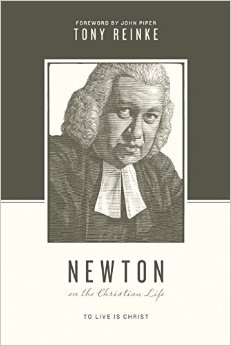
Every Sunday, I will share a quote from something I’ve been reading. The hope is for you, dear reader, to share your thoughts on the quote and related issues and perhaps pick up some reading material along the way!
On Theological Controversies- From John Newton
I recently finished reading Newton on the Christian Life (see my review here), a book about John Newton’s pastoral theology. John Newton worked on slave ships but after his conversion worked to help end slavery in the British Empire. His pastoral theology had great depth, as evidenced in this quote on theological controversies, published in a newspaper during a particularly bitter debate between Arminians and Calvinists:
[B]efore you engage in debate, you must take heed of your opponent. He is an eternal creature. If he is not a Christian… he warrants your deepest pity, kindness, and prayers… If, however, your theological opponent is a genuine Christian, think about your future together in heaven.” (Kindle Location 5460, cited below)
Think about that for a moment. Your “debate opponent” will be together with you in heaven forever. This isn’t someone you can hide comfortably from behind a keyboard. You’ll meet one way or another. How do you think you should treat this child of God?
But that’s not all. Newton’s advice applies even moreso if the debate is against someone who is not a Christian, for they “warrant… your deepest pity, kindness, and prayers.” What kind of Christians are we if our theological debates drive people away from Christ (another theme in Newton’s pastoral theology)?
We should keep in mind Newton’s advice as we engage others; all of whom bear the image of God.
Links
Be sure to check out the page for this site on Facebook and Twitter for discussion of posts, links to other pages of interest, random talk about theology/philosophy/apologetics/movies and more!
Sunday Quote– If you want to read more Sunday Quotes and join the discussion, check them out! (Scroll down for more)
Source
Tony Reinke, Newton on the Christian Life (Downers Grove, IL: Crossway, 2015).
SDG.
Book Review: “Bavinck on the Christian Life” by John Bolt
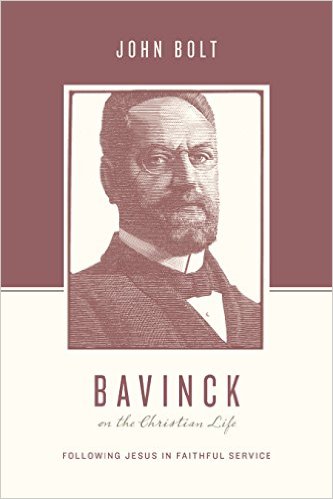
Bavinck on the Christian Life is another entry in the “Theologians on the Christian Life” series from Crossway. Check out my other reviews in the series.
The chapter on union with Christ is particularly insightful. Bolt draws out Bavinck’s insights into Christology, which include going beyond redemption and looking to eschatology and creation as important aspects of Christology as well. Union with Christ is explored from various angles, including penetrating looks at deism and pantheism alongside an examination of the Orthodox doctrine of theosis. This latter portion is particularly interesting both because it allows for some evangelical-Orthodox dialogue and because it clarifies some important distinctions Orthodox distinctions make that allow them to avoid pantheism or panentheism in regards to divinization.
I also appreciated the extensive biographical background to set the stage for Bavinck’s theology by showing how he interacted with the controversies of his time. The overview provided herein of Bavinck’s thought is also insightful. He was thoroughly Calvinist. His view of the world was tied up in Trinitarianism, and he grounded not only his view of reality but also of various aspects of reality in the Trinity. An important insight from Bavinck is the way in which work is part of the human vocation and living out of the image of God. As a Lutheran I particularly enjoyed the emphasis on work as being part of God’s plan for humanity.
One criticism I have is that the author seemed to have a bit of a political axe to grind. In chapter 3, for example, welfare is mentioned at least twice and referenced off hand a third time. Bolt seems keen to point out that Christians can differ on this subject, writing at one point “The Bible is quite clear about the responsibility of God’s children to help those who are poor and needy. Whether or not this commitment to the poor demands support for higher taxes and greater government welfare is quite another matter” (Kindle location 1211-1221). The 10th chapter of the book returns to this issue and places it in Bavinck’s own context with debates over the social gospel and the meaning of the Kingdom (see especially Kindle location 4300 and following). This at least places the whole discussion in Bavinck’s own day.
Yet, remarkably, Bavinck’s response to social inequality seems, according to Bolt, to simply shift the problem elsewhere. Bavinck casts inequality and social injustice squarely into the realm of divine sovereignty: “God’s preordaining was the final, most profound cause of all differences among creatures… It is neither the free will of man, nor merit and worth, nor culture or even nature that is the source… but God’s almighty and all-powerful will…” (4540). I’m not saying this is inherently mistaken. What I’m saying is this doesn’t even begin to answer the question raised: how should we deal with injustice? Sure, a Calvinist would argue that all that happens is sovereingly decreed by God, but how does just saying that in any way answer the preceding question? It just moves it up a (or several) level(s).
Bavinck was also someone who “ascribe[d] to women a primary calling in the home, and he point[ed] to human history, as well as the narratives and laws of the Old Testament, as evidence for a patriarchal structure of human society” (Kindle location 3001). Yet, he also argued that no man is complete without some aspects of femininity and no woman is complete without some aspects of masculinity. How that plays out is largely left up for interpretation, though Bolt argues that this demonstrates that although Bavinck would align with “complementarianism”–the view that men and women have different roles in church and home–he would not ascribe to some of the “will-to-power, macho masculinity and eroticized or subservient, passive femininity” (Kindle loc 3076). Bavinck also challenged some of the patriarchal views of his own society. One way he did this was supporting women’s suffrage. These are admirable qualities He emphasized the role of children and family as the calling of humanity, but one wonders what this might say to those who remain single or childless.
A final, though minor, critique is that there are many portions of the book in which the overall outline of the book is walked back through, or references are made to previous chapters alongside a brief description of why such a reference is relevant in context. It’s a minor thing to point out, but it was distracting at points and gave an impression that the book wasn’t always organized logically.
Bavinck on the Christian Life provides perspective on Bavinck’s thought, life, and context. It isn’t quite as polished as the other books in the series, but it remains a worthy read.
The Good
+Interesting insight into the theological context of Bavinck’s day
+Good cautionary words on worldview analysis
The Bad
-At some points too concerned with modern controversies
-Too many words spent explaining why the book was organized in the fashion it was
-Expresses commitment to “patriarchy”
Disclaimer: I was provided with a review copy of the book from the publisher. I was not asked to give any specific kind of feedback whatsoever.
Links
Be sure to check out the page for this site on Facebook and Twitter for discussion of posts, links to other pages of interest, random talk about theology/philosophy/apologetics/movies and more!
Book Reviews– There are plenty more book reviews to read! Read like crazy! (Scroll down for more, and click at bottom for even more!)
Source
John Bolt, Bavinck on the Christian Life (Wheaton, IL: Crossway, 2015).
SDG.
——
The preceding post is the property of J.W. Wartick (apart from quotations, which are the property of their respective owners, and works of art as credited; images are often freely available to the public and J.W. Wartick makes no claims of owning rights to the images unless he makes that explicit) and should not be reproduced in part or in whole without the expressed consent of the author. All content on this site is the property of J.W. Wartick and is made available for individual and personal usage. If you cite from these documents, whether for personal or professional purposes, please give appropriate citation with both the name of the author (J.W. Wartick) and a link to the original URL. If you’d like to repost a post, you may do so, provided you show less than half of the original post on your own site and link to the original post for the rest. You must also appropriately cite the post as noted above. This blog is protected by Creative Commons licensing. By viewing any part of this site, you are agreeing to this usage policy.
Book Review: “Theology as Retrieval” by W. David Buschart and Kent D. Eilers
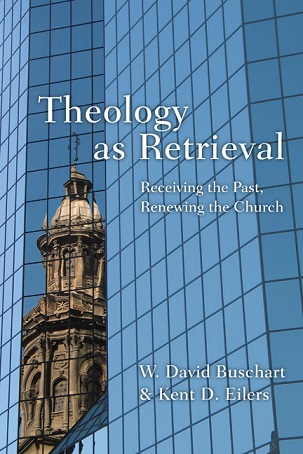
Theology as Retrieval is an exploration of how theologians might look to the past to gain applicable insights into today’s challenges. It is more than that, though. There are several specific aspects of theological retrieval that are addressed in the book from a variety of angles.
After a robust introduction that outlines what is meant by retrieval of theology and the different ways this is being brought about, there are individual chapters on various topics around which retrieval is centering. These are scripture, theology (broadly), worship, spirituality, mission(s), and cosmos. Each chapter has a question that is being addressed by many of the projects, examples of how retrieval is taking place in this specific area, and some of the results of retrieval in that field.
For example, the chapter on worship asks the question “Whose House is This?” Then, it traces various responses to the question, whether various Protestant positions or a Roman Catholic perspective. Next, specific examples of how churches went about creating worship spaces alongside their own explorations of Christian thought from the past about the place of worship. Finally, a few concluding remarks are offered about how retrieval is being done in the area of worship.
The layout thus allows for readers to pick and choose sections to read while continuing to gain different insights into how retrieval is being done. I found the chapters on worship and spirituality to be particularly enlightening. Buschart and Eilers offer not only examples of retrieval but also serve these up almost as morsels to whet the appetite for more. Throughout the book, there is a sense that there is a vast wealth of knowledge waiting to be retrieved and that the work is only being begun. I think this is an accurate portrayal of the state of theological recovery.
After the meaty introduction, the authors tend to take a kind of show, don’t tell approach to the activity of theological retrieval. The examples used are often quite robust, but I was left at times wondering whether it would have been more helpful to add another chapter on how exactly readers might go about their own activity of theological retrieval. The basics are provided in the introduction, and the examples also give several ways of how others have done so, but it would have been nice to have a more substantive overview of methodology.
Theology as Retrieval is a good read with plenty of avenues to explore. Readers will likely experience a yearning to enter into conversation with theologies of the past, and the authors provide some avenues to pursue this research. As far as methodology, however, readers will have to develop their own or try to adapt one from the glimpses provided in the book.
The Good
+Uses plenty of examples to highlight areas of retrieval
+Suggests ways to apply the concepts from the book to the church
+Highlights importance of past theologians
The Bad
-Use of examples sometimes extremely brief
-Could have used more conceptual framework
Disclaimer: I was provided with a review copy of the book from the publisher. I was not asked to give any specific kind of feedback whatsoever.
Links
Be sure to check out the page for this site on Facebook and Twitter for discussion of posts, links to other pages of interest, random talk about theology/philosophy/apologetics/movies and more!
Book Reviews– There are plenty more book reviews to read! Read like crazy! (Scroll down for more, and click at bottom for even more!)
Source
W. David Buschart and Kent D. Eilers, Theology as Retrieval (Downers Grove, IL: InterVarsity, 2015).
SDG.
——
The preceding post is the property of J.W. Wartick (apart from quotations, which are the property of their respective owners, and works of art as credited; images are often freely available to the public and J.W. Wartick makes no claims of owning rights to the images unless he makes that explicit) and should not be reproduced in part or in whole without the expressed consent of the author. All content on this site is the property of J.W. Wartick and is made available for individual and personal usage. If you cite from these documents, whether for personal or professional purposes, please give appropriate citation with both the name of the author (J.W. Wartick) and a link to the original URL. If you’d like to repost a post, you may do so, provided you show less than half of the original post on your own site and link to the original post for the rest. You must also appropriately cite the post as noted above. This blog is protected by Creative Commons licensing. By viewing any part of this site, you are agreeing to this usage policy.
“Never use an argument that you don’t find convincing”?

Not an argument, but a pretty picture nonetheless.
I was contemplating a post I was working on not too long ago and realized I didn’t find one of the arguments I put forward very convincing.
I think that there may be situations in which it is permissible and perhaps even wise to use arguments that you don’t personally find convincing. I want to start this with the caveat that as Christians in no way should you use arguments in this fashion without honestly prefacing them by saying something like “I don’t find this convincing necessarily” or “This is not my view, but some think…” We must be honest in our argumentation, but that doesn’t mean we have to be limited in it.
The Impossibility of Knowing Everything
One reason to use arguments that you don’t personally find convincing is because it is impossible for us to know everything. For example, for a long time I thought Pascal’s Wager was an okay, but not ultimately convincing argument. However, I then read a book on the argument, Pascal’s Wager: Pragmatic Arguments and Belief in God by Jeff Jordan (review linked), which convinced me that the argument is actually fairly powerful. Indeed, after reading the book I even started to use the argument myself.
Thus, what this means is that there was an argument I did not find convincing at one point, but which I later found to be quite convincing indeed. I didn’t have a complete picture of the Wager type argument, and I still don’t. It’s possible that one day I might discover a strong counter-argument which undermines my confidence in the argument.
Effectively any argument that we consider is in a situation like this. We cannot possibly have read every single angle on most (any?) arguments, and so it is possible that any number of arguments we find convincing are really not; or vice versa.
Thus, it might not be a bad idea in some situations to offer something like this: “I haven’t studied X argument much, but as of now I don’t find it very convincing. However, I do think the position it ultimately argues for is true. Perhaps you’d find X argument convincing, and we can talk about it. [Offer X argument.]”
Opening Up New Avenues for Discussion
The closing example above offers another insight into why mentioning or “using” arguments that we don’t personally find convincing could be effective- they might open up avenues for more discussion. For example, when one is doing apologetics, I could see a conversation happening in which an opening could be found by saying something like “I agree! I don’t find X to be a convincing reason to believe in God. Here’s why. Can we talk about Y, though, which I do find convincing?”
Moreover, we are called to pursue the truth and hold fast to what is good. In discussing an argument we might not find convincing, there might be new points raised which cause us to reevaluate the rejected argument in a different light.
The Pragmatic Use of Arguments
Finally, another reason it might be even wise to utilize arguments that we don’t personally find convincing would be pragmatic. For the sake of the following example, just assume that the positions presented are thought be the apologist to be acceptable biblically, though they favor one over the other. Suppose one is talking to an atheist whose only objection left to Christianity is the doctrine of eternal conscious punishment. In that case, the apologist might mention the alternative Christian doctrine of annihilationism/conditionalism, pointing out that although they don’t personally hold the view, it is a view that is established within the Christian tradition and offers an alternative to the eternal conscious punishment view.
In this case, the atheist’s final objection is at least possibly answered–they are confronted with the reality that their final objection is possibly mistaken. And, the apologist with whom they are having this discussion was honest enough to point out they don’t hold to the view, merely that it is a view which answers their objection.
This pragmatic use of argument must be done carefully, and again very openly and honestly. I have found that if one does use this method in a conversation, it generally goes to more fruitful discussions and drawing out more areas of agreement.
Conclusion
Thus, I am of the opinion that it is at least permissible to use arguments that you do not personally find convincing, with the caveat that you do so honestly.
What do you think? Should you only use arguments you personally find convincing? Is it permissible to use arguments you don’t find convincing? Are there circumstances in which this is different?
By the way, I did take that argument out of the post I was working on.
SDG.
——
The preceding post is the property of J.W. Wartick (apart from citations, which are the property of their respective owners, and works of art as credited) and should not be reproduced in part or in whole without the expressed consent of the author. All content on this site is the property of J.W. Wartick and is made available for individual and personal usage. If you cite from these documents, whether for personal or professional purposes, please give appropriate citation with both the name of the author (J.W. Wartick) and a link to the original URL. If you’d like to repost a post, you may do so, provided you show less than half of the original post on your own site and link to the original post for the rest. You must also appropriately cite the post as noted above. This blog is protected by Creative Commons licensing. By viewing any part of this site, you are agreeing to this usage policy.

 J.W. Wartick - Reconstructing Faith