literary apologetics
“Evermore: Edgar Allan Poe and the Mystery of the Universe” by Harry Lee Poe
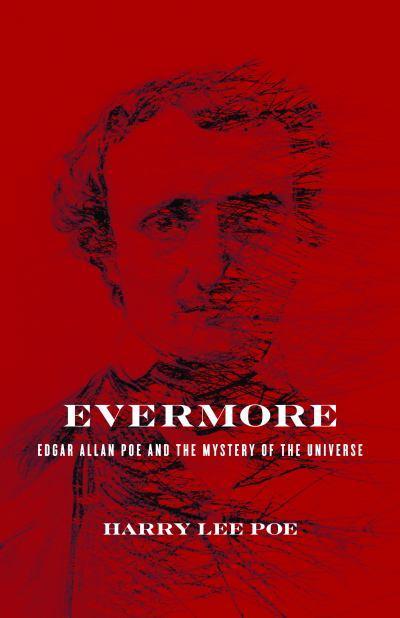 Edgar Allan Poe. His name immediately calls to mind images: a black raven haunting one’s thought, the beating of a heart driving one mad, gruesome, macabre deaths. It also brings to mind thoughts on the man himself: twisted, slightly mad, alcoholic, broken.
Are these images of the man’s work and life accurate? Harry Lee Poe (a cousin of Poe’s) argues that they are not. Instead, this kind of imagery is a result of both the popularization and the character assassination of one of the great American literary giants.
Harry Lee Poe’s work, Evermore: Edgar Allan Poe and the Mystery of the Universe
The Myth of Edgar Allan Poe
It is interesting to note that from the time he died, Edgar Allan Poe’s person was the target of a character assassination which would give rise to the popular portrayal of him as a dark, haunted drunkard. Rufus Griswold, a man who portrayed himself as a minister despite having never been ordained, published a work which has remained in the popular consciousness through the present day. In it, he falsified information about Poe and heavily edited a number of letters from the author in order to portray him as the dark, fearsome man he is often imagined even today. Harry Lee Poe exposes this mythos by noting the work of Arthur Hobson Quinn, who in 1942 published the letters Poe wrote alongside the altered letters Griswold used to make the image he created.
Thankfully, Edgar Allan Poe’s (hereafter EAP) image has been recovering in scholarship, but the damage at a popular level continues to be seemingly ubiquitous. The image of Poe as a brooding man matches what people wish to see when they read his works of horror and thrills. However, Harry Lee Poe (hereafter HLP) notes that there is much more to EAP’s body of work than is often known.
The Broader Poe
EAP’s body of work had its share of horror and mystery, but it also featured humor and satire, science fiction, and beauty. Remarkably, EAP contributed to the formation and even creation of entire genres which are extremely popular today. His science fiction was, at the time, known as “hoaxes” because no actual genre existed in order to encompass them. He also wrote the first detective mystery works to be known in literature. He was innovative and unique in his contributions to literature. He truly stands easily among the literary giants of all time.
The distribution of his works is also worth noting. EAP intentionally wrote in a number of different ways about a number of different things. HLP documents his major tales, numbering each under headings of genre. The results are surprising: EAP wrote more humor and satire than he did horror. Yet he is largely known today only for the latter (24-27). It is worth looking at Poe’s entire body of work in order to understand the man.
Mystery and Reality
One of the central parts of Poe’s work involves the writing of mystery stories. As has been noted, EAP was the first to write in the specific genre of detective mystery stories. EAP’s use of the mystery story shows that he assumed the problem of evil as a very real difficulty. However, the concept of a detective mystery story, in which the reader, through the characters, seeks to solve the mystery and find the one who committed the crime. In short, there is a broader concept of justice involved in a mystery story. Unless there is justice in the universe, the problem of evil cannot present a difficulty for one’s worldview, for evil could just be a given.
EAP, who had written horror stories already, moved the blood and gore from the climax of the story (horror) to the beginning (mystery). The rest of the story would not be about the blood and gore, but about righting a wrong: “injustice cannot be allowed to continue… the sense of justice assumes the basica rationality and order of the universe so that Truth may be discovered. The reader wants to know the truth” (115).
Beauty and Love
The concept of beauty was central to EAP’s work. He used the concept to evoke a particular feeling related to the injustice of crime, but he also saw beauty as a way to point beyond the mundane. “Beauty constituted to Poe evidence that human experience is not bound by time but belongs to eternity” (83).
The different varieties of love are exemplified throughout Poe’s works. Affection, friendship, and passion are developed by HLP to explain EAP’s concepts of how these related to the world at large. Each of these concepts could be forces for the positive or for ill. Affection, friendship, and passion could each become corrupted, and each would lead to devastating results if one allowed this to happen (86ff). Love provided a difficulty for EAP, for he saw that it may tell us about something beyond the world: it may inform us about God. But if it could be perverted, does that suggest an outside source from which love sprang, which we corrupted (107-108).
Eureka
Perhaps the most interesting portion of Evermore is the discussion of EAP’s own views as he expounded them in his work, Eureka. In this work, Poe examined the mystery of the universe. He held that the universe had a beginning and was actually expanding. He argued that light and electricity belonged “to the same continuum.” His view was close to the modern theory of the Big Bang. Yet EAP thought of this around a century before the latter came into vogue. Because the universe began, “Poe concluded that a God exists who created the universe for his pleasure. Love and Beauty provide a glimpse of God… Pain, suffering, evil, and death are the contingencies of physical existence that are left behind” (55). EAP saw the universe as a grand story, which was “the plot of God” (ibid).
The reasoning behind EAP’s amazingly prophetic vision of cosmology was found in his own observations. He noted the difficulties presented by the notion of an infinite universe, including the fact that the night sky had places where there were no stars to be seen (known as “Olber’s Paradox”).
In Eureka, EAP postulated a deity. It seemed intuitively obvious to him that if the universe began to exist, God must exist. Given that his own observational evidence led him to the conclusion that the universe began, he concluded that God exists. Moreover, he posited that this deity would have to design the universe and guide its expansion from a primordial particle (152). However, this deity was essentially pantheistic, which was his solution to the problem of evil. Each individual person would become Spirit individualized. God would become all-in-all, thus bringing holiness to all.
Edgar Allan Poe’s Beliefs?
HLP argues that EAP may indeed have become an orthodox believer late in life. Having already come to the conclusion that God exists and that the universe had a beginning (itself something EAP noted matched remarkably with the Biblical account), Poe would come forward at a Sons of Temperance meeting. HLP notes that such a move cannot be abstracted purely as coming out against alcoholism (something EAP struggled with himself). Instead, the group was explicitly evangelical in nature. Coming forward would be similar to someone today coming forward at a Billy Graham meeting (166). Those interested in Poe’s beliefs must therefore come to one of two conclusions: either he was “the charlatan and scoundrel that Griswold said he was” or “he had a conversion experience.” The Sons of Temperance taught explicitly evangelical Christianity, which would suggest that if EAP was genuine, he had come to accept a more evangelical, orthodox faith before he died.
Conclusion
Few works have intrigued me as much as Evermore has. Edgar Allan Poe has been a favorite of mine for some time, but I admit that I had bought into the stereotypical picture of the man as much as anyone else. Having only really read his horror and some poems, I have not had a complete vision of his actual body of work. Harry Lee Poe does an exemplary job of showing how EAP explicitly viewed his works as a growing body of interconnected themes, seeking to find the mysteries of the universe.
Edgar Allan Poe was a visionary. He was a great American author whose writings paved the way for hundreds of years to come. He was also well ahead of the science of his day, and similarly had already deduced the theological conclusions well before others had attempted to do so. Harry Lee Poe has presented a convincing, thorough look at EAP’s entire body of work. Having done so, he makes the man even more interesting than the myth. Edgar Allan Poe’s explorations of the mysteries of the universe leaves me profoundly interested in the man and his body of work. I highly recommend Evermore: Edgar Allan Poe and the Mystery of the Universe
Source
Harry Lee Poe, Evermore: Edgar Allan Poe and the Mystery of the Universe
SDG.
——
The preceding post is the property of J.W. Wartick (apart from citations, which are the property of their respective owners, and works of art as credited) and should not be reproduced in part or in whole without the expressed consent of the author. All content on this site is the property of J.W. Wartick and is made available for individual and personal usage. If you cite from these documents, whether for personal or professional purposes, please give appropriate citation with both the name of the author (J.W. Wartick) and a link to the original URL. If you’d like to repost a post, you may do so, provided you show less than half of the original post on your own site and link to the original post for the rest. You must also appropriately cite the post as noted above. This blog is protected by Creative Commons licensing. By viewing any part of this site, you are agreeing to this usage policy.
Really Recommended Posts 8/2/13
 After a brief hiatus, “Really Recommended Posts” are back. This go-round I have found for your reading/viewing pleasure a debate on sola scriptura, Buddhism, fear, the Shroud of Turin, and presuppositional apologetics. As always, let me know what you liked/didn’t like! Send me your own recommendations!
Is the Bible the only infallible rule of faith? Tim Staples vs. James White (Video)- A (lengthy) debate between a Roman Catholic and a Calvinist regarding the rule of faith. Should we hold to sola scriptura, or do we need the Magisterium in order to preserve teaching? The debate is really worth listening to.
A Comparison of the Ethical teachings and Impact of Jesus and Buddha– A brief insight into comparative religions between Buddhism and Christianity. What of truth in other religions? I found this a very interesting post.
Fiction and Fear– A really excellent post over at Hieropraxis which notes the importance of an element of fear in fiction. The post ties this back to the relevance of the Christian teaching of Christ’s redeeming work.
Shroud of Turin Blog– I am not convinced that the Shroud of Turin is authentic. However, I do find some of the work being done regarding its authenticity is very interesting. This blog has a constant string of posts related to various evidences in favor of the Shroud’s authenticity. I recommend it for those interested in reading on the topic, with the caveat of my own (hopeful) skepticism.
What is pre-suppositionalism? What is presuppositional apologetics?– Over at Wintery Knight, this interesting post turned up with a critique of presuppositionalism as an epistemology (largely based on this post at The Messianic Drew). I found it interesting, though I do not fully agree with all the critiques leveled therein. For balance, I would also direct readers to Janitorial Musings for a counter-argument to the first major contention against presuppositionalism- Presuppositionalism and Circularity. I think readers should read all the posts involved for a more complete picture. Judge for yourselves what to think of the presuppositional “worldview” (to use Drew’s term–I would lean towards saying “epistemology” instead).
Abortion, fundamentalists, physicalism, and evolution: Sawyer’s “Calculating God” and some contentious issues
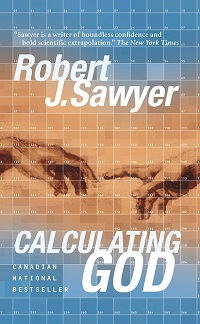 I have already written on Sawyer’s Calculating God
Fundamentalism, Religion, and Abortion
Sawyer lumps fundamentalism in with the discussions about abortion. Unfortunately, fundamentalism is portrayed in the worst possible light, not unlike in the work of Ben Bova. The religious fundamentalists here are extremists bent on destroying anything that counts as evidence against their worldview. As such, they are first introduced as blowing up an abortion clinic (86-87). Frequent readers of my site know that I write often from a pro-life perspective but also that I am very much opposed to violence in this opposition. Unfortunately, such principled opposition is not portrayed as an option in Sawyer’s work.
Interestingly the discussion of abortion in the book–intentionally or not–reveals some important details about the abortion debate. The alien, Hollus, notes the irony in being “pro-life” while also killing people who perform abortions. Yet in this discussion, Hollus reveals something of note:
Hollus looked at me [Tom Jericho, the main character] for the longest time. “These–what did you call them? Fundamentalist extremists? These fundamentalist extremists believe it is wrong to kill even an unborn child?”
“Yes” [Tom responded].
It may take a moment, but think about it: Sawyer expresses incredulity at this notion through the alien Hollus, yet in what may have been a Freudian slip, calls the unborn “children.” Yes, of course I’m opposed to killing an unborn child! In fact, this dialogue reveals exactly what is at stake in the abortion debate: if the unborn is not a human person, then who cares what you do with it? But if it is, then what relevant status difference is there between a child who is located inside the mother as opposed to outside the mother? Again, I’ve written more on this issue elsewhere, but it is important to note that even in expressing incredulity about this, there is a revealing phrase: child. It is an unborn child killed in abortion.
Disturbingly, the book touches on an issue very relevant to the personhood debate: children who are screened for disabilities. In one scene, Hollus is confronted by a child with Down’s Syndrome. He notes nonchalantly that a similar disease is almost always “screened for” in the wombs of the alien mothers (115-116). Unfortunately, this exact thing is happening right now. Unborn children who are shown as having Down’s Syndrome are being aborted inside their mothers at an alarming rate. I can’t help but see this as a modern eugenics movement: killing those we deem unworthy of life for a genetic reason. The logic that this entails is even more disturbing.
Of course the same fundamentalists who bombed the abortion clinic were also out to destroy any evidence for evolution. They sought to destroy a fossil exhibit which they saw as an affront to God. Thus, I can’t help but think that the way Sawyer presents fundamentalists is a bit disingenuous. Not all fundamentalists are incapable of reason and violent. Indeed, almost no fundamentalists are like this! Thankfully, there are positive examples of religious persons in Calculating God, including Tom’s wife.
In one poignant scene, Tom–who is dying from cancer–struggles with the fact that he has been confronted with evidence for the existence of a god. He considers famous atheists who purportedly went to death, all the while denying God’s existence to the end. Yet Tom himself gets down on his knees to pray. When he does so, though, he considers the words of someone from his past: “The Lord works in mysterious ways.” He can’t help but react violently against this:
Such bull. Such unmitigated crap. I felt my stomach knotting. Cancer didn’t happen for any purpose. It tore people apart; if a god did create life, then he’s a shoddy workman, churning out flawed, self-destructing products. “God,” [he prayed] “I wish–I wish you had decided to do some things differently.” (230-231)
Interestingly, in the book, cancer turns out to actually have a purpose… in the sense of being a side-effect of something great: the ability to fuse genetic codes with other intelligently designed species. Here it seems Sawyer has employed a great deal of imaginative techno-babble to explore the notion of a physical god, but it also has hints of a greater good theodicy akin to that of Swinburne.
Physicalism
The discussion of physicalism in Sawyer’s work is very brief, but enlightening. There is a variety of substance dualism here in the sense of emergence. That is, in Sawyer’s fictional world, intelligence and “mind” emerges from matter once complexity reaches a certain threshold. This is similar to the theories of emergence theorists like William Hasker. I can’t help but find this a bit strange. The people who argue for this type of theory are frequently the same who are very hostile to the notion of anything beyond the physical realm, yet they argue that something aphysical can indeed “emerge” from matter itself. Surely this is a leap of the imagination! That matter has creative force simply because it can reach a certain level of complexity seems to me patently absurd.
Not only that, emergence suffers from a second major problem. Namely, if our “mind” is simply a product of complexity in matter, then our “intelligence” is entirely supervenient upon physical complexity. Indeed, our intelligence is a product of that complexity and therefore cannot operate independently of that matter. Therefore, it is hard to see any kind of properties that our minds would have that would be capable of maintaining free will or even rational thought on this theory. Indeed, I have trouble seeing how this theory would be any different from physicalistic monism.
Evolution
The simple notion of evolution is a given in the book. No, it is not friendly to any who are unwilling to accept the notion of “macroevolution,” as the term is used in relevant literature. All the intelligent beings depicted in the book had evolved from a (potentially distinct) distant ancestor.
Darwinian evolution is simply assumed as truth in Calculating God. Or is it? The deity presented in the book is not very conducive to undirected evolution via natural selection and chance. It is portrayed as hurling asteroids at the planets where life was developing in order to press a “reset” button on the creatures that were currently dominant there. It also shown that this deity prevented other catastrophes from happening on these planets, thus interfering with natural selection. Indeed, the evolution depicted here is eerily similar to intelligent design, wherein the process is guided by a deity with a specific aim.
Indeed, one could argue that the entire book is an argument for intelligent design, albeit divorced from much of the theological framework that many of that movement’s frameworks operate within. Yet I can’t help but find this part of Sawyer’s argument (if, indeed, the intention is to make the argument that theists have it all wrong) is completely off. After all, the “god” of Sawyer’s universe is imperfect and concrete in the sense of physically existing. But this works against his concept of deity as being capable of coordinating the events it brings about. Granted, he could perhaps continue to increase the power of this deity beyond what is clearly outlined in the book, but there are hints that the deity is capable of knowing what is happening on places where it is not present, that it is capable of knowing what will happen with certain directions for evolution, and what will happen at the end of the universe. These work against the notion of God as a kind of blundering physical entity that just happens to be supremely powerful. Indeed, the god of calculating God may not be as hostile to Christianity as it initially seems. It serves as a pointer towards the true God of spacetime.
Links
Like this page on Facebook: J.W. Wartick – “Always Have a Reason”
Check out my other post on this book: Aliens that believe in God: The theological speculations of Robert Sawyer’s “Calculating God”
I have discussed the use of science fiction in showing how religious persons act. Check out Religious Dialogue: A case study in science fiction with Bova and Weber.
What would it mean if we discovered life? I have reflected on the possibility: Alien Life: Theological reflections on life on other planets.
Our Spooky Universe– I make the case for the intelligent design argument for the existence of God, which is heavily used throughout Calculating God.
Check out my other looks at popular level books. (Scroll down to see more!)
Source
Robert Sawyer, Calculating God
SDG.
——
The preceding post is the property of J.W. Wartick (apart from citations, which are the property of their respective owners, and works of art as credited) and should not be reproduced in part or in whole without the expressed consent of the author. All content on this site is the property of J.W. Wartick and is made available for individual and personal usage. If you cite from these documents, whether for personal or professional purposes, please give appropriate citation with both the name of the author (J.W. Wartick) and a link to the original URL. If you’d like to repost a post, you may do so, provided you show less than half of the original post on your own site and link to the original post for the rest. You must also appropriately cite the post as noted above. This blog is protected by Creative Commons licensing. By viewing any part of this site, you are agreeing to this usage policy.
Really Recommended Posts 3/1/13

Having scoured the internet for great posts to commend to my readers, I have turned up this smorgasbord for your reading pleasure.
My Father’s “Eviscerated” Work – Son of Hobbit Scribe J.R.R. Tolkien Finally Speaks out– Christopher Tolkien gives some fascinating insight to the world of the Lord of the Rings as well as Tolkien’s writing process in this interview/overview. I find it unfortunate that he feels his father’s work has been distorted by all the commercializing, and in particular I am saddened by his analysis of the movies. I have enjoyed them greatly and found The Hobbit in particular to be edifying (see my analysis of the first Hobbit movie). Nonetheless, this was a fascinating read.
William Lane Craig: [Young Earth] Creationism is an embarrassment– A Youtube video that is really a picture with an audio file in which Craig discusses the scientific impossibility of the young earth position which is held by the majority of evangelical pastors. The problem is that some have taught that the only Biblical position is that of the young earth interpretation and when youths realize that the earth is not 10,000 (or so) years old, they will fall away.
Much Undead Ado About Nothing– Our recent obsession with zombies and the undead has lead to some interesting philosophical and scientific reflection. Check out Anthony Weber’s excellent post, which relates back to The Walking Dead, among other references.
Bait and Switch– Eminent philosopher Alvin Plantinga evaluates Sam Harris’ book on free will. Spoilers: Plantinga is unimpressed. Read on for his systematic refutation of Harris’ work.
The New Apologetics– Check out this fantastic post on literary apologetics and using imagination in the defense of the faith.
‘Going Clear,’ Lawrence Wright’s Book on Scientology– Scientology is fascinating in its ability to continue. Founded by a science fiction author who describes the real world in terms that reflect those writings, Hubbard founded a religion that continues to fascinate. Check out this look at a recent book outlining the beliefs of Scientology.
Time to Tour the Camp– I found this post on the Holocaust and abortion fascinating and convicting. Please, check it out.
Aliens that believe in God: The theological speculations of Robert Sawyer’s “Calculating God”
The interplay between worldviews and science fiction is very strong. In any writing, an author’s viewpoint will show through, but I think that it is particularly true in sci-fi. For in science fiction, the author is most frequently presenting a view of the world as it should be or as it should not be. The speculative future can be used as a foil through which the reader views reality in a new way. Often, science fiction will touch upon theological issues.
Robert Sawyer’s Calculating God
Fine Tuning
The most immediately striking and pervasive theme of Calculating God is that aliens show up on earth, and they believe in God. In fact, they take the existence of God to be a scientific certainty. The main character of the book, a paleontologist named Tom Jericho, is very skeptical throughout. Here’s the kicker, though, the aliens have been convinced of the existence of God through the evidence–specifically, the fine-tuning argument. Said argument is presented throughout the course of the book in interactions between Tom and Hollus, an alien paleontologist.
What is surprising is how much depth the book goes into while exploring the argument. Yes, Sawyer does fudge the argument a bit by allowing the aliens the possibility of a grand unified theory of science as well as a few other fictionalized aspects of the argument, but overall the fine-tuning argument he presents is very similar to the modern fine-tuning argument.
Not only that, but the characters Sawyer created go to great lengths to explore objections to and defenses of the fine tuning argument. For example, there is a discussion on p. 144ff (mass market paperback edition) in which Hollus and Tom discuss some objections to fine tuning. Tom is arguing against the probability of God:
“All the actions you ascribe to God could have been the doing of advanced aliens” [said Tom].
“There are… problems with your argument,” said Hollus, politely. “[E]ven if you dispense with the need for a god in recent events–events of the last few billion years; events after other conscious observers had emerged in this universe–you have done nothing to dispense with the relative strengths of the five fundamental forces [its science fiction, so there is an extra force], who designed the thermal and other properties of water, and so on. And therefore what you are doing is contrary to the razor of Occam you spoke of: you are increasing, not reducing the number of entities that have influenced your existence…”
The book is replete with debates like this, and the inevitable conclusion is that, shock of all shocks, God exists. I don’t say that sarcastically, I mean that I was genuinely surprised that the book affirmed God exists. But what kind of God?
God Exists… but?
It should be clear that in Calculating God, God is nowhere near the God of classical theism. In fact, one could almost argue that what Sawyer has offered here is a materialistic supplanting of God. The “god” of this work is essentially a super-powerful alien which is capable of swallowing the enormous energy output of a supernova, while also capable of designing our biology and fixing the constants of the universe during the early stages of the Big Bang.
God’s action is described purely in non-transcendent language. For example, the aliens confirm that god caused ice ages and mass extinctions on all the planets with intelligent life. The way this was accomplished was a matter of some speculation–perhaps God generated a dust cloud by using particles from across the galaxy to shield the planets from light and lower the temperature, or perhaps God redirected an asteroid or two to send them hurtling at the planets with life that needed a ‘jump start’ of evolution (146ff).
So why think that this is an image of god supplanting the classical theistic God? Well, clearly many who use the teleological argument are intending for it to point towards a creator God. What Sawyer has offered is a more naturalistic explanations of these events. Yes, there is a ‘god’ in the sense of a being capable of tampering with the very fabric of our universe, but that ‘god’ is itself trapped within the spatio-temporal boundaries of the known universe. In fact, god is said to subsist by recreating itself via a kind of reproductive method and passing one generation through a Big Crunch (think of a bouncing universe model).
Now what?
Calculating God offers a unique look at theology from a science fiction perspective. The fine tuning argument is presented in full force–even enhanced by some fudging of the science–and it leads to the inevitable conclusion that god exists. Yet this ‘god’ is not at all amenable to the god of Christianity or classical theism. So what should we do with this book?
Well, it is important to note that it is a work of fiction. The author clearly adds in some extra ‘fluff’ to make the fine tuning argument more powerful than it is (and I think it is quite powerful as it stands). And really Sawyer’s shoehorning in of a materialistic entity that is able to fiddle with physics boils down to hand-waving. Again, it is fiction, but it is important to note that Sawyer’s attempt to supplant the God of classical theism simply doesn’t work. Think of it this way: how would a purely physical being, however powerful, manage to transcend the physical universe in such a way as to literally rewrite the laws of physics? Extremely interesting science fiction? Yes. Compelling argument? No.
So where are we left? Sawyer does present the fine tuning argument in a way that is quite compelling, even when one strips away all the layers of fiction over it. It seems to me that, at a minimum, readers are left with a rock in their shoe: how do we explain away all this fine tuning without going beyond the cosmos? Sawyer’s own proffered answer, while entertaining fiction, remains that: fiction.
Other Issues
I have not yet even begun to delve into the depths of Sawyer’s Calculating God. The book covers an extremely broad array of topics related to science and faith as well as the secular-religious [false] dichotomy. For example, he discusses abortion in a few places, and I think the view the characters favor is very inconsistent. There is also some clear portrayal of the religious “other” as only a fundamentalist who seeks to halt scientific advancements. Yes, Sawyer panders to Christians in a few places, but the overall look at religious persons seems to be fairly negative (apart from Tom’s wife). I wish I could do justice to each of these topics, so I think I may follow this post up with another touching on more. For now…
Conclusion
Ultimately, Sawyer’s work is a simply phenomenal read. The amount of scientific, ethical, and religious issues upon which it touches is stunning, and readers will be forced to deal with the argument. Sawyer has done an excellent job using fiction for what I think it is called to do: inspire, entice, and force thought. Readers will be uncomfortable. The work will challenge people to really think about the arguments, and to think about the offered solutions.
Links
I have discussed the use of science fiction in showing how religious persons act. Check out Religious Dialogue: A case study in science fiction with Bova and Weber.
What would it mean if we discovered life? I have reflected on the possibility: Alien Life: Theological reflections on life on other planets.
Our Spooky Universe– I make the case for the intelligent design argument for the existence of God, which is heavily used throughout Calculating God.
Check out my other looks at popular level books. (Scroll down to see more!)
Source
Robert Sawyer, Calculating God
SDG.
——
The preceding post is the property of J.W. Wartick (apart from citations, which are the property of their respective owners, and works of art as credited) and should not be reproduced in part or in whole without the expressed consent of the author. All content on this site is the property of J.W. Wartick and is made available for individual and personal usage. If you cite from these documents, whether for personal or professional purposes, please give appropriate citation with both the name of the author (J.W. Wartick) and a link to the original URL. If you’d like to repost a post, you may do so, provided you show less than half of the original post on your own site and link to the original post for the rest. You must also appropriately cite the post as noted above. This blog is protected by Creative Commons licensing. By viewing any part of this site, you are agreeing to this usage policy.
Really Recommended Posts 12/30/12
 Another round of Really Recommended Posts here. Featured are undesigned coincidences, literary and culutral apologetics, egalitarianism/complementarianism, young earth creationism, and the “Gospel of Jesus’ wife.” I hope you’ll check them out and let me know what you thought!
Tim McGrew replies to Ed Babinski’s Critique of his Discussion of Undesigned Coincidences– I recently wrote on one of the [mostly] forgotten arguments for the truth of Christianity- Undesigned Coincidences. Tim McGrew is the best current proponent of this argument, and here he offers a response to some of the standard objections to the argument, along with a general criticism of trying to rebut the argument based on Markan priority. Check out my post, and check out this post to see the excellent defense of the argument.
“Full Dark, No Stars”: Stephen King’s Worlds of Night– An excellent blog that often looks into cultural apologetics, “Empires and Mangers,” Anthony Weber’s Blog takes a look at one of Stephen King’s work from a Christian perspective. It’s a very intriguing read. Anthony Weber is the author of “Learning to Jump Again,” which I reviewed.
It’s About the Bible, not Fake ideas of Progress– NT Wright is one of the most lucid Christian thinkers with whom I have ever interacted. Here, he takes a look at some strategies of those who are both for and against women in the ministry and evaluates the arguments. He offers a way forward in the discussion.
How prestigious evangelical scholars helped debunk the Jesus wife myth– Did Jesus have a wife? Some recent controversy occurred over the alleged finding of a fragment purporting to tell the truth on this exact detail. However, it has come to light that the fragment is almost certainly a fraud. Wintery Knight’s post looks at how evangelical scholars helped to expose this fraud. I have linked to a number of posts about this “Gospel” myself. For those wondering: even if it were not a fraud (which it is), it is a late fragment that doesn’t tell us much other than what some heretics believed at the time.
The Call to Adventure– Why is it that we are so intrigued by stories of adventure? Garret Johnson at Hieropraxis–one of my favorite websites–offers a look into this theme.
Nathaniel Jeanson of the Institute for Creation Research in Montana– I found this post extremely interesting. It is often alleged by young earth creationists that old earth proponents and “secularists” follow a strict uniformitarianism. Unfortunately, this definition of uniformitarianism is outdated by a couple hundred years.The GeoChristian offers a response to this YEC argument. Yes, this is part 3 of a 5 part series, no you don’t have to read them all to make sense of it. But do check out the whole series, because it is interesting!
Nonrandom Mutations Scramble the Case for Common Descent: Reasons to Believe, my favored resource for science-faith discussions, is chock-full of excellent articles like this one, which argues that mutations are not necessarily always random, but rather take place in such a way that reflects design.
Saint Nicholas- A Christian life lived, a story told
It has been remarked, with much truth, that all of us lead double lives, a life of our fancy, in a world of things as they should be, or as we should like them to be, and a life in a world of things as they really are. And this is as it should be. We can lift the level of real existence by thinking of things as we should like them to be. It is well not to walk with one’s eyes always fixed on the ground. (McKnight, cited below, Kindle location 401)
It is easy to hear the “real story” of Santa Claus, but few investigate further than looking it up to see the parallels between the Bishop of Myra’s life and that of the story of Santa Claus. There is so much more to his story–and indeed to stories in general–than that.
Saint Nicholas (270-343 AD) was a valiant man who fought prostitution, abortion, and poverty. He attended the council at Nicaea, from which we received the Nicene Creed. At that council, he defended vigorously the orthodox doctrine of the Trinity. He was an exemplar of Christian teaching put into practice. Not only that, but the legend which has grown up around his life has inspired and enthralled untold numbers of people through the Christian era.
It is important to note the intertwining of legend and truth in the stories about St. Nicholas, and the impact that has had upon innumerable people. George McKnight, writing in the early 1900s, explored a number of issues related to the mingling of fact and fiction in the life of St. Nicholas. The quote highlighted above touches on many of these topics.
First, there is power in narrative. A story which is told well is one which can effect change. We are impacted by fantasy in ways which cause us to reflect upon reality with new–perhaps better trained–eyes. Second, we, as spirited people in a world which we so often see only as the physical, are called to heights of reality by fiction. As McKnight noted, “It is well not to walk with one’s eyes always fixed on the ground.” Our eyes are driven upwards and outwards by the stories we hear–they cause us to interact with others in new ways, and they also cause us to think about topics which perhaps we had not even considered before.
The story of St. Nicholas is no different. Yes, legend has crept into the accounts of this godly man, but what is the purpose of that legend? Not only that, but is it possible to separate out the fiction?, McKnight also commented upon the nature of radical skeptical history being done in his time (about 100 years ago). He bemoaned the fact that nearly every facet of Nicholas’ life is thrown into question with the arrival of critical scholarship. But of course to focus merely upon what is historical fact or fiction is to miss the entire point of the life of St. Nicholas. McKnight goes on:
The story of St. Nicholas consists almost entirely of a series of beneficent deeds, of aid afforded to humanity in distress, accomplished either by St. Nicholas… or through his intervention… The conception of St. Nicholas, then, is almost that of beneficence incarnate. (Kindle Location 469-481).
That is, the story of St. Nicholas, and the legends that surround him, turn him into a type of Christ–one who is deeply concerned for humanity and showing Christian love for God and neighbor.
Yet this is not all there is to the life of the Saint. Although difficult to sift from the legends, there is a historical core to the life of St. Nicholas which is just as profoundly Christian as the legends which have grown up around him. With that said, we turn to the story of St. Nicholas, with an eye toward how his life is one of a Christian lived as well as a story told.
Nicholas is well-attested to have attended the council of Nicaea. There is a possibly apocryphal story about his  attendance there wherein he confronted the heretic Arias himself and slapped him in the face. The story continues, telling of how Nicholas was initially exiled for his act but later allowed to return after Arianism had been thoroughly acknowledged as heresy. Although it is nearly impossible to know whether this story is historically accurate, there is at least some truth behind the story in that Nicholas was known to vehemently defend the orthodox doctrine of the Trinity.
Nicholas actively opposed prostitution. However, instead of simply condemning the practice, he also gave money to young women in need to keep them from turning to prostitution to feed themselves. Again, this truth served as the basis for a possibly historic legend in which Nicholas learned of three women who were about to turn to prostitution (or be sold into slavery, depending on the account) because they couldn’t pay their dowries in order to be wed. Nicholas is said to have thrown a bag of gold for each young woman through their window so that they could be married instead of sell their bodies. Again, this legend may not be true–but it points to the truth about Nicholas’ life–he gave to those in need and fought against the evils of prostitution. It also points beyond itself towards an ideal.
Nicholas fought against the Pagan practices, which led to his persecution and imprisonment by those angered by his preaching against false idols. Furthermore, his opposition to paganism included working against a number of practices in the pagan world, including abortion. Roman Catholics have continued to spearhead St. Nicholas’ commitment to helping children. A search for “Nicholas of Myra” turns up adoption agencies one after another. Christians have used Nicholas’ example as a call to end human trafficking and slavery. One can see throughout these historical kernels how myth and legend could grow up around this figure–fighting heresy, giving to those in need, and having utmost concern for the innocent were all aspects of St. Nicholas’ life. We don’t necessarily know the extent of his actions in these areas, but we know enough to be inspired.
Therefore, we turn to another part of McKnight’s thought-provoking quote at the beginning of this post:
…all of us lead double lives, a life of our fancy, in a world of things as they should be, or as we should like them to be, and a life in a world of things as they really are. And this is as it should be. We can lift the level of real existence by thinking of things as we should like them to be.
Take a moment to consider what McKnight is saying here: we know there is a realm of absolutes–a way that things should be. We also have a way that we should like things to be. But the way the world “really is” does not often reflect that. Yet we can enact change upon our realm of existence–we can “lift it up”–by focusing on the way that things should be, and living our lives differently because of that. St. Nicholas enacted this in his life, working towards the ideal while living in an imperfect world. The legends of St. Nicholas inspire us to do the same. We are not to focus so much on the critical challenge–which stories are true and which are “only” legends. Instead, we are to focus on St. Nicholas as a story–one which inspires us to change the world around us.
Nicholas’ life was one which fought against poverty, paganism, heresy, prostitution, and idolatry. He incorporated sound doctrine into his life and then lived it. There can hardly be a better example of a Christian life lived than that of St. Nicholas. Yet that is not all there is to the story of the “real” saint. No, his life is one of calling us to live a life for Christ as well. His life is action. It is a life incarnate with truth and the beneficence that comes from the Christian worldview. It is a call to follow Christ.
Sources
James Parker III, “My Kind of Santa Claus.”
Robert Ellsberg, “St. Nicholas, Bishop of Myra.”
George Harley McKnight, St. Nicholas (New York: G.P. Putnam’s sons, 1917). This book is available legally free of charge in a number of digital formats through Open Library.
SDG.
——
The preceding post is the property of J.W. Wartick (apart from citations, which are the property of their respective owners, and works of art as credited) and should not be reproduced in part or in whole without the expressed consent of the author. All content on this site is the property of J.W. Wartick and is made available for individual and personal usage. If you cite from these documents, whether for personal or professional purposes, please give appropriate citation with both the name of the author (J.W. Wartick) and a link to the original URL. If you’d like to repost a post, you may do so, provided you show less than half of the original post on your own site and link to the original post for the rest. You must also appropriately cite the post as noted above. This blog is protected by Creative Commons licensing. By viewing any part of this site, you are agreeing to this usage policy.
Really Recommended Posts 11/30/12
Today’s Really Recommended Posts were honestly really hard for me to select. There are so many good posts out there that I’ve had to prep posts for over a month out so far. Soon I’ll have these things set up for years. Oh well, I guess that will mean the blog will keep going! Anyway, pacifism, literary apologetics, magicians, creationism, Dawkins, and more are featured this week. Like ’em? Let me know!
Pacifism, Matthew 5, and “Turning the other cheek”– Glenn Andrew Peoples is, in my opinion, one of the most lucid and fun bloggers on the planet. I don’t always agree with him, but when I do…. I almost made a tired joke. Anyway, this post is lengthy, but it is worth a thorough read. I can’t wait for his podcast episode to come out on it… sometime.
HP Lovecraft and Christian Thought– Readers, if you have not followed Hieropraxis, let me tell you right now to just go ahead and do it. Holly Ordway’s site is just full of phenomenal posts on cultural apologetics, and the posts are always fascinating. This one discusses HP Lovecraft’s view of the universe and compares it to the theistic picture.
Shouldn’t a magician be a skeptic?– A very insightful post on the distinctions between illusion and the Creator. Can magicians be Christians?
The Toba Super Eruption and the Polar Ice Cores– Some very interesting scientific data which may bring into question a young earth.
Friedrich Nietzsche Was not a Nihilist– Max Andrews argues that Nietzche saw an “abyss” from which he could find no value and thus the development of the übermensch served his need for value and teleology.
Defecting from Darwinian Naturalism: A review of Thomas Nagel’s Mind and Cosmos– does Darwinian Naturalism have an adequate worldview? Nagel argues no, and this look at his fascinating book draws out several reasons why.
Atheist’s Reviews of Dawkins’ The God Delusion– Some fascinating insights into Dawkins’ book from atheists.
Really Recommended Posts: 11/09/2012
I have featured literary apologetics, apologetics to Muslims and Jehovah’s Witnesses, geocreationism, and more. Check out the posts. Let me know what you liked. Come back for more.
Elves, Orcs, and Freaks: The Shared Authorial Vision of JRR Tolkien and Flannery O’Connor– Garret Johnson has written a very interesting look into the works of Tolkien and O’Connor. He notes that they viewed fiction as reality from a different outlook. It’s a fascinating post, and there is a second part, which can be viewed here.
An Encounter with a Jehovah’s Witness– It is easy for Christians to slam their doors on those who come door-to-door. What if, instead, we engaged them? This post is a model for engagement and provides some ways forward to engage with Jehovah’s Witnesses.
The Day After: My Thoughts on the Presidential Election– Michael Licona, author of The Resurrection of Jesus: A New Historiographical Approach
Human Footprints in Dinosaur Footprints– Over at GeoCreationism (a highly recommended site), Mike addresses the notion that human and dinosaur footprints have been found together or side by side. Some argue that this supports young earth creationism. Mike explores the paleontological evidence.
Meet the Multiverse– Edgar Andrews, author of what I think is the best introduction to Christian apologetics with a scientific emphasis, Who Made God?
Did Jesus Claim to be Divine? (Answering Islam)– I found this look at answering Muslim objections to the deity of Christ refreshing. It offers an essentially presuppositional approach, which I have found to be very useful when engaging with Muslims. Check it out.
Religious Dialogue: A case study in science fiction with Bova and Weber
I love science fiction. One of the main reasons is because it provides a medium for authors to share their philosophical outlook for the world. Some authors portray their vision of what the world would like like if…. and what fills in that “if” is that which the author would like readers to be wary of our condemn. For example, distopian fiction often takes some aspect of society and shows how if we allow it to run rampant, we will create a world wherein we would not want to dwell. Other authors use science fiction to portray an ideal (or nearly ideal) society and show how the things they are promoting or believe fit into that ideal society.
Ben Bova and David Weber are two of my favorite science fiction authors. Bova blends hard science fiction (sci-fi which is largely focuses upon the applications of science that is at least seemingly possible) with great storytelling. His “Grand Tour” series of books is the story of humanity spreading across our solar system and even finding life on mars and founding a colony on the moon. David Weber writes military science fiction on an epic scale, complete with amazing battles in space (and who doesn’t like some big explosions in space?). I was fascinated to see both authors interact with Christianity, particularly on a fundamentalist level, and see how they took that discussion.
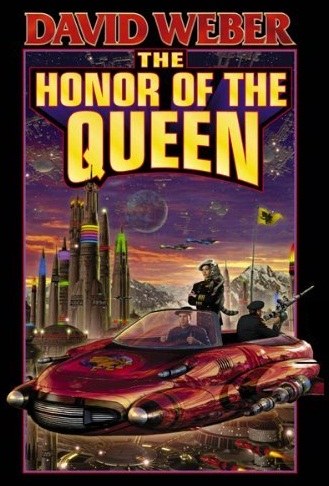 David Weber
David Weber’s book, The Honor of the Queen
What really struck me is that David Weber fairly presented firm believers as a spectrum. He showed that believers can be reasoned with and even persuaded to believe differently based upon evidence. Furthermore, he showed that even those who may line up on the side with which he disagrees [presumably–I don’t know where he stands on the issue] are not all (or even mostly) blinded by faith or foolishness. Rather, although there are some truly evil and disillusioned people, Weber shows that many are capable of changing their position or at least acknowledging that rival views are worth consideration.
The most vivid portrayal of this theme is found in a conversation between Admiral Courvosier and Admiral Yakanov. Courvosier is from the same nation as Honor Harrington and wholly endorses his female officer in a position of command. They discuss Captain Honor Harrington:
[Yanakov responds to Courvosier’s question about his society’s reaction to Honor]: “If Captain Harrington is as outstanding an officer as you believe–asI believe–she invalidates all our concepts of womanhood. She means we’re wrong, that our religion is wrong. She means we’ve spent nine centuries being wrong… I think we can admit our error, in time. Not easily… but I believe we can do it.”
“Yet if we do[” Yanakov continues, “]what happens to Grayson [their world]? You’ve met two of my wives. I love all three of them dearly… but your Captain Harrington, just by existing, tells me I’ve made them less than they could have been… Less capable of her independence, her ability to accept responsibility and risk… How do I know where my doubts over their capability stop being genuine love and concern?”
The exchange is characteristic of the way Grayson’s people are treated throughout the book. They are real people, capable of interacting with other views in honest ways. They feel challenged by a view contrary to their own. Some react poorly, and there are extremists who are blinded by hatred and anger. Yet all of them are treated as people with real concerns shaped by their upbringing and backgrounds.
Honor Harrington ends up saving Grayson, and at the end of the book, she is commended by the rulers of that planet. She talks to the “Protector” [read: king/president]:
“You see,” [said the Protector] “we need you.”
“Need me, Sir?” [Responded Honor]
“Yes, Grayson faces tremendous changes… You’ll be the first woman in our history to hold land… and we need you as a model–and a challenge–as we bring our women fully into our society.”
Weber thus allows for even ardent supporters of specific religious backgrounds to respond to reasoned argument and to change. They are capable of interacting on a human level and deserve every bit of respect as those who disagree with them. Again, there are those who are radicals and will not be reasoned with, but they are the minority and they do not win out.
Weber therefore presents religious dialogue in The Honor of the Queen as a genuine interaction between real people from differing backgrounds. Those who are “fundamentalist” are capable of changing their views when challenged with a rival view which out-reasons their own. Religious dialogue is possible and fruitful.
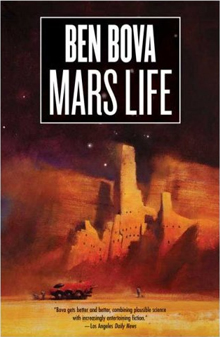 Ben Bova
Ben Bova’s whole “Grand Tour” series has a number of dealings with “fundamentalists.” He never really defines the term to be specifically Christian but one can tell when reading the books that it is pretty clear he is referencing hardcore fundamentalist evangelical Christianity.
I recently finished reading Mars Life
Bova’s treatment of extremist positions in religion is somewhat disingenuous in my opinion, particularly when one compares his portrayal with that of Weber. Bova tends to illustrate religious fundamentalists as a black and white issue. Basically, if you are a hardcore believer, you’re in it for power and control, you are willing to incite violence to achieve your ends, and you are incapable of reasoning. Again, note the contrasts with Weber’s depiction above. A few examples will help to draw this out.
On page 142 and following there is a discussion about putting together a panel to discuss the finding of a fossil on Mars. The interaction shows that no matter what, fundamentalists cannot accept scientific findings:
“Look,” said the bureau chief… “everybody’s calling it a fossil…. …”Call it an alleged fossil, then,” insisted the consultant (from the fundamentalists)… [The group then continues to suggest terms for the fossil:] “A probable fossil?” …”A possible fossil”… [Then, finally] “Say that the scientists believe it’s a fossil and until proven otherwise that’s what we’re going to call it.”
Here one can see that fundamentalism is intrinsically tied to an anti-science mentality. The key for them is to use words which deny absolutes, essentially skirting issues rather than discussing the truth. But that’s not all there is to it. Later on, one of the fundamentalists is engaged in a discussion about “requesting” that some lyrics in music they view as morally reprehensible be changed. The musician flat out refuses, angering the fundamentalist in the process. The section closes as follows:
[The musician] was shot to death at a Dog Dirt concert three months later. His killer surrendered easily to the police, smilingly explaining that he was doing God’s work.
What is interesting about this example is that it is illustrative of a number of such examples throughout the book. These are completely unrelated to the main plot. Rather, it seems what Bova is doing is very explicitly showing that fundamentalists are unafraid to use immoral tactics, censoring, and even incite violence in order to get their way. Theirs is an unquestioned and unquestionable faith. Those in power in fundamentalism are inherently evil and devious. They only want to control. Again, these asides are in no way tied to the plot of the book. It’s almost as though Bova is preaching a different worldview, one which views religiosity as inherently dangerous and violent, with few exceptions.
There is one positive example, however. A Roman Catholic, Monsignor Fulvio DiNardo, who is also a world-renowned geologist decides he wants to go to Mars to find the answer to a question about faith which is pressing on him. Namely, why God would exterminate an entire intelligent species. His thread in the story seems to show two things: first, that fundamentalism is inherently incapable of responding to reason; second, that it is possible to have reasoned faith and science together. The second point is illustrated very well when DiNardo is finally on Mars. He suffers from a likely stroke and is dying and begins a dialog with God:
Why did you kill them, Lord? They were intelligent. They must have worshipped You in some form or other. Why kill them? How could you–
And then DiNardo understood. Like a calming wave of love and peace, comprehension flowed through his soul at last… God had taken the Martians to Him! Of course. It was so simple, so pure. I should have seen it earlier. I should have known. My faith should have revealed the truth to me.
The good Lord took the Martians to Him. He ended their trial of tears in this world and brought them to eternal paradise. They must have fulfilled their mission. They must have shown their Creator the love and faith that He demands from us all. So He gave them their eternal reward…
The light was getting so bright… Glaring. Brilliant… Like staring into the sun. Like looking upon the face of… (297-298)
So Bova does offer a counterbalance to fundamentalism, and I appreciate that portrayal. Although DiNardo’s death and his revelation receives very little further comment (and no further comment at all on the revelation), it seems as though it is positively portrayed.
A reason for criticism is that Bova is uncompromising with fundamentalists. I’ve already drawn out his portrayal of them, and it seems to me to be a bit disingenuous. Although there are plenty on the “religious right” who would be all too happy to be able to legislate all morality, control the media, and deny well-attested scientific findings, I have hardly found that to be the majority. And certainly, fundamentalism is not a homogeneous entity filled with people who are trying to control everyone else. I’ll grant that this is a work of fiction, but in light of how Weber was able to handle a fairly similar issue with respectful portrayals of the ‘other side,’ I had hoped for more from Bova, whose work I enjoy greatly. For Bova, it seems, religious dialogue is not a real possibility, with few exceptions. Fundamentalists are incapable of reasoning and are barely even convinced believers; rather they are using their positions of authority within their organizations to consolidate power and execute their own prerogatives on their witless followers.
Fair Discussion
It seems pretty clear to me that David Weber provided a better model for utilizing science fiction in religious dialogue than Ben Bova did. The people representing the ‘bad guys’ in Weber’s book did have some who were truly evil and/or beyond reason, but also had many with whom reason resonated. When confronted with rival views, they were thoughtful and even receptive. On the other hand, the characters with whom Bova disagreed were a true black/white dichotomy with the “good guys.” Fundamentalists were bad. Period. He portrayed them as power-hungry, censor-happy maniacs. Although there was one notable exception (the Catholic priest, DiNardo), who showed a bright spot for “believers” at large, he was by far the exception.
It seems clear this study has applications for real-world dialogue about religion. When we interact with other worldviews, we should be capable of treating the other side with the same kind of dignity we would like to be treated. Although other worldviews may have their extremists who will not respond to reason, our attitude should be that of the humble friend trying to explore the beliefs of the “other.” The “other” is not that which must be demonized, but rather understood and with which to interact.
More Reading
I explore the theological implications of life on other planets.
I discuss a book which will change the way you think about about the notion that religion is violent. It also deals with the notion of the religious “other” as a construct.- William Cavanaugh’s The Myth of Religious Violence.
Sources
Ben Bova, Mars Life
David Weber, The Honor of the Queen
SDG.
——
The preceding post is the property of J.W. Wartick (apart from citations, which are the property of their respective owners, and works of art as credited) and should not be reproduced in part or in whole without the expressed consent of the author. All content on this site is the property of J.W. Wartick and is made available for individual and personal usage. If you cite from these documents, whether for personal or professional purposes, please give appropriate citation with both the name of the author (J.W. Wartick) and a link to the original URL. If you’d like to repost a post, you may do so, provided you show less than half of the original post on your own site and link to the original post for the rest. You must also appropriately cite the post as noted above. This blog is protected by Creative Commons licensing. By viewing any part of this site, you are agreeing to this usage policy.

 J.W. Wartick - Reconstructing Faith