philosophy of religion
“Interstellar”- A Christian Perspective on the Film
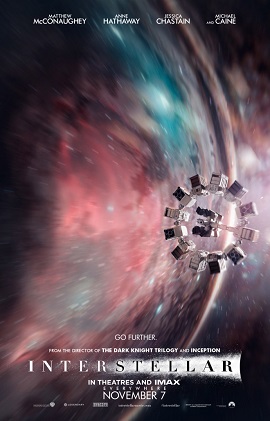 “Interstellar” is the latest from the acclaimed Christopher Nolan. A sprawling epic, it delves into some of the deepest questions we face. Here, I will reflect on the film from a worldview perspective. There will be SPOILERS for the movie in what follows.
A Crisis
Humanity must face the slow creep of possible starvation and suffocation on the Earth of “Interstellar.” The “blight” is impacting crops and has caused the death of 6 billion people. It is unclear as to what this “blight” is but it clearly means that humans will not survive if it continues. The question is of our mortality, and although it never becomes explicit, it seems that “blight” could be some kind of analogy for climate change and the problems we may bring upon ourselves.
But humanity’s crisis is not merely mortal; it is also moral. A few hints are offered of this, but the most poignant is when Dr. Amelia Brand spoke to Cooper about how evil does not exist in the places humans are going (at times one-by-one) to explore. She argued that nature itself is not evil; morality is a transcendent concept. The way that it is transcendent is unexplained.
Another aspect of the crisis is epistemological–as the crisis continues, people have rewritten history in order to avoid glorifying space travel. Cooper struggles to form concepts of seemingly transcendent ideas in a universe that he strongly believes is entirely explicable based upon science. The questions these ideas bring up should be clear: how do we know anything?
We’re So Tiny
I watched “Interstellar” in IMAX, and one of the most beautiful scenes was when the Endurance was shown against the backdrop of Saturn. It was a mere speck–a speck of a speck. It poignantly drove home a point that was found throughout the movie: We are tiny. But this message was not found alone; instead, it was juxtaposed against the continued focus on humanity and our struggles to survive in the universe. In a way, though we’re tiny, in “Interstellar,” we’re what is important. Humanity is what it’s all about. Or is it? It seems that the question is ultimately left open; perhaps there is transcendence beyond us. Our (minuscule) place in the universe may point beyond it.
Who Helps Us?
The question is another which is found through the film. Where did the wormhole come from? Cooper assumes that it is from a future humanity–we save ourselves!–but reflection seems to show this cannot be the case. After all, if the wormhole were not there, humans would have had no way of surviving; no future. Perhaps Dr. Brand is closer to the truth, because she argues that love is a transcendent concept which goes beyond space and time. It cannot be fully explained by our calculations.
The film never goes beyond this kind of stirring question, and Cooper’s assumptions are offered as one possible explanation for many questions: perhaps humans do rule all, and perhaps they are the end-all. But realistically, the ultimate questions of morality, the origin and power of love, and some others remain unanswered. I think that’s certainly intentional–it allows viewers to form their own conclusions–but the reality of the situation is that Cooper’s purely scientistic worldview (his notion that science is ultimately the only possible explanation) find itself inadequate to explain reality.
Conclusion
Some have argued that “Interstellar” is merely a secular humanist manifesto, but it seems to me the story is much deeper than that. I have argued above it leaves open several questions about the nature of humanity, our crisis, and the transcendent. Whatever else is said about the film, it is one that will start conversations and one with which, I would argue, Christians need to be conversant. It’s a fabulous space epic that is a must-see.
What are your thoughts? Share your own perspectives in the comments.
The image used in this post is from an official movie poster. I claim no rights to it and use it under fair use.
Links
Be sure to check out the page for this site on Facebook and Twitter for discussion of posts, links to other pages of interest, random talk about theology/philosophy/apologetics/movies and more!
Movies– Read other posts on this site about movies written from a worldview perspective. (Scroll down for more.)
Like sci-fi movies? Read about another one I really enjoyed in my look at “Edge of Tomorrow.”
SDG.
The image used in this post was a movie poster and used under fair use. I make no claims to the rights for the image.
——
The preceding post is the property of J.W. Wartick (apart from quotations, which are the property of their respective owners, and works of art as credited; images are often freely available to the public and J.W. Wartick makes no claims of owning rights to the images unless he makes that explicit) and should not be reproduced in part or in whole without the expressed consent of the author. All content on this site is the property of J.W. Wartick and is made available for individual and personal usage. If you cite from these documents, whether for personal or professional purposes, please give appropriate citation with both the name of the author (J.W. Wartick) and a link to the original URL. If you’d like to repost a post, you may do so, provided you show less than half of the original post on your own site and link to the original post for the rest. You must also appropriately cite the post as noted above. This blog is protected by Creative Commons licensing. By viewing any part of this site, you are agreeing to this usage policy.
Book Review: “Pascal’s Wager” by Jeff Jordan
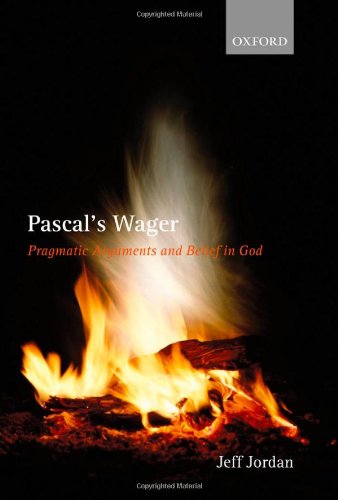
For some time, I’d been wanting to put some effort into studying Pascal’s Wager. I picked up Pascal’s Wager: Pragmatic Arguments and Belief in God by Jeff Jordan in order to familiarize myself more with the philosophical grounding behind the argument. Jordan approaches the Wager through a lens of analytic philosophy and, I think, demonstrates that the argument has some force to it.
Jordan’s work has great scope. Several aspects of the Wager are brought to light. He analyzes several different formulations of the argument, while also noting where the argument has been changed or modernized. For example, the notion that Pascal’s Wager was infinite bad vs. infinite good is a more recent innovation than Pascal’s original argument.
He studies the argument contextually to determine whether the Wager was intended as a generalized theistic proof or an argument for Christianity. Numerous objections from leading critics of the Wager are put to the test. Ultimately, a version of the Wager developed by William James is put forward as an argument that passes the philosophical muster. Jordan analyzes this argument from many angles, ultimately demonstrating that it overcomes the challenge of the “many gods” objection and provides grounds for Christian faith.
The value of Pascal’s Wager may is increased by the fact that many aspects of Jordan’s work are applicable to other arguments or areas of interest for philosophers of religion and apologists. For example, Jordan raises significant challenges to the notion that philosopher’s fictional deities may actually be counted as evidence for a “many gods” objection (75-76; 80-81). Another example is a rather interesting argument he derives from the work of James Beattie (1735-1803- Jordan notes Beattie is at times rightly accused of misrepresenting Hume’s arguments) about whether attempts to deconvert might bring about pragmatic wrongs (190-194). These and other tantalizing topics command even more interest than the book might otherwise have had.
Simply put, Pascal’s Wager: Pragmatic Arguments and Belief in God is a phenomenal, thought-provoking work that will have readers rethinking their evaluation not only of the (in)famous Wager but also of a number of related topics. Even at its steep price tag, the book is a bargain.
Links
Be sure to check out the page for this site on Facebook and Twitter for discussion of posts, links to other pages of interest, random talk about theology/philosophy/apologetics/movies and more!
Pascal’s Wager: The Utility Argument Examined– I outline and defend one of the versions of Pascal’s Wager which Jordan brings up in this work. I find it to be a very interesting argument and a great addition to the apologist’s toolkit.
Source
Jeff Jordan, Pascal’s Wager: Pragmatic Arguments and Belief in God
SDG.
——
The preceding post is the property of J.W. Wartick (apart from quotations, which are the property of their respective owners, and works of art as credited; images are often freely available to the public and J.W. Wartick makes no claims of owning rights to the images unless he makes that explicit) and should not be reproduced in part or in whole without the expressed consent of the author. All content on this site is the property of J.W. Wartick and is made available for individual and personal usage. If you cite from these documents, whether for personal or professional purposes, please give appropriate citation with both the name of the author (J.W. Wartick) and a link to the original URL. If you’d like to repost a post, you may do so, provided you show less than half of the original post on your own site and link to the original post for the rest. You must also appropriately cite the post as noted above. This blog is protected by Creative Commons licensing. By viewing any part of this site, you are agreeing to this usage policy.
A God Who Risks… too much?- A Difficult Dilemma for Open Theists
 Open theism is, briefly, the notion that God does not comprehensively know the future [edit: strictly speaking, the view is that there is no settled “future” to know to begin with, so it is not a lack of knowledge but rather the absence of such a thing as a future that will occur; see next sentence and thanks for a clarifying comment below]. The future, it is held, is in some sense “open” because it is undetermined, even for God. Most frequently, this claim is put forth in terms of denial of knowledge of free creaturely action. Representative is the claim of John Sanders:
God cannot know as definite what we will do unless he destroys the very freedom he granted us… The future is not completely fixed, but open, to what both God and humans decide to do, so there are numerous possible futures (not just one). God knows as possibilities and probabilities those events which might happen in the future. (Sanders, 206, cited below)
Thus, it is fairly central to the open theistic perspective that God does not (and indeed cannot) know the future exhaustively, and the parts God does not know exhaustively are such because free will is involved. For the open theist, then, the proposition: ‘God does not know the future free actions of creatures with certainty’ is true. Gregory Boyd, another prominent open theist, puts it this way: “open theists hold that if God is omniscient… and if the future is in fact partly comprised of ontological possibilities, then God must know the future as partly comprised of such possibilities” (Boyd, 195, cited below).
Because of this, we may fairly state the open theistic perspective as holding the following proposition to be true: “God does not know [future] counterfactuals of creaturely freedom [CCF].”
The Dilemma
I propose that open theism, because of its commitment to denial that God knows the future free actions of agents, raises an enormously difficult dilemma for those who hold to the position:
Either God possibly created knowing that it was possible no one would be saved or at least one counterfactual is true.
The dilemma draws its strength from propositions open theists, by their own writings, accept. Open theists, as demonstrated above, deny that God knows CCF. Thus, the following statement is unknown to God according to open theism:
If I (God) create the universe, at least one free creature will be saved.
Open theists must deny this statement as being known by God in order to maintain their stance that God cannot know the future free actions of creatures. But denying this counterfactual is theologically very problematic, because it means that the God who risks (to use John Sanders’ terminology) effectually risked so much that God decided to create a universe populated by moral agents without so much knowing that even one of these agents would be saved. Sure, one of the possibilities was probably that all such moral beings would be saved, but another possibility is that all moral beings would be damned. On open theism, God just didn’t know.
Now it could be that God was 99.999999999(repeating)% sure that at least one agent would be saved, but according to open theism, God could not know. I would suggest that any theological system which seriously puts forth the notion that God would create without knowing that at least one being would be saved is a theological system that cannot maintain the moral benevolence of deity.
The second part of the dilemma is also a serious problem for the open theist. Suppose the open theist embraces this part and counters “Very well, then God knew that at least one being would be saved.” But of course this would have been a CCF when God chose to create. Thus, the open theist would be forced to accept that at least one of these future counterfactuals is true. But if one is true, what possible grounds could there be for denying that others are true as well? It seems the open theist would either have to accept that CCF can be known without restraint (and therefore overthrow the philosophical framework of open theism) or simply engage in special pleading for those CCFs that must be maintained in order to not impugn the moral character of God.
Counter Arguments
Character Settled?
Greg Boyd has argued that free agents may have settled characters such that free will may not be a consideration (for the sake of space I’ve greatly summarized here; see Boyd 193-194 for one example). Perhaps at least one creature could have a settled will such that they are saved and thus God could know their salvific status without threatening to know CCFs. My response to this would be to note the highly controversial nature of this argument on a number of levels: 1) it suggests that humans are capable of, by their own free will, coming to such a point that they change their will into a form that will, with certainly, act according to God’s will, which is objectionable on a number of Scriptural grounds; 2) it holds to a view of human nature that both affirms and denies compatibilism; 3) the possibility of a “settled will” is difficult to establish or define; etc.
CCFs not Denied
Perhaps the open theist could respond by arguing that open theism need not deny that God knows CCFs. I do not think this would be possible while still maintaining open theism because it would mean God knows comprehensively the future including my future free actions.
God’s Character not Impugned?
Perhaps the most fruitful counter for the open theist would be to deny that God’s moral character is impugned by creating without knowing that at least one person would be saved. Perhaps such an activity is merely morally neutral, or God’s other reasons for creating could overcome the difficulty.
I think this is, as I said, the best avenue for open theists to pursue, but on reflection I think that the real possibility that God would create in such a way as to not know that the moral agents God brought into being would be saved–that they all might be damned despite that not being God’s intent–is extremely problematic.
Conclusion
I believe that the dilemma offered above is, frankly, lethal to open theism. I have read several works by leading proponents of open theism and think that many arguments against the same are off the mark because they often do not hit on the points open theists actually hold. Here, however, I have presented an argument derived from the core of open theistic thought. Thus, I believe that open theism is untenable. It either impugns God’s character or is self-referentially incoherent.
Links
Be sure to check out the page for this site on Facebook and Twitter for discussion of posts, links to other pages of interest, random talk about theology/philosophy/apologetics/movies and more!
The Consolation of Counterfactuals: The Molinism of Boethius– Boethius was an early Christian thinker who thought of a very insightful way to discuss counterfactuals of freedom.
Is God Just Lucky?: Possible Worlds and God’s Providence, a Defense of Molinism– I examine the set of possible worlds from a molinistic perspective.
The New Defenders of Molinism: Reconciling God’s Foreknowledge and Our Free Will– I present a general case for molinism, analyzing various positions and concluding that God does know what we will do without predetermining it.
Sources
John Sanders, The God Who Risks (Downers Grove, IL: InterVarsity, 2007).
Gregory Boyd “God Limits His Control” in Four Views on Divine Providence edited Gundry and Jowers (Grand Rapids, MI: Zondervan, 2011).
SDG.
——
The preceding post is the property of J.W. Wartick (apart from quotations, which are the property of their respective owners, and works of art as credited; images are often freely available to the public and J.W. Wartick makes no claims of owning rights to the images unless he makes that explicit) and should not be reproduced in part or in whole without the expressed consent of the author. All content on this site is the property of J.W. Wartick and is made available for individual and personal usage. If you cite from these documents, whether for personal or professional purposes, please give appropriate citation with both the name of the author (J.W. Wartick) and a link to the original URL. If you’d like to repost a post, you may do so, provided you show less than half of the original post on your own site and link to the original post for the rest. You must also appropriately cite the post as noted above. This blog is protected by Creative Commons licensing. By viewing any part of this site, you are agreeing to this usage policy.
Move Over, Kalam, Here is the best argument for theism
 Yeah, I said it. The Kalam Cosmological Argument is in vogue, and for good reason. It’s an extremely powerful argument for the existence of God, the first Cause. Nothing I say here should be taken as a condemnation of the Kalam. However, I don’t think it is the most powerful argument for theism. In fact, I don’t think it’s even close. The Argument from Religious Experience wins that prize, and it is a landslide.
Is it so powerful?
The obvious question is this: what makes the Argument from Religious Experience (hereafter ARE) so powerful? Here are just a few reasons:
1. The ARE is malleable and may be used as an argument for a) merely the existence of the transcendent–anything beyond the physical world; b) theism specifically c) Christianity specifically.
2. The ARE does not rely upon anything more than things we already do in everyday life, such as trusting that people are reporting the truth.
3. The ARE has evidence backed from millions of persons across the world and time.
4. It is possible, though not at all certain, to have personal confirmation of the ARE.
Why Not ARE?
Okay, well if it’s so strong, why don’t more apologists use the argument? There are a number of reasons, and some are basic: they haven’t read about the argument in much popular apologetic literature and so are unfamiliar with the argument, they know of it but are unsure of how to formulate it in a helpful way, or they simply haven’t thought about how powerful the argument is. Another reason may be (as I suggested elsewhere) that apologists prefer arguments that are useful in debate formats.
To be honest, though, I think the primary reason is because the ARE has almost an inherent strangeness to it. There is a kind of spiritualism about the argument itself which might turn off apologists who would prefer a purely deductive argument. If one wants to talk about a religious “experience,” there is a kind of feeling to that phrase which an argument like the Kalam does not share. Just admitting that there is a category of religious experience itself admits to a kind of transcendence, and I think that apologists–I include myself in this category–are overly cautious about spirituality. So let’s get over it and start using this powerful argument, okay?
What is the ARE?
As I noted in point 1 in favor of the ARE’s strength above, the argument itself is malleable and may be formulated in different ways (for some examples, see my post on the usefulness of the argument). Here’s a way to formulate it to merely defend a transcendent reality:
1. Generally, when someone has an experience of something, they are within their rational limits to believe the experience is genuine.
2. Across all socio-historical contexts, people have had experiences they purport to be of a transcendent realm.*
3. Therefore, it is rational to believe there is a transcendent realm.
Just consider this for a second. The argument leaves a few spaces to fill in for the sake of making it deductively valid, but we’ll just look at how it stands now. Suppose that 2 is true. In that case, one who wants to deny the ARE’s strength would have to say that all of the experiences of these people have been in error. Frankly, when it comes down to it, that’s a pretty big claim, because reports of religious experience really do come from all times and places.
The argument, though, can be narrowed to defend theism specifically or even Christianity. For more on this, see my post talking about its strength as it narrows.
Now point 2 above suggested the ARE doesn’t rely on anything more than what we do in everyday life. I am speaking, of course, of the principle of credulity: the notion that when x appears to someone in way s, it is rational [barring some epistemic defeater]** to believe that x is s (or some other formulation). Moreover, we also trust the principle of testimony: when person x tells us that y occurred, it is prima facie rational to believe y. When you read a news story and someone says they saw a woman running from the scene of a crime, it is rational to believe them. Similarly, when millions say they have experienced a transcendent realm, prima facie it is rational to believe them.
 The Knock Down Objection?
The most common objection is the objection from competing religions. That is, if person x has an experience that purports to prove Christianity, and person y has an experience of the truth of Buddhism, what then? Often it is suggested that x and y’s testimony would just cancel each other out. But of course that’s not the case in any other area of experience. If I am a witness in court testifying about a murder, and I say I saw a tall dark male commit the crime, while another witness says they saw a short pale male, does each testimony cancel the other? Well, suppose the criminal was of average male height and fairly tan. To me, a short very pale man, he would appear tall and dark. To someone who is taller than I and of darker skin, the person would appear short and pale.
The point is that even with religious experience, different facets may be recognized even were the experience the same. Now much more nuance needs to go into this argument, but I think cogent answers have been provided in the relevant literature. The point is that even the most common and strongest objection to the ARE really isn’t that powerful in the end, particularly when weighed against the cumulative force of religious experience.
Conclusion
I readily admit this post has only very briefly touched on issues which could each take entire volumes to discuss. There is so much more to consider, and so many avenues to explore, but I think my overall point stands: The ARE is the strongest argument for theism. Fellow apologists, I suggest you research the argument (see the suggested reading list at the end of this post and also check out my other posts below) and use it! Let’s integrate it into our defense of the faith. Let me know your own thoughts below.
Links
Be sure to check out the page for this site on Facebook and Twitter for discussion of posts, links to other pages of interest, random talk about theology/philosophy/apologetics/movies and more!
The Argument from Religious Experience: Some thoughts on method and usefulness– a post which puts forward an easy-to-use version of the ARE and discusses its importance in apologetic endeavors.
The Argument from Religious Experience: A look at its strength– I evaluate the different ways the ARE may be presented and discuss how strong the argument may be considered across different formulations.
The image above to the left was a photo taken by me and I claim all rights noted below. The image to the right is from Wiki Commons.
*[thanks to a commentator for correcting this error- see comments]
**In the interest of shortening this post, I glossed over tightening of the principle of credulity and have added this clause to make it more clear.
SDG.
——
The preceding post is the property of J.W. Wartick (apart from quotations, which are the property of their respective owners, and works of art as credited; images are often freely available to the public and J.W. Wartick makes no claims of owning rights to the images unless he makes that explicit) and should not be reproduced in part or in whole without the expressed consent of the author. All content on this site is the property of J.W. Wartick and is made available for individual and personal usage. If you cite from these documents, whether for personal or professional purposes, please give appropriate citation with both the name of the author (J.W. Wartick) and a link to the original URL. If you’d like to repost a post, you may do so, provided you show less than half of the original post on your own site and link to the original post for the rest. You must also appropriately cite the post as noted above. This blog is protected by Creative Commons licensing. By viewing any part of this site, you are agreeing to this usage policy.
Question of the Week: Wagering much?
Each Week on Saturday, I’ll be asking a “Question of the Week.” I’d love your input and discussion! Ask a good question in the comments and it may show up as the next week’s question! I may answer the questions in the comments myself.
Wagering much?
Okay, the title may be a little deceptive. I’m talking about Pascal’s Wager! I recently finished Pascal’s Wager: Pragmatic Arguments and Belief in God by Jeff Jordan (and loved it- posts coming… eventually). That got me thinking quite a bit on Pascal’s Wager, of course! It also made me wonder why I haven’t really heard much about it in apologetic circles. Thus, the question:
What do you think of Pascal’s Wager as an argument for Christian theism (or bare theism)? Why? How much have you studied it?
I am, of course, a bit biased having just read a book I thought was phenomenal arguing that the argument is sound. Let’s hear what you have to think in the comments! I might chime in as well!
Links
Be sure to check out the page for this site on Facebook and Twitter for discussion of posts, links to other pages of interest, random talk about theology/philosophy/apologetics/movies and more.
Question of the Week– Check out other questions and give me some answers!
SDG.
Does good always eliminate evil?
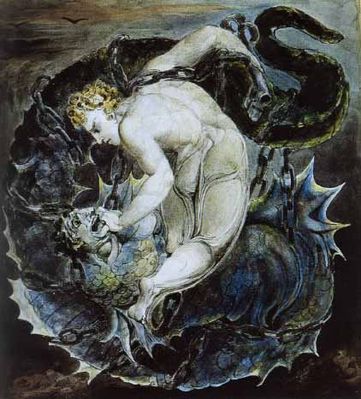 One of the key components of the composition of the problem of evil (at least its logical variety)* is the notion that good will eliminate evil. The late J.L. Mackie put it this way:
A wholly good omnipotent being would eliminate evil completely; if there really are evils, then there cannot be any such being. (Mackie, 150, cited below)
Simply put, this statement and any like it seem fairly obviously false if made without any rather major qualifications. After all, it seems clear that the total elimination of evil is not actually a logically necessary end for a good being, even an all-good, all-powerful being.
C. Stephen Evans presented a case to show that Mackie’s statement (and those like it) are simply mistaken. He noted that the principle that good must eliminate evil seems to be blatantly false without a number of qualifications. He argued that there are some evils which good beings will allow in order to bring about a greater good. The analogy he used was that of parents not allowing their children to ride in automobiles. After all, this would ensure that they would never be involved in the evil of a car crash, but surely it would also prevent greater goods of interaction with friends, learning to drive and the responsibility that comes with, and more (127). However, Evans was quick to note that a deity is by no means directly analogous to a human parent. The resources God would have to prevent evil are infinitely greater than that of a human parent.
In the case of God, however, God cannot bring about the logically impossible. Rather than going for a full-on theodicy (an account of why evils exist), Evans argued that certain goods are impossible to achieve without some evil. Thus, courage necessitates some kind of suffering (128). He did not argue that this notion alone provides a comprehensive theodicy; but for our purposes it is enough. It seems clear that the notion that good must eliminate evil is not only unsupported by argument (it is an a priori assumption), but also patently false. That is, we have evidence that at least some evil must be allowed in order for some good to be brought about.
I want to be clear about my thesis in this post: I am not claiming to have a comprehensive explanation for all evil everywhere. My claim is rather that good does not, by necessity, eliminate evil. That’s all. I believe that I have established this thesis. If so, then Mackie’s argument (and those like it) fail.
*The logical problem of evil is basically an argument that there is a contradiction in theistic belief related to God’s power and goodness and the existence of evil.
Links
Be sure to check out the page for this site on Facebook and Twitter for discussion of posts, links to other pages of interest, random talk about theology/philosophy/apologetics/movies and more!
Sources
C. Stephen Evans, Faith Beyond Reason: A Kierkegaardian Account (Reason & Religion)
J.L. Mackie, The Miracle of Theism (New York: Oxford, 1982).
SDG.
——
The preceding post is the property of J.W. Wartick (apart from quotations, which are the property of their respective owners, and works of art as credited; images are often freely available to the public and J.W. Wartick makes no claims of owning rights to the images unless he makes that explicit) and should not be reproduced in part or in whole without the expressed consent of the author. All content on this site is the property of J.W. Wartick and is made available for individual and personal usage. If you cite from these documents, whether for personal or professional purposes, please give appropriate citation with both the name of the author (J.W. Wartick) and a link to the original URL. If you’d like to repost a post, you may do so, provided you show less than half of the original post on your own site and link to the original post for the rest. You must also appropriately cite the post as noted above. This blog is protected by Creative Commons licensing. By viewing any part of this site, you are agreeing to this usage policy.
Book Review: “The Knower and the Known” by Stephen Parrish – Part 1
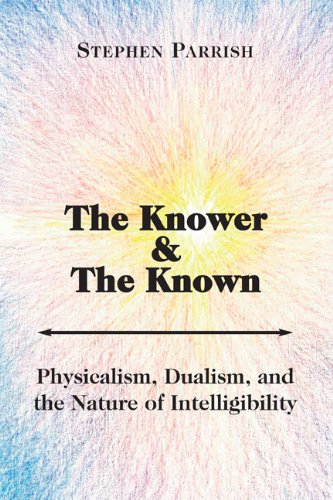 What is the mind? Are humans purely physical beings? What are we to make of physicalist/materialist philosophies of the mind? Do these debates have any relevance for the existence of God?
Stephen Parrish seeks to answer these questions (and more) in his work, The Knower and the Known
The work is split into two major sections. The first is an exploration of physicalist/materialist theories of mind; the second is an exploration of consciousness and how theism provides the best explanation for our phenomenal consciousness (among other things). We shall explore these in order. In this post, I shall focus upon Parrish’s critique of physicalism.
Physicalism
Parrish introduces the major physicalist theories related to the mind-body problem. These include reductionism, eliminativism, supervenience, and emergence. In order to make sense of the claim that the mind is a purely physical substance, it is important to come to an understanding of what it means to be “physical,” and Parrish cites numerous philosophers in order to come to a fairly simple working definition: “to be a material object (to be composed of matter) is ultimately to have certain kinds of causal power over certain areas” (69). The definition must, necessarily, be more complex. Thus, various aspects of dimension, space, and the like are explored. Then, KK provides an explanation of the standard materialist/physicalist view of reality, which is essentially that “everything that exists… can be located within space and time…” (85, Parrish’s definition cites that of C. Koons, and is also lengthier, but for the purpose of this review I have left it at this).
The nature of physicalism must also be understood in order to analyze the claims of physicalists. How is it, exactly, that the physical is to account for the mental? Parrish explores numerous ways proposed to explain physically the connection. These are centered around various proposed psycophysical laws, which hold that there are certain ways in which conscious states relate relation to other physical states. There have been many different proposals about how these laws might work.
According to the nomological theory, there is a lawlike correlation between conscious and other physical states. A nomological theorist would note the correlation between neurons firing in the brain and various mental states. The proposal would then lead to a law of correlation (and perhaps causation) for brain states b1, b2, and b3 with conscious states c1, c2, and c3. Parrish notes a number of problems with this theory, however. Most notably is the fact that there are sometimes different patterns of neurons firing for the same thought. Of course, a physicalist could counter that there are different laws for these different patterns as well. In that case, notes Parrish, “there would have to be laws to regulate the relation of every brain state with the relevant phenomenological aspect of thought to which it is correlated” (89-90). Of course, this becomes even more problematic when one considers that there is an infinite set of phenomenological aspects of our consciousness. That is, we can focus our minds around thinking of numbers and continue counting from one to a billion and beyond. For nomological theory to be correct, there must be a specific brain state for each of these thoughts (along with whatever different brain states would need to exist for the variations which can produce the same number). So there would then need to be an infinite set of laws to account for our mental life.
Yet there is another difficulty, for “since it seems possible for different types of brains to have the same conscious phenomenal thought, and every brain is constructed somewhat differently from every other brain, there would have to be even more laws that accounted for conscious items to accommodate all of the brain states of all the different brains” (90). To say that such a theory of mind begins to make a bloated metaphysics seems something of an understatement. And this is not to even begin to consider the possibility of other intelligent life in the universe, which would also need these lawlike relations for governing their conscious states.
And all of this is not to take into account the problems with explaining how and why there could be different patterns for the same thoughts not only across species but also across brains of the same species and also across individuals. A number of other possibilities are examined, including accidental correlation theory, realizability, and identity. Each of these comes with their own set of problems which Parrish elucidates (92-97).
Parrish throws the gauntlet at physicalist theories of mind in the chapter aptly titled “Judging Physicalist Theories of the Mind.” In this chapter, KK provides a thorough critique of all the major physicalist theories of mind. For the purpose of this review, I will only provide the briefest of summaries for each of these critiques. Mysterianism is essentially the notion that we cannot know how consciousness and the brain relate, but we do know that physicalism is true. The problem with this position is that such a position basically pushes the burden of proof unto other physicalist theories of mind as opposed to providing its own explanation, and the theory in fact seems to be just another form of epiphenomenalism.
Eliminativism is a simpler theory in which it is simply asserted that consciousness does not exist (133ff). Such a theory seems patently absurd on its face, yet some physicalist philosophers continue to maintain that despite any appearance to the contrary, “there are no conscious aspects, objects, properties, or events at all” (136). The difficulty with such a position is that it is “self-referentially incoherent” (137). That is, it cannot be consistently believed (whatever it means to “believe” something) that there are on mental state when, in order to have such a belief, one must have some sort of mental state. Parrish further offers a scenario to describe our world in terms of an eliminativist worldview, which would yield a kind of “zombie” world in which our fictional mental states have no relation to the world around us (149-150).
Identity theory basically asserts that consciousness just is identical to the brain. Much work must be done to analyze this theory by noting which theory of identity one might hold to, along with how such a theory of identity might play out. KK provides just such an exploration and comes to conclude that any of these identity theories falls to a number of objections, including the arbitrariness of the connection between the physical and the [identical] consciousness (162-163). Supervenience theory, which holds that somehow the mental supervenes upon the physical, suffers from providing no actual explanation for how this should be the case and thus basically devolves into one of the other physicalist theories.
Functionalism is the theory that “the conscious mind is the brain functioning in a certain manner” (171). Again, the difficulty here is that this seems to boil down largely into a bare assertion and how closely related to (and probably reliant upon) eliminativism it is.
Higher order theories of mind posit that consciousness is something like the brain scanning itself. However, this provides no explanation for how consciousness could arise and thus is again parasitic upon other varieties of physicalism, most notably eliminativism.
Epiphenomenalism is at the core of Parrish’s critique, for throughout the work he shows in numerous ways how the other physicalist theories of mind are ultimately mysterian or epiphenomenal in nature. Epiphenomenalism is basically the view that consciousness is causally inefficacious. Thus, it is the brain which “does the work” while consciousness is some kind of byproduct of brain activity. However, such a theory does not adequately explain how consciousness may itself arise, nor does it provide any attachment for our thoughts to reality. It thus suffers again from self-referential incoherence, for our mental states have no causal attachment to our brain states or reality. They are, again, merely “epiphenomena” which somehow are generated by our brains. If our mental states happen to line up with reality, that becomes a merely happy accident, for our mental states do not control our brain states but are rather generated by them. This is not to imply that mental states must control brain states to give rise to coherency, but rather to note that unless our mental states are causal in some sense, the very process of rational thought is illusory, for our prior mental states have no connection to our past mental states other than to be generated in a certain temporal order.
Conclusion
We have outlined Parrish’s critique of physicalism. Next week, we shall explore his defense of dualism and his case for theism from the nature of intelligibility. However, by way of conclusions for this section, it is important to note the insights which Parrish has offered in KK. The arguments he presented seem devastating to physicalism. In particular, the fact that so physicalist theories of mind all seem to either ultimately appeal to mystery or reduce consciousness beyond causal powers undermine the physicalists’ ability to explain reality sufficiently. If a worldview cannot even account for something as basic as our thoughts, such a deficiency seems to bode ill for the rest of that view. As noted, we shall note a powerful alternative which Parrish argues for in the latter part of the book, theistic substance dualism.
Parrish, of course, offers much more thorough critiques of every position listed here (along with many that were not included in this outline). The work is extremely important in not only its comprehensiveness but also its thoroughness for exploring theories of mind.
Stephen Parrish’s The Knower and the Known
Source
Stephen Parrish, The Knower and the Known
SDG.
——
The preceding post is the property of J.W. Wartick (apart from citations, which are the property of their respective owners, and works of art as credited) and should not be reproduced in part or in whole without the expressed consent of the author. All content on this site is the property of J.W. Wartick and is made available for individual and personal usage. If you cite from these documents, whether for personal or professional purposes, please give appropriate citation with both the name of the author (J.W. Wartick) and a link to the original URL. If you’d like to repost a post, you may do so, provided you show less than half of the original post on your own site and link to the original post for the rest. You must also appropriately cite the post as noted above. This blog is protected by Creative Commons licensing. By viewing any part of this site, you are agreeing to this usage policy.
Against Christian Materialism
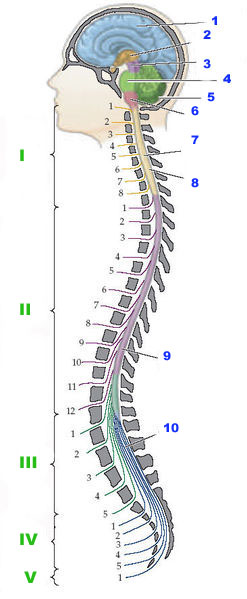 Is it possible for Christians to be materialists? A number of Christians say that yes, it is. Here, I will argue that the conjunction of Christianity and materialism is indefensible.
The Biblical Witness
Having read a bit on this topic, I realize that many who are Christian materialists do not think that the Biblical data is conclusive. However, granting that this is their position, I would maintain that the Biblical evidence is very strong: we are more than a material body. Here, I will examine only a small collection of texts.**
Matthew 10:28- “Do not be afraid of those who kill the body but cannot kill the soul. Rather, be afraid of the One who can destroy both soul and body in hell.” (NIV)
What does this text mean if the soul and the body are not different things which compose the human being?
Ecclesiastes 12:7- “and the dust returns to the ground it came from, and the spirit returns to God who gave it.” (NIV)
When we die, our bodies–made of dust–return to the earth, but our spirit returns to God. What does this mean on materialism? Which part of our material selves go to God?
Revelation 6:9- “When he opened the fifth seal, I saw under the altar the souls of those who had been slain because of the word of God and the testimony they had maintained.” (NIV)
The souls of those killed for their faith cry out for justice from under the altar. The objection may be made that this is apocalyptic language. In answer, I would simply point out that even then it makes no sense on materialism even in that context. What are the souls that are crying out in this vision? What is the referent for the alleged metaphor?
In Matthew 17:1-8, Jesus speaks with Moses and Elijah, who have died. Did God raise them bodily, and did they then die again immediately afterwards and decompose when they are no longer visible?
1 Peter 3:18-19- “For Christ also suffered once for sins, the righteous for the unrighteous, to bring you to God.He was put to death in the body but made alive in the Spirit. After being made alive, he went and made proclamation to the imprisoned spirits…”
What was Jesus proclaiming the Gospel to? What is imprisoned? Where are the physical/material bodies in this passage? (Note that in context it is talking about those alive in Noah’s day–so again, where did their bodies go?)
Verses like these could be multiplied continually. Perhaps more telling is that the reasoning I’m using here regarding the texts and the distinction between body and soul is similar to the arguments put forth to justify the Trinity. That is, texts which discuss the Father and Son as different entities or even have all three persons of the Trinity in the same context are used to demonstrate that there really are three distinct persons in the Godhead. Yet this is exactly the type of argument I am here making for body and soul. They are used too many places together to be the same thing.
It seems to me utterly clear from the Biblical text that human beings are not purely material entities. Again and again texts can be shown to refer to the body on the one hand and the soul on the other. This is not to say that humans are necessarily one or the other; instead, it is to point out that humans are (at least) body and soul. (I say “at least” because there is a long tradition of trichotomy in Christianity wherein people hold that humans are body, soul, and spirit. I remain neutral in that debate and here only wish to show that humans are not merely material entities.)
The Philosophical Debate
Suppose that one maintains that the Biblical evidence is inconclusive. What then? Could we then say that Christianity and materialism are compatible, for materialism is not explicitly ruled out by the text? Here, I will offer two arguments against these conjoined propositions.
Identity Through Time
How do we maintain identity through time? Here, the problem must be answered by all materialists, not just Christian materialists.
The problem is, of course, that our bodies don’t maintain physical identity. We are continually replacing the physical parts of our body over time. Now, I am hesitant to make the oft-repeated claim that our entire bodies are replaced every so many years, as I have been unable to find any research confirming it. However, it simply is the case that large portions of our body are replaced. Given this fact, how do we maintain identity? What is it that keeps us the same person over time?
Another major problem is this: to which part of our body are we identical? Or, to put it another way, which parts of our body do we need to keep in order to be the same person? Here we can appeal to a thought experiment. A mad scientist has us captured and he wants to see how long we can maintain identity. Slowly, he replaces each part of our body with a new one with the exact same DNA, structure, etc. As he replaces these parts, he discards the old ones and destroys them. He starts with the legs. Then he moves to the midsection, replacing one organ at a time. Then the heart, the arms, the ears, the eyes. When he gets to the brain, he goes through and replaces only single neurons at a time.
The question is pretty obvious: When do we stop being the same person? The materialist simply has to admit that we are our bodies (for what else could we be?). But given that fact, to which part are we identical? The brain? If so, at one point in the experiment do we cease to exist? 51% of our brain is gone? 70%? All but one neuron? So is our identity grounded in that one neuron? If so, which one? Or is it just grounded in having any one neuron as the same? If so, how?
Frankly, I think this problem is devastating for materialists, but especially those who are Christians. Why would it be more acute for Christians? Well…
 Is There Hope in the Resurrection?
Central to the Christian hope is the hope for a future resurrection. The question which must be asked is this: Is this hope grounded in reality?
Suppose materialism were true. If that is the case, then humans are identical with their bodies in some fashion. I am intentionally vague here because I admit I’m not convinced as to how identity works within a Christian view of materialism (see above). If this were the case, then when we die and our material body decomposes, it may go on to become all sorts of different things, which themselves later pass away (plants may grow from the nutrients broken down from the body; then those plants may be harvested and eaten by other humans/animals/etc, which then die and are broken down, etc.). In the resurrection, then, God creates our body anew, complete–I assume–with our memories, experiences, etc. built in (perhaps they are simply functions of our brain, which God recreated perfectly, which thus contains our experiences).
Is there actual hope on this scenario?
Suppose the mad scientist were to come and kidnap you. He gleefully announces that he is going to use you for excruciatingly painful experiments which will take place over several years until you die. But, do not worry, because once you die, he is going to create a new body which is an exactly perfect copy of you, which will of course have all your experiences (minus this torturous one) and memories in place, and then he is going to give you billions of dollars.* Would you be comforted by this scenario? After all, you’re not going to remember the pain and you are going to come out the other end extremely rich!
Well there is a problem: the new body is not you. It is just a copy. For any materialist, this is problematic. We seem to know that identity transcends the body. But let us not delve into that difficulty right now. Instead, we will focus on Christian materialism. Now, it seems to me that this problem is almost the same for the Christian materialist with the Resurrection. After all, we are going to die. But we are told, don’t worry, we will be raised bodily by God! But whose body is going to be raised? How will God gather the material from our body (and at which time of our body–see above) in order to recreate us? And will not this body purely be a copy, rather than actually us?
There is a real disconnect here. Christian materialism cannot offer us the hope of the resurrection, without which our faith is worthless (1 Corinthians 15). Instead, it offers us the hope for our future copies, which will themselves have our memories and experiences, but will not be us. Our bodies will die and distribute throughout various portions of the world (even the universe–who knows if an asteroid might hit and distribute the molecules which made up our body elsewhere?). Then God will create us again in some fashion, and that body will live on in the Kingdom. But that body is not us. It will be a new body. This isn’t begging the question, it is merely stating a fact. The body that will be raised is not the body I have now. Thus, if I am my body, I am not raised.
Interestingly, Peter van Inwagen, a Christian philosopher who is himself a materialist, concedes the point I made in this section. In order to escape this extreme problem for Christian theology, he comes up with a rather unique solution: “Perhaps at the moment of each man’s death, God removes each man’s corpse and replaces it with a simulacrum which is what is burned or rots. Or perhaps God is not quite so wholesale as this: perhaps he removes for ‘safekeeping’ only the ‘core person’–the brain and the central nervous system–or even some special part of it… I take it that this story shows that the resurrection is a feat an almighty being could accomplish. I think it is the only way such a being could accomplish it…” (Van Inwagen, 121, cited below).
What response can we have to this? Well surely, it is possible for God to do this, but it raises all kinds of speculation. First, what Biblical evidence do we have to support that our bodies or our brains/nervous systems are transported by God somewhere in order to preserve them? Honestly, I think that someone who posits this kind of miraculous working holds a burden of proof to support it. Second, where is this storage yard of brains/nervous systems? This question is not intended to beg the question. Instead, my intent is to point out that they would have to be somewhere in the physical universe. Thus, we should be able to find a planet where all the brains/central nervous systems of everyone who ever died are being stored. Third, given this, could we potentially destroy this planet and thus destroy all possibility of the resurrection? Fourth, other than as a completely ad hoc measure to preserve the possibility of hope, what possible justification (philosophical, theological, and/or Biblical) do we have for this?
On the whole, it seems to me that Peter van Inwagen’s proposed solution fails. It fails because it is extremely ad hoc and because it may not even solve the problem it is intended to solve. Thus, it seems to me that Christian materialism fails as a worldview.
Conclusion
I have offered several arguments against the conjunction of Christianity and materialism. I think any one of these arguments is successful on its own (I should note that I also think the argument from the ego is successful–I have argued here against atheistic materialism, but this argument would be equally successful against Christian materialism). If any one is successful, the conjunction of Christianity and materialism must be false. Frankly, I think all the arguments are successful. I leave the Christian materialist to justify their position.
Links
Like this page on Facebook: J.W. Wartick – “Always Have a Reason.”
If Materialism, are there Subjects?– I contend that a materialist worldview cannot account for subjects. This post was written specifically to address atheistic materialism, but is perfectly relevant for theistic materialism as well.
Sources
*I am indebted to Alvin Plantinga and Stephen Parrish for this type of argument.
**I am indebted to Kevin A. Lewis for his list of texts provided in his “Essentials of Christian Doctrine II” syllabus.
Peter van Inwagen “The Possibility of Resurrection,” International Journal for Philosophy of Religion, 9:2 (1978), 114ff.
SDG.
——
The preceding post is the property of J.W. Wartick (apart from citations, which are the property of their respective owners, and works of art as credited) and should not be reproduced in part or in whole without the expressed consent of the author. All content on this site is the property of J.W. Wartick and is made available for individual and personal usage. If you cite from these documents, whether for personal or professional purposes, please give appropriate citation with both the name of the author (J.W. Wartick) and a link to the original URL. If you’d like to repost a post, you may do so, provided you show less than half of the original post on your own site and link to the original post for the rest. You must also appropriately cite the post as noted above. This blog is protected by Creative Commons licensing. By viewing any part of this site, you are agreeing to this usage policy.
“How Much Evidence to Justify Religious Conversion?” – John Warwick Montgomery on Conversion
I had the opportunity to hear John Warwick Montgomery speak at the Evangelical Theological/Philosophical Conference in 2012. He was one of the most engaging speakers I have ever had the pleasure of listening to. Here, we’ll look at his presentation alongside the journal article that he discussed. The topic was “How Much Evidence to Justify Religious Conversion?”*
Conversion and Evidence
Montgomery began by discussing the possibility of a position which had so much evidence that it becomes difficult to not believe it. Despite this, people do not hold that position. The reason, he argued, is because reasons other than evidence play into one’s conversion. Moreover, we live in a pluralistic age, which means that there are a vast array of options available to people looking for a worldview. This pluralism necessitates a drop in conversion rates because there are more worldviews presenting their evidence to each individual. Thus, it is important to look into the issue of the burden of proof alongside the issue of the standard of proof.
Burden and Standard of Proof
Here, Montgomery turned to his experience in law to explore the notion. Simply put, the burden of proof can also be seen as the burden of persuasion . Montgomery noted that the prosecutor does not always carry the burden of proof because the defendant often provides a positive defense, and so has their own burden of proof. For example, if someone says “I could not have done x because I was doing y at the same time at location z” then they have made a positive claim which itself requires a burden of proof. Or, as Montgomery put it, “The person who wants to make a case has the burden of proof.”
But it is important to note that the burden of proof is not the same thing as a standard of proof. When people object to Christianity based upon a supposed lack of proof, they are not addressing the burden of proof but rather the standard. Montgomery acknowledged that Christianity must assume the burden of proof but makes several points related to the standard of proof.
First, proof “depends on probability–not on absolute certainty or on mere possibility” (Montgomery, 452, cited below). He appealed to the “Federal Rules of Evidence” to make this clear. The key is to note that probability ,not absolute certainty, is at stake. Why? Epistemologically speaking, absolute certainty can only be set out in formal logic or mathematics. It is unjustifiable to require absolute certainty for every fact. “Where matters of fact are concerned–as in legal disputes, but also in the religious assertions of historic Christianity–claims can be vindicated only by way of evidential probability” (Ibid).
Second, and more importantly for the current discussion, there are differing standards of proof. The legal system is again a model for this notion. In criminal trials, there is a higher standard of proof than for civil matters. The criminal standard is beyond reasonable doubt, while the civil standard is “preponderence of evidence.” Montgomery argued that religious conversion should be seen as bearing a standard of proof “beyond a reasonable doubt” (453).
Third, competing religious claims must each assume their own burden of proof. They cannot simply say “prove my religious claim false.” One must meet the standard of proof in order to have legitimate entry into the competition between worldviews.
Extraordinary Claims Need Extraordinary Evidence?
Often, the claim is made that religious claims, because they are extraordinary, need extraordinary evidence. I have written on this exact topic at length elsewhere, but here will focus on Montgomery’s argument. He argued “The notion that the ‘subject matter’ should be allowed to cause a relaxation or an augmentation of the standard of proof is a very dangerous idea…. No one would rationally agree to a sliding evidence scale dependent on the monetary sum involved [in a crime]–nor should such a scale be created… The application to religious arguments based on the factuality of historical events should be obvious. Of course, the resurrection of Christ is of immensely more significance than Caesar’s crossing of the Rubicon, but the standards required to show that the one occurred are no different from those employed in establishing the other” (Ibid, 455-456).
The notion that the import of a claim makes a sliding scale of evidence is made to be absurd because historical events have more importance across cultures and so would, on such a view, be radically different in their acceptable standards of proof.
The Existential Factor
Finally, Montgomery focused on the existential side of conversion. Here, he offered what he admitted as a somewhat crude argument which was derived from Pascal’s wager. Assuming that the standard of proof is met for a religious system, one still must deal with the existential factors of conversion. Thus, Montgomery argued, one’s commitment to a truth claim should be weighed by the benefits divided by the entrance requirements: C=B/E.
Because the entrance requirements for Christianity are extremely low, and its benefits infinite, one should, assuming the standard of proof has been met, be highly committed to Christianity. Montgomery noted that some may argue the entrance requirements are very high (i.e. setting aside adulterous relationships). Against this, Montgomery argued that the benefits vastly outweigh the finite bliss one feels by such sinful actions.

Applications
The subtlety of Montgomery’s argument should not be missed. It has application in a number of areas. First, Montgomery is as thoroughgoing an evidentialist as they come. His argument about the standard of proof being probabilistic is unlikely to gain much credence among those who favor a presuppositional approach to apologetics.
Yet it seems to me that Montgomery’s argument in this regard is correct. We must take into account the evidence when we are looking at various religious claims, and also acknowledge the existential factors which play into conversion.
Montgomery’s argument does much to clarify the issue for apologists in general. Our task is to clear barriers and present convincing evidence to those who argue that Christianity has not met the standard of proof. But our task does not end with that; we must also present the existential challenge of Christianity to those who believe the standard of proof has been met. This includes the preaching of the Gospel.
Montgomery was also careful not to discount the Holy Spirit in religious conversion. He made it clear that he was speaking to the notion of conversion in the abstract. People must be renewed by the Holy Spirit; yet that renewal may come through evidence and standard of proof.
It seems to me that Montgomery’s arguments were insightful and sound. He presented an excellent way to look at religious claims and evaluate them in light of evidence, while also taking existential factors into account.
Links
Like this page on Facebook: J.W. Wartick – “Always Have a Reason”
Montgomery’s use of evidence in law to look at religious truth claims reminds me very much of J. Warner Wallace’s Cold Case Christianity. Check out my review of that fantastic book.
Extraordinary Claims need… what, exactly?– I argue that the claim that religious claims need extraordinary evidence is mistaken.
I have written about numerous other talks at the EPS Conference on an array of topics. Check them out:
Gregg Davidson vs. Andrew Snelling on the Age of the Earth– I write about a debate I attended on the age of the earth.
Caring for Creation: A dialogue among evangelicals– I discuss a lecture and panel discussion on caring for the environment.
Genetics and Bioethics: Enhancement or Therapy?– Here, I outline a fascinating talk I attended about gene enhancement and gene therapy.
You can read my overview of every single talk I attended: My Trip to the Evangelical Philosophical/Theological Society Conference 2012.
Sources
*Unless otherwise noted, the information herein was discussed in John Warwick Montgomery’s EPS 2012 Conference talk entitled “How Much Evidence to Justify Religious Conversion? Some Thoughts on Burden and Standard of Proof vis-a-vis Christian Commitment”
John Warwick Montgomery, “How Much Evidence to Justify Religious Conversion?” in Philosophia Christi 13, #1 2011, 449-460.
SDG.
——
The preceding post is the property of J.W. Wartick (apart from citations, which are the property of their respective owners, and works of art as credited) and should not be reproduced in part or in whole without the expressed consent of the author. All content on this site is the property of J.W. Wartick and is made available for individual and personal usage. If you cite from these documents, whether for personal or professional purposes, please give appropriate citation with both the name of the author (J.W. Wartick) and a link to the original URL. If you’d like to repost a post, you may do so, provided you show less than half of the original post on your own site and link to the original post for the rest. You must also appropriately cite the post as noted above. This blog is protected by Creative Commons licensing. By viewing any part of this site, you are agreeing to this usage policy.
The Unbeliever Knows God: Presuppositional Apologetics and Atheism
[A]ll men already know God–long before the apologist engages them in conversation–and cannot avoid having such knowledge… People lack neither information nor evidence… [A]ll men know that God exists… In a crucial sense, all men already are “believers”–even “unbelievers” who will not respond properly by openly professing and living obediently in accordance with the knowledge they have of God. (Greg Bahnsen, Van Til’s Apologetic
, 179-180, emphasis his, cited below).

One crucial point of presuppositional apologetics is that even the unbelieving atheist really does know God. All people have knowledge of God. None can turn from it, none can escape it: everyone knows God. This knowledge is not saving knowledge. Instead, it is knowledge which is suppressed. The knowledge is ignored or even reviled. The quote above from the famed presuppositionalist Greg Bahnsen is just one example. C.L. Bolt, a popularizer of presuppositional apologetics, says similarly:
It is in the things that have been created that God is clearly perceived. This perception is, again, so clear, that people have no excuse. Not only do all of us believe in God, but we know God. (C.L. Bolt, cited below)
What are we to make of this claim? What is the point from the presuppositionalist perspective? The claim is firmly rooted in Paul’s discussion of God’s wrath against evil in Romans 1-2 (see the text at the end of this post). Therefore, it behooves all Christians to reflect upon the notion that God is known to all people. Presuppositional Apologists have done much reflecting on these subjects, and here we shall reflect upon their insights.
 What is meant by ‘knowledge of God’?
It is important to outline what exactly it is that this knowledge is supposed to be. Greg Bahnsen notes in Van Til’s Apologetic
Note that there is an important distinction within presuppositional thought about what this knowledge of God means. John Frame makes it clear that there is a sense in which the unbeliever knows God and yet another sense in which the unbeliever does not know God (Frame, The Doctrine of the Knowledge of God
Frame also makes clear the reasons why all people know God in at least the limited sense: “God’s covenental presence is with all His works, and therefore it is inescapable… all things are under God’s control, and all knowledge… is a recognition of divine norms for truth. Therefore, in knowing anything, we know God” (18). Frame elaborates: “[B]ecause God is the supremely present one, He is inescapable. God is not shut out by the world… all reality reveals God” (20).
Therefore, this knowledge should be understood as the blatant, obvious awareness of God found in the created order. It is not saving faith or saving knowledge; instead, it is knowledge which holds people culpable for its rejection. All are accountable before God.
 The Implications of the Knowledge of God
The Practical Implications of the Knowledge of God
Of primary importance is the notion that there is no true atheism. Instead, atheism can only be a kind of pragmatic or living atheism: a life lived as though there were no God. All people know that God exists. The eminent Calvinist theologian, William Greenough Thayer Shedd writes, “The only form of atheism in the Bible is practical atheism” (Shedd, Dogmatic Theology
Van Til notes, “It is… imperative that the Christian apologist be alert to the fact that the average person to whom he must present the Christian religion for acceptance is a quite different sort of being than he himself thinks he is” (The Defense of the Faith
Furthermore, this knowledge of God is of utmost importance. Bahnsen writes, “Our knowledge of God is not just like the rest of our knowledge… The knowledge that all men have of God… provides the framework or foundation for any other knowledge they are able to attain. The knowledge of God is the necessary context for learning anything else” (181). As was hinted at above, without God, there is no knowledge. Even the unbeliever relies upon God for any true beliefs he has. Van Til notes, “our meaning… depends upon God” (63).
Apologetics in Practice
For presuppositionalists, this means that apologetics is reasoning with people who already know and use their knowledge of God to ground whatever knowledge they do have and bringing them to an awareness of their double-standards. They reject God in practice, but accept God in their epistemology. Thus, presuppositional apologists use the transcendental argument: an argument which seeks to show that without God, the things which we take for granted (knowledge, logic, creation, etc.) would not exist.
Can evidentialists use the insights of presuppositionalists here as well? It seems they must; for the Bible does clearly state that everyone knows God. However, the way evidentialists may incorporate this insight is by using an evidential approach to bring the unbeliever into an awareness of the knowledge they are rejecting in practice. Thus, a cosmological argument might be offered in order to bring the unbeliever into an awareness that their assumptions about the universe can only be grounded in a creator.
Conclusion
We have seen that presuppositional apologetists makes use of the knowledge of God attested in all people by Romans 1 in order to draw out a broadly presuppositional approach to apologetics. I have also given some insight into how evidentialists might use this approach in their own apologetic. We have seen that the core of this argument is that all people know God. Therefore, there are no true atheists; only practical atheists. All true knowledge must be grounded on the fact of God. There are none with an excuse to offer before God at judgment. God’s existence is clear. The unebeliever knows God.
I end with the Biblical statement on the state of the knowledge of the unbeliever, as written by Paul in Romans 1:
The wrath of God is being revealed from heaven against all the godlessness and wickedness of people, who suppress the truth by their wickedness, since what may be known about God is plain to them, because God has made it plain to them. For since the creation of the world God’s invisible qualities—his eternal power and divine nature—have been clearly seen, being understood from what has been made, so that people are without excuse.
For although they knew God, they neither glorified him as God nor gave thanks to him, but their thinking became futile and their foolish hearts were darkened. Although they claimed to be wise, they became fools…
Links
Like this page on Facebook: J.W. Wartick – “Always Have a Reason”
Unbeliever’s suppression of the truth-A brief overview of the notion that unbelievers are suppressing the truth from a presuppositional perspective.
The Presuppositional Apologetic of Cornelius Van Til– I analyze the apologetic approach of Cornelius Van Til, largely recognized as the founder of the presuppositional school of apologetics.
Choosing Hats– A fantastic resource for learning about presuppostional apologetics.
Sources
C.L. Bolt, “An Informal Introduction to Covenant Apologetics: Part 10 – Unbeliever’s knowledge of God.”
Greg Bahnsen, Van Til’s Apologetic
John Frame, The Doctrine of the Knowledge of God
Cornelius Van Til, The Defense of the Faith
Shedd Dogmatic Theology
SDG.
——
The preceding post is the property of J.W. Wartick (apart from citations, which are the property of their respective owners, and works of art as credited) and should not be reproduced in part or in whole without the expressed consent of the author. All content on this site is the property of J.W. Wartick and is made available for individual and personal usage. If you cite from these documents, whether for personal or professional purposes, please give appropriate citation with both the name of the author (J.W. Wartick) and a link to the original URL. If you’d like to repost a post, you may do so, provided you show less than half of the original post on your own site and link to the original post for the rest. You must also appropriately cite the post as noted above. This blog is protected by Creative Commons licensing. By viewing any part of this site, you are agreeing to this usage policy.

 J.W. Wartick - Reconstructing Faith