philosophy
The Argument from Religious Experience: A look at its strength
 I have written previously about the argument from religious experience. I provided a brief outline of the argument and commented on its usefulness. Now, I turn to the question of the strength of the argument from religious experience.
[Note: Through this post, when I say “religious experience” I am referring to experience generally–that is, numinous, sensory, and the like. I will distinguish when I mean otherwise.]
The Sheer Numbers
Religious Experience is pervasive throughout human history. You can find accounts of it in the Upanishads, the Vedas, the Qur’an, the Torah, the Gospels, and more. Not only that, but recent, systematized studies have found that religious experience continues to be a part of people’s realm of experience.
Consider David Hay’s study, Religious Experience Today. The book is based upon a number of national and community surveys in the UK. For example, one Gallup poll in Britain in 1987 yielded a response rate of 48% of people saying they had had a religious experience as described by the poll. In 2000, another poll in the UK yielded a 36% positive response. Granted that some of this may be due to false positives, one must also realize that there is a kind of repression of expressing religious experience due to embarrassment and/or personal bias, so these numbers may also lean towards the lower end (Hay, 57ff).
One could also look at the sheer number of luminaries throughout all time who have claimed religious experience. Throughout the literature, such experiences are far too numerous to be restricted to a descriptor like “many.”
One can’t help but agree with Richard Swinburne, who wrote, “[T]he overwhelming testimony of so many millions of people to occasional experience of God must… be taken as tipping the balance of evidence decisively in favour of the existence of God” (Is There a God?, 120).
The Balance of the Scales
“The argument from religious experience” (hereafter ARE) is itself somewhat of a misnomer–there are many forms of arguments from religious experience, so it is helpful to clarify when one is in dialog which version one is using. I have noted elsewhere that the ARE comes in two varieties: one which argues for public belief and one which argues for personal justified belief. There are two more variants to introduce here: the broad version and the narrow version.
1. The Broad Version of the ARE presents religious experience as a general proof for either:
A) the existence of some transcendent realm–this being a transcendent aphysical realm. This is the broadest version of the argument.
B) the existence of God. This is a broader version of the argument, but isn’t as generalized as A).
2. The Narrow Version of the ARE argues for the truth of a particular religion based upon religious experience. Note that this is narrow in that many religions could affirm a “transcendent realm” or the existence of God[s], but if the argument is construed in this fashion, only the religion which is claimed to have superior evidence from religious experience is [fully] true. [Other religions could have many truths which could be affirmed through RE, but only one would have the “full” or “realized” truth.]
 The argument from religious experience is much easier to defend if it is presented broadly. As one narrows the argument, one is forced to deal with potential defeaters from religious experiences which do not accord with the argument being made. For example, if one argues that God exists based upon religious experience, one would have to somehow contend with the great amount of evidence for monistic or Nirvanic religious experience.
Think of the argument like as a bridge with a counterbalance or a scale with a counterbalance. The more weight one places on the argument [i.e. saying that it can justify the existence of God] (scale/bridge), the more one must deal with that weight on the other end (counterbalance).
If the argument is presented as a way to prove general transcendence of experience, it is extremely strong and very easy to defend. When one instead uses the argument to try to justify the truth claims of a specific religion, one then must come up with a mechanism for determining how to evaluate competing religious experiences. For example, if I argue that religious experiences prove Christianity to be true because so many people have experienced in sensory ways Jesus Christ as Lord and Savior, then it is my task to also show that the experiences of, say, Shiva as god are unwarranted. Thus, the philosopher’s task increases in difficulty the more narrowly he presents the arguments conclusion.
Consider the following two conclusions from arguments (granting me authorial privilege to assume that readers can plug in the premises): 1) Therefore, religious experience justifies the belief that there is a realm apart from our mere physical existence; 2) Therefore, religious experience serves as powerful evidence for the truth of Christianity. The fact that 2) is much more narrow means that one must do much more to show that the conclusion is justified.
Does this mean that the argument is useless when arguing for a particular religion? Certainly not. There are many who have used the ARE for a defense of Christianity specifically (cf. William Alston Perceiving God and Nelson Pike Mystic Union). What is important to note is that when one uses the argument in dialog they must be very aware of how they formulate the argument. As a “Broad/public” version, it can serve as powerful evidence in part of a cumulative case for Christianity; as a “narrow/private” version, it can be strong confirmation of the justification of one’s faith. These variants can be used together or separately.
The Strength of the Argument
So how strong is the ARE? I hope I don’t disappoint readers when I respond by saying: that depends! As far as my opinion is concerned, it seems to me that the “broad/public” and “broad/private” version of the argument are nearly irrefutable. I think it is an invaluable tool for apologists and philosophers of religion. The “narrow/private” or “narrow/public” versions of the argument are not as strong by necessity: they must contend with more objections as they narrow. However, as part of one’s own faith life, I think the “narrow/private” and “narrow/public” versions can give great comfort and solace.
[Author’s note: The next post on the argument from religious experience will defend the principle of credulity.]
Further Reading
See my “The Argument from Religious Experience: Some thoughts on method and usefulness“- a post which puts forward an easy-to-use version of the ARE and discusses its importance in apologetic endeavors.
The following books are all ones I have read on the topic but do not present a comprehensive look at literature on the subject.
Caroline Franks Davis, The Evidential Force of Religious Experience
Jerome Gellman, Experience of God and the Rationality of Theistic Belief
Paul Moser, The Evidence for God
Richard Swinburne, Is There a God?
There are a number of other fantastic books on the topic as well. Swinburne’s The Existence of God
William Alston’s Perceiving God
Keith Yandell’s The Epistemology of Religious Experience
Kai-man Kwan’s Rainbow of Experiences, Critical Trust, and God
Nelson Pike provides a unique look at the phenomenology of RE and a synthesis of theistic and monistic experiences in his work Mystic Union
SDG.
——
The preceding post is the property of J.W. Wartick (apart from citations, which are the property of their respective owners) and should not be reproduced in part or in whole without the expressed consent of the author. All content on this site is the property of J.W. Wartick and is made available for individual and personal usage. If you cite from these documents, whether for personal or professional purposes, please give appropriate citation with both the name of the author (J.W. Wartick) and a link to the original URL. If you’d like to repost a post, you may do so, provided you show less than half of the original post on your own site and link to the original post for the rest. You must also appropriately cite the post as noted above. This blog is protected by Creative Commons licensing. By viewing any part of this site, you are agreeing to this usage policy.
Shoulders of Giants? -Philosophy and Science in Context, or, “Lawrence Krauss jumps off!”
If I have seen further [than other scientists/philosophers] it is by standing on ye sholders of Giants.- Isaac Newton
We act as if they’re [philosophers without current knowledge of science] authorities about something; they knew nothing!- Lawrence Krauss
Lawrence Krauss recently appeared on the English [UK] radio show “Unbelievable?” In this radio program, Krauss and Randy Holder, a Christian, were in dialog about “A Universe from Nothing?” [not necessarily Krauss’ book, but the subject in general]. The dialog, unfortunately, showed that Krauss continues in his ignorance of the importance of philosophy to his own subject, as well as his own flippant dismissal of generations of scientists.
At one point in the program (around the 26:00 mark), Krauss says the following:
I don’t [indiscernible–he may say “also”] care about what Mr. Leibniz said… we refer to philosophers who wrote at a time when we didn’t know that there were a hundred billion galaxies. [So?] Who cares what they say? We act as if they’re authorities about something; they knew nothing!- Lawrence Krauss
Really?
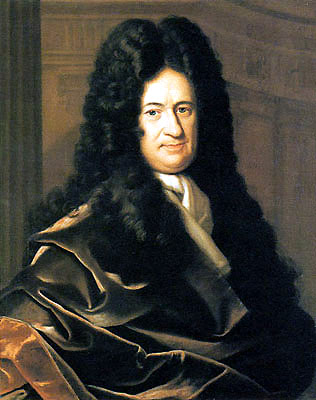 I can’t think of a more galling statement for a contemporary cosmologist to make. Gottfried Wilhelm Leibniz, for those who don’t know, happened to be one of the men who discovered infinitesimal calculus. He also (among countless other contributions to mathematics, science, social sciences, engineering, and philosophy) developed a calculator, contributed to the development of binary language, was one of the first to posit that space was relative, and developed the principle of sufficient reason (which supports all scientific investigation).
Yet, according to Krauss, because he lived in a time before we know how large the universe was, he “knew nothing!” You see, Krauss, and some other scientists and thinkers with a scientistic/physicalist bent, too often throw out the very basis of their thought. How far do you think Krauss could get in his cosmological research without infinitesimal calculus? How would Krauss go about investigating the causes of various natural phenomena without the principle of sufficient reason?
The answer is pretty simple: he wouldn’t get anywhere.
Krauss, like those before him, stands on the shoulders of giants. But, unlike those who are humble enough (or who know enough about philosophy and history?) to admit it, Krauss says “We act as if they are authorities about something, they knew nothing!”
Really, Krauss? Let’s see how well your next research project goes if you throw out all the contributions they made to your methodology. Next time you do an experiment, try to do it without parsimony or inference to the best explanation. Write to me how that goes!
What’s happened with people like Krauss, and I can think of others (like Stephen Hawking, Richard Dawkins) who do the same thing, is that in their gusto for the marvels of modern science, they have forgotten the very basis for their methods, their research, and their rationality.
Without philosophy, there would be no way to infer causes from effects; without the principle of sufficient reason, there would be no reason to think that causes even have effects; without a well developed notion that what will happen can be inferred from what has happened, these scientists could not even get going. But then they have the absurd tendency to turn around and reject philosophy. They say things like the quote Krauss fired off above.
Here’s the thing: science is utterly dependent upon philosophy to survive. If we didn’t have philosophy–if we didn’t have the developed notions of rationality, inference, and the like–there would be no science. Other theists (and philosophers) have contributed things like parsimony/Occam’s Razor to the wealth of philosophical methodological backbone which makes the scientific enterprise possible. In fact, there is still debate over whether we can reliably make inferences from science (for one example philosophically defending scientific inference, see Wesley Salmon, The Foundations of Scientific Inference). Some scientists have now apparently become those who sit in the ivory towers, blissfully ignorant of how their own research depends upon others’ outside of their field.
I suspect a multifaceted problem behind the motivation of those who throw philosophy out the window once they’ve embraced full-fledged empiricism. First, many of these thinkers have demonstrated they don’t actually know what empiricism means as a–that’s right–philosophical system. Apart from Krauss and Hawking, one could cite the recent example of Richard Dawkins admitting that he doesn’t know what “epistemic” means. Note to those who embrace that philosophical system of Krauss et al.: without epistemology, you would not even be able to justify inferences to best explanation. How’s that for a dose of reality?
Second, there is a kind of blatant ignorance of–or even intentional trampling on–the historical development of scientific inquiry. I hesitate to say that philosophy makes a “contribution” to science, because that’s not what it is. A simple study of schools of knowledge reveals that science, by its very nature, is utterly dependent upon epistemological research. Without such development, there would be no scientific method.
Third, these scientists constantly make philosophical claims, apparently in complete ignorance of the fact that they are philosophical claims. For example, in the same dialog Krauss argues that “the universe certainly doesn’t care what I like…” and throughout the discussion points out that it doesn’t matter what we think, the universe is revealed in a certain way by research.
He apparently seems utterly oblivious to the fact that that, in itself, is a philosophical position. One could take a rival position and argue that the appearances of nature don’t actually determine reality because everything is mind-dependent (idealism, solipsism, or other schools). It’s not enough to just point at nature and say “see, this is how things are!” because if that’s all one does, then someone could say “Your ideas about how things are are dependent upon your mind and ideas, and therefore don’t have any access to reality.” No scientific research could rebut such an argument, only a philosophical position in which nature can give us a reliable record for rationality can ground science.
Krauss dismisses philosophy very nonchalantly. It seems as though he (and others like him) is oblivious to the fact his entire system is philosophical. Consider the claim that “science can examine reality.” How does one go about proving it? One could argue that one could simply make a test and show that over and over again in circumstances y, x result happens, so we are justified that when we assert that if y, then x. But of course we would have to justify that a test can be connected to reality; we’d have to figure out what it means to have “justified” belief; we have to show that our scientific method is trustworthy; we have to assume that mathematical truths are true; we have to operate within a rational perspective; etc. All of these are philosophical positions. Some of them are debates within philosophy of science, in fact. The bottom line is that whenever someone does science, they are utterly reliant upon philosophy. By simply taking the empirical world as something which can be explored, they have made a number of philosophical assumptions, whether realized or not. Scientists take much of the philosophical development as a given before they even start their research. And then, some of them, like Krauss, have the gall to turn around and dismiss philosophers as though they “know nothing.” Suddenly, he has undermined his own system of thought, without even acknowledging that it is a system of thought.
Frankly, some of these scientists are just confused. Thankfully, many scientists operate with a system that respects the contributions of philosophy to science and encourage the interplay between the fields of knowledge.
Here’s the bottom line for those scientists who agree with Krauss: your entire field of research can only proceed if you grant over a thousand years of philosophical development. One major contribution was made by Leibniz, whom people like Krauss casually dismiss. But without the theistic philosopher with the awesome wig, scientists would have nothing. Thanks, philosophy! Thanks again, Christianity!
SDG.
——
The preceding post is the property of J.W. Wartick (apart from citations, which are the property of their respective owners) and should not be reproduced in part or in whole without the expressed consent of the author. All content on this site is the property of J.W. Wartick and is made available for individual and personal usage. If you cite from these documents, whether for personal or professional purposes, please give appropriate citation with both the name of the author (J.W. Wartick) and a link to the original URL. This blog is protected by Creative Commons licensing. By viewing any part of this site, you are agreeing to this usage policy.
Crossing the Most Dangerous Line: How some bioethicists undermine humanity
Our point is only that there is nothing bad about death or killing other than disability and disabling. (Sinnott-Armstrong and Miller, cited below)
The authors also do not agree with the term euthanasia for this practice [after birth abortions] as the best interest of the person who would be killed is not necessarily the primary reason his or her life is being terminated. In other words, it may be in the parents’ best interest to terminate the life, not the newborn’s. (Klimas, emphasis mine, cited below)
These are not quotes from a dystopic sci-fi epic; these are quotes from a journal article about murder and a news story about bioethics. The disturbing reality is that there are a number of people working in the field of bioethics today whose positions undermine basic human rights.
Murder as Causing Disability
Why is murder wrong?
There are a number of answers generally given to this question which generally focus on the wrongness of ending life or terminating consciousness. However, a recent article by Walter Sinnott-Armstrong and Franklin Miller denigrates this position as “traditionalist” (note the subtle choice of the word to create an opposition: “traditionalists” are opposed to what? apparently they are opposed to “innovation” “reality” and the like; they are stuck in their mores and these bioethicists must free us from the stone age). They argue that it is causing disability which makes murder wrong; not the wrongness of killing itself.
Murder is wrong, on their view, because it causes “total disabling.” The authors draw out a thought experiment in which a woman, Betty, is incapable of controlling her thoughts, has no motor control, and the like. Essentially, she is completely disabled and cannot do anything, has no awareness of her actions, and the like. Then, the authors ask:
In this case, is Betty any better off totally disabled than dead? If so, then death must involve the loss of something valuable beyond the loss of all abilities forever. If not, then death does not involve the loss of anything valuable beyond what is lost in total disability. Death is still distinct from total disability, but it is no worse.
It is fascinating to see that the authors apparently take this to be a decisive blow to the “traditionalist” position. They write, “We see nothing to make Betty’s death worse than her total disability. This intuition seems to be widely shared, since many people dread death no more than and for the same reasons that they would dread total disability.”
Yet there is something fairly obvious that is just waiting to be pointed out: namely, that Betty’s death does “involve the loss of something valuable beyond the loss of all abilities forever”–what it involves losing is one’s life.
Yes, that’s right, some people make the apparently not-so-obvious claim that life itself is valuable. See, articles like this by Sinnott-Armstrong and Miller don’t interact with their opponents’ positions as much as they try to claim they have refuted them; rather, they simply assume their opponents are wrong. But these authors seem to have anticipated this point (despite their total rejection of the alternative in their thought experiment–they use the experiment as though it seals their case and then only later, once the reader has been led to believe they are absolutely correct, do they deal with this objection). They write:
Of course, opponents will claim that life is sacred or that killing her violates God’s commandment, but why would God forbid us (or have any reason to forbid us) to do something that does not make Betty worse off? Similarly, secular theorists might claim that life has sanctity or intrinsic value (cf Dworkin), but why is life valuable in this extreme case when it includes no ability (or pleasure, as we are still assuming)?
But this is the end of their response! After these lines they turn to attempting to justify their consequentialist assumptions. Surely, however, this is an extremely insufficient response. Nothing in this response undermines the position that life is valuable. Rather, they just ask a question: why is life valuable? But of course the authors are the ones making the claim here. They are claiming life itself is not valuable. If that’s the case, the burden of proof is upon them to show that their position is correct. And note that the way they try to justify this position is by simply assuming their position is correct. They ask why God would forbid something that doesn’t make Betty any worse off… but the point the “traditionalist” is making is that it does make Betty worse off because killing her deprives her of life! There is a subtle question begging occurring throughout the article because the authors simply can’t seem to fathom that life is valuable in itself. Instead, they assert that what is valuable is ability and then sift all moral statements through that assumption.
One who reflects upon this position should be not just appalled but also outraged and fearful. Why? Well Sinnott-Armstrong and Miller, by suggesting that what makes killing wrong is the causation of disabilities, imply that disabilities significantly reduce the value or worth of persons. Consider this: the authors repeatedly point out that it is not the deprivation of life that harms Betty, but rather the causing total disability. The grounding of Betty’s value is therefore based upon her abilities. If that is the case, then as Betty suffers disabilities, her value is decreased. Suppose Betty goes from being totally “able” with nothing wrong to becoming paralyzed. Does that mean she is less valuable? “Traditionalists” like me would say no, she is no less valuable. However, the authors of this article have grounded human value on ability. Again, it is the deprivation of capabilities which is wrong with murder, not the deprivation of life on their view. A consequences of this position is that the more “disabled” one becomes, the less valuable they become. Such a position is rightfully horrifying, but it is exactly what such a position entails. If humans’ value is grounded not simply in their being, then whatever standard one grounds this value will imply a sliding scale. Sinnott-Armstrong and Miller suggest that abilities ground value; therefore a disabled child is less valuable than one who is not; a man with Down Syndrome is less valuable than one who does not have it. These are the horrifying implications of their view.
One wonders if it is worth embracing such a position when it entails such blatantly immoral consequences. When one notices that the argument produced therein is based simply upon begging the question and assuming that life itself is not valuable, one finds little reason to commend this position.
Killing Our Children
Bioethicists have not stopped at the line crossed above, however. Recently another pair of bioethicists, Alberto Giubilini and Francesca Minerva, have argued for what they are terming “after-birth abortions.” In layman’s terms, they’re arguing for murdering one’s own children.
What could possibly ground this? Well, these bioethicists argue that, “Both a fetus and a newborn certainly are human beings and potential persons, but neither is a ‘person’ in the sense of ‘subject of a moral right to life’… Merely being human is not in itself a reason for ascribing someone a right to life.”
What exactly constitutes something which could justify killing a newborn? Again, “The circumstances… where after-birth abortion should be considered acceptable include instances where the newborn would be putting the well-being of the family at risk, even if it had the potential for an ‘acceptable’ life.” The authors go on to cite Down Syndrome as an example of these circumstances. Honestly, there is nothing to distinguish this form Eugenics. Let’s kill off those we deem unsuitable for life. It’s abhorrent.
I predicted this very consequence of the pro-choice position not too long ago. Pro-abortion arguments which aim to redefine what it means to be a “person” lead inevitably to infanticide. Fortunately, most pro-choice advocates do not realize this consequence of their position and still find infanticide and the like abhorrent. But those who have carefully reflected on the topic–bioethicists who research the issues involved–have come to realize that if an unborn human being is not worth being called a person, then it is hard to see why a newly born human being is a person either.
Bioethics: A brief reflection
The two case studies provided in this post provide examples for why it is so important to defend a proper view of the value of persons and worth. Once we start to define worth as things which can become a sliding scale (abilities vs. disabilities); once we allow that human beings are worthless if in one location (the womb) but valuable in another (outside the womb); once we seek to redefine terms in order to win a debate; that is when our world will collapse around us. These bioethicists are literally trying to say that it is permissible to kill people if they are totally disabled; they are literally telling us that a child with Down Syndrome might have a life worth living, but is such a strain on their family that the family should be allowed to kill their own child. I wish I were making these things up. These are our times: times in which we’ve allowed people to redefine rights and values in order to allow us to kill our children; times in which the people writing our ethics books argue that murder isn’t wrong because it takes a life but because it disables someone; times in which we can read discussions in medical journals about permitting the killing our own infants because they have certain defects.
God help us.
Sources
Walter Sinnott-Armstrong and Franklin Miller, “What Makes Killing Wrong?” Journal of Medical Ethics, January 2012. Accessible here: http://jme.bmj.com/content/early/2012/01/19/medethics-2011-100351.full
Liz Klimas, “Ethicists Argue for Acceptance of After-Birth Abortions” The Blaze, February 27, 2012, accessible here: http://www.theblaze.com/stories/ethicists-argue-in-favor-of-after-birth-abortions-as-newborns-are-not-persons/.
Picture credit: http://commons.wikimedia.org/wiki/File:Pinedap.JPG
SDG.
——
The preceding post is the property of J.W. Wartick (apart from citations, which are the property of their respective owners) and should not be reproduced in part or in whole without the expressed consent of the author. All content on this site is the property of J.W. Wartick and is made available for individual and personal usage. If you cite from these documents, whether for personal or professional purposes, please give appropriate citation with both the name of the author (J.W. Wartick) and a link to the original URL. If you’d like to repost a post, you may do so, provided you show less than half of the original post on your own site and link to the original post for the rest. You must also appropriately cite the post as noted above. This blog is protected by Creative Commons licensing. By viewing any part of this site, you are agreeing to this usage policy.
The Argument from Religious Experience: Some thoughts on method and usefulness
 The argument from religious experience (hereafter referred to as “argument from RE”) has seen a resurgence in scholarly work. Keith Yandell, Richard Swinburne, Jerome Gellman, Kai-man Kwan, Caroline Franks-Davis, Paul Moser, and others have contributed to the current discussion about the topic.
One thing which has disappointed me on more than one occasion is the dismissive attitude that some Christian apologists show towards the argument from religious experience.
What reasons are there for apologists to adopt such a stance? Well it seems possible that some of them simply haven’t studied the argument enough to consider its plausibility. I admit that before interacting with the argument, I was skeptical of the possibility for its having any value. But I want to suggest another possibility: apologists tend to favor arguments which can be presented and defended in a debate format or which are useful in short conversations with others. I’m not suggesting this as an attack on my fellow Christians, merely as an observation. And this is not a bad thing; it is indeed greatly useful to have arguments which can be presented quickly and defended easily when one is trying to present a case for Christianity to others.
The problem is the argument from RE requires a great deal of epistemological background in order to get to the meat of it. The authors listed above each develop a robust epistemology to go with their argument. This seems to put a limit on the usefulness of the argument; if it must be conjoined with a broad discussion of epistemology, then how can one present it in such a way that those who aren’t professional philosophers (or at least interested in the topic) can understand? It is to this question I hope to present an answer.
Background Information
Formulations of the Argument
There are two primary ways the argument from RE can be formulated (Caroline Franks Davis suggests a number of ways the argument can presented in The Evidential Force of Religious Experience, 67-92). The first is the personal argument; the second is the public argument. Now I have seen very few versions of the former in the literature. The personal argument is essentially an argument from RE which centers not on trying to demonstrate the existence of God to others, but rather upon justifying one’s own belief that such an experience is genuine. In other words, the personal argument from RE focuses upon defending one’s own conviction that a religious experience is veridical.
Paul Moser, in his work The Evidence for God, suggests one possible way to formulate this argument [he does not refer to it in the same terminology as I use here]:
1. Necessarily, if a human person is offered and receives the transformative gift, then this is the result of the authoritative power of… God
2. I have been offered, and have willingly received, the transformative gift.
3. Therefore, God exists (200, cited below).
This argument is one example of what I would call the personal argument from RE. It focuses on one’s own experience and uses that to justify one’s belief in God. [It seems Moser could be arguing for this as a public argument as well, but a discussion of this would take us too far afield.]
A public argument from RE is generally formulated to establish the belief in God (or at least a transcendent reality), just as other theistic arguments are intended. It will best function as part of a “cumulative case” for the existence of God. One example of an argument of this sort can be found in Jerome Gellman, Experience of God and the Rationality of Theistic Belief:
If a person, S, has an experience, E, in which it seems (phenomenally) to be of a particular object, O… then everything else being equal, the best explanation of S’s having E is that S has experienced O… rather than something else or nothing at all (46, cited below).
Readers familiar with the literature on RE will note the similarities between this and Richard Swinburne’s principle of credulity. The basic idea is that if someone has an experience, then they are justified in believing they had that experience, provided they have no (epistemic) defeaters for that experience.
Brief Epistemological Inquiry
I’ve already noted the intricate ties the argument from RE has with epistemology, and a quick introduction to the argument would be remiss without at least noting this in more explicit detail. The core of establishing the argument from RE is to undermine methodological/metaphysical naturalism. Thus, a robust defense of the argument from RE will feature building up a case for an epistemological stance in which theistic explanations are not ruled out a priori.
A second step in this epistemological background is to establish a set of criteria with which one can judge and evaluate individual religious experiences. Caroline Franks Davis’ study (cited below) is a particularly amazing look into this tactic; she explores a number of possible defeaters and criteria for investigating REs. These range any where from hallucinogenic drugs to the multiplicity of religious experience.
The Force of the Evidence
One concern I had when I was exploring the argument from RE is that it would not have very much force. Upon investigating the topic, however, I can’t help but think the force of the argument is quite strong. Swinburne seems correct when he writes, “[T]he overwhelming testimony of so many millions of people to occasional experience of God must… be taken as tipping the balance of evidence decisively in favour of the existence of God” (Swinburne, Is There a God?, 120, cited below). The important thing to remember is that an overwhelming number of people from all stations of life and cultures have had experiences that they deem to be “spiritual” or hinting at “transcendence.” Denying universally all of these experiences as genuine would seem to require an enormous amount of counter-evidence.
A Suggested Version for Quick Discussion
So what to do with this background knowledge? It seems to me it is possible to at least sketch out a version of the argument from RE for a brief discussion, with a defense. Further reading is provided below.
The Argument Stated
1. Generally, when someone has an experience of something, they are within their rational limits to believe the experience is genuine.
2. Across all socio-historical contexts, people have had experiences of a transcendent realm.
3. Therefore, it is rational to believe there is a transcendent realm.
The argument made more explicit
The reason I suggest this as the way to use the argument from RE in a brief discussion is because it can more easily form part of a cumulative case and requires less epistemological work to justify it. The first premise is, in general, a principle of rationality. While there are many who have attacked Swinburne’s principle of credulity, it does seem that we generally affirm it. If I experience x, then, provided I have no reasons to think otherwise, I should believe that x exists/was real/etc.
The second premise is the result of numerous studies, some of which are cited in the works cited below. To deny this nearly universal experience is simply to deny empirical evidence. People like William James have observed this transcultural experience of the transcendent for hundreds of years.
Thus, it seems that we are justified in being open to the existence of things beyond the mundane, everyday objects we observe in the physical reality. If people from all times and places have had experiences of things beyond this everyday existence, then it does not seem irrational to remain at least open to the possibility of such things existing.
The conclusion may come as something of a letdown for some theists. But I would like to reiterate that this is a version of the argument intended for use in a brief conversation. There are versions of the argument in the cited literature below which defend theism specifically and engage in synthesis of these experiences into the theistic fold. What I’m trying to do here is make the argument part of the apologist’s arsenal. If we can use the argument merely to open one up to the reality of the transcendent, then perhaps they will be more open other theistic arguments. As part of a cumulative case, one can’t help but shudder under the overwhelming weight of millions of experiences.
Conclusion
The argument from religious experience has enjoyed a resurgence in scholarly popularity. A number of books from publishers like Oxford University Press, Cornell, and Continuum have reopened the argument to the scholarly world. It is high time that Christian apologists put in the work needed to utilize these arguments in everyday, accessible apologetics. The argument formulated above is just one way to do this, and Christians would do well to explore the argument further. The experience of God is something not to be taken lightly; Christians throughout our history have had such experiences and been moved into intimate relationships with God. We should celebrate these experiences, while also realizing their evidential value.
Further Reading and Works Cited
The following books are all ones I have read on the topic but do not present a comprehensive look at literature on the subject.
Caroline Franks Davis, The Evidential Force of Religious Experience
Jerome Gellman, Experience of God and the Rationality of Theistic Belief
Paul Moser, The Evidence for God
Richard Swinburne, Is There a God?
There are a number of other fantastic books on the topic as well. Swinburne’s The Existence of God
William Alston’s Perceiving God
Keith Yandell’s The Epistemology of Religious Experience
Kai-man Kwan’s Rainbow of Experiences, Critical Trust, and God
Nelson Pike provides a unique look at the phenomenology of RE and a synthesis of theistic and monistic experiences in his work Mystic Union
SDG.
——
The preceding post is the property of J.W. Wartick (apart from citations, which are the property of their respective owners) and should not be reproduced in part or in whole without the expressed consent of the author. All content on this site is the property of J.W. Wartick and is made available for individual and personal usage. If you cite from these documents, whether for personal or professional purposes, please give appropriate citation with both the name of the author (J.W. Wartick) and a link to the original URL. If you’d like to repost a post, you may do so, provided you show less than half of the original post on your own site and link to the original post for the rest. You must also appropriately cite the post as noted above. This blog is protected by Creative Commons licensing. By viewing any part of this site, you are agreeing to this usage policy.
Book Review: “Where the Conflict Really Lies” by Alvin Plantinga
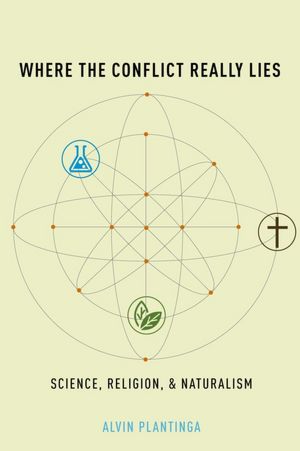 There are few names bigger than Alvin Plantinga when it comes to philosophy of religion and there are few topics more hotly debated than science and religion. Plantinga’s latest book, Where the Conflict Really Lies
Plantinga minces no words. The very first line of the book outlines his central claim: “there is superficial conflict but deep concord between science and theistic religion, and superficial concord and deep conflict between science and naturalism.”1
The first part of the book is dedicated to the superficial conflict between science and religious belief. The reason this alleged conflict is important is due, largely, to the success of the scientific enterprise. Because science has shown itself to be a reliable way to come to know the world, if religion is in direct conflict with science, then it would seem to discredit religion. Not only that, but, Plantinga argues, Christians should have a “particularly high regard” for science due to the foundations of the scientific enterprise on a study of the world.2
In order to examine this alleged conflict, Plantinga first takes on the article of science most often taken to discredit religion: evolution. Here, readers may be surprised to find that Plantinga does not try to argue against evolution itself. Rather, Plantinga draws a distinction between the notion of evolution and Darwinism. The former, argues Plantinga, is consistent with Christian belief, whether or not it is the way the variety of life came to be, while the latter is not consistent with Christianity because central to its account is the notion that the process of evolution is unguided.3
WCRL then turns to Richard Dawkins. Plantinga argues that “A Darwinist will think there is a complete Darwinian history for every contemporary species, and indeed for every contemporary organism.”4 Here again there is nothing which puts such a theory in conflict with Christian belief. Writes Plantinga, “[The process of evolution] could have been superintended and orchestrated by God.”5 But Dawkins (and others) claim that evolution “reveals a universe without design.” But what argument is provided towards this conclusion? Plantinga draws out Dawkins reasoning and shows that the only logic given is that evolution could have happened by way of unguided evolution. But then:
What [Dawkins] actually argues… is that there is a Darwinian series of contemporary life forms… but [this series] wouldn’t show, of course, that the living world, let alone the entire universe, is without design. At best it would show, given a couple of assumptions, that it is not astronomically improbable that the living world was produced by unguided evolution and hence without design. But the argument form ‘p is not astronomically improbable’ therefore ‘p’ is a bit unprepossessing… What [Dawkins] shows, at best, is that it’s epistemically possible that it’s biologically possible that life came to be without design. But that’s a little short of what he claims to show.6
Plantinga then moves on to argue that Daniel Dennett’s argument is similarly flawed.7 Paul Draper’s argument that evolution is more likely on naturalism than theism is more interesting, but assumes that “everything else is equal.”8 But then, everything is not equal. Theism provides a number of relevant probabilities which weigh the argument in favor of theism instead.9
The arguments against theism from evolution are therefore largely dispensed. What of the possibility of divine action? Some argue that God doesn’t actually act in the world—in fact, the argument is made that even most theologians don’t believe this, despite writing that God does act in various ways. The argument is made that because of natural laws, God cannot or does not intervene.10 However, one can simply argue that the correct view of a natural law is that “When the universe is causally closed (when God is not acting specially in the world), P.”11
Plantinga does acknowledge that there are some fields in science which do provide at least superficial conflict with theism. These include evolutionary psychology and (some) historical critical scholarship.12 Evolutionary psychology generally doesn’t challenge religious belief. “Describing the origin of religious belief and the cognitive mechanisms involved does nothing… to impugn its truth.”13 Now some suggest that religious beliefs are due to devices not aimed at truth, and this would provide a reason to doubt religious belief.14 However, the way that most do this is by conjoining atheism with psychology or operating under other assumptions which undermine religious belief a priori. While this may mean that specific conclusions in psychology are in conflict with theism, these conclusions only follow from the anti-theistic assumptions at the bottom. Thus, while some accounts of evolutionary psychology are in conflict with theism, they don’t provide a solid basis for rejecting it.15 Similarly, varied methods of historical concept may draw some conclusions which are in conflict with Christian theism, but these methods are themselves undergirded by assumptions that theism is, at best, not to be entered into historical discussion.16
There are, Plantinga argues, significant reasons to think that theism is in concord with science. First, the argument from cosmological fine-tuning, he argues, gives “some slight support” for theism.17 The section on fine-tuning has responses to some serious criticisms of such arguments. Most interesting are his responses to Tim and Lydia McGrew and Eric Vestrup—in which Plantinga argues that we can indeed get to the point where we can assess the fine-tuning argument;18 Plantinga’s discussion of the multiverse;19 and his discussion of relevant probabilities regarding fine-tuning.20
Michael Behe’s design theory is discussed at length in WCRL.21 Plantinga offers some additional insights into the Intelligent Design debate. He argues that one can view design not so much as a probabilistic argument but instead as simple perception.22 He reads both Behe and William Paley in this light and argues that they are offering design discourses as opposed to arguments.23 This, in turn, allows him to argue that design is a kind of “properly basic belief” and he offers a robust discussion of epistemology to support this intuition.24
Further, there is deep concord between Christian Theism and Science when one looks at the very roots of the scientific endeavor. Here, rather than simply listing various theists who helped build the empirical method, Plantinga argues that science relies upon various theistic assumptions in order for its methods to succeed. These include the “divine image” in which humans are capable of rational thought;25 God’s order as providing regularity for the universe;26 natural laws;27 mathematics;28 induction;29 and simplicity and “other theoretical virtues” (like beauty).30
Finally, Plantinga turns to naturalism: does it really resonate so well with science? Plantinga grants for the sake of argument that there is at least superficial concord between naturalism on science, if only because so many naturalists trumpet this “fact.”31 Yet there is, he argues, a deep conflict between science and naturalism: namely, that if evolution is true and naturalism is true, there is no reason to trust our cognitive abilities.32 “Suppose you are a naturalist,” he writes, “you think there is no such person as God, and that we and our cognitive faculties have been cobbled together by natural selection. Can you then sensibly think that our cognitive faculties are for the most part reliable?”33
Plantinga argues you cannot. The reason is because we have no way to suppose that evolution is truth aimed, but rather it is merely survival aimed (if indeed it is aimed at all!). He also argues that because naturalists are almost all materialists, there is no way to adequately ground beliefs.34 Finally, because naturalism and evolution conjoin to give a low probability that our rational abilities are reliable, we have received a defeater for every belief we have, including naturalism and evolution.35 Thus, the conflict “is not between science and theistic religion: it is between science and naturalism. That’s where the conflict really lies.”36
WCRL covers an extremely broad range of topics, and will likely be critiqued on each topic outlined above and more. The book touches on issues that are at the core of the debate between naturalists and theists, and as such it will be highly contentious. That said, the book is basically required reading for anyone interested in this discourse. Plantinga provides extremely valuable insights into every topic he touches. His discussion of biological design, for example, provides unique insight into the topic by locating it within epistemology as opposed to biology alone. Further, his “evolutionary argument against naturalism” continues to live despite endless criticism. The list of important topics Plantinga illumines in WCRL is extensive.
Where the Conflict Really Lies
——
1 Alvin Plantinga, Where the Conflict Really Lies (New York, NY: Oxford, 2011), ix.
2 Plantinga, Where the Conflict Really Lies, 3-4. (Unless otherwise noted, all references are to this work.)
3 12 (emphasis his).
4 15 (emphasis his).
5 16.
6 24-25.
7 33ff, esp. 40-41.
8 53.
9 53ff.
10 69ff.
11 86, see the arguments there and following.
12 129ff.
13 140.
14 141ff.
15 143ff.
16 152ff.
17 224.
18 205-211.
19 212ff.
20 219ff.
21 225-264.
22 236ff.
23 240-248.
24 248ff; see esp. 253-258, 262-264.
25 266ff.
26 271ff.
27 274ff.
28 284ff.
29 292ff.
30 296ff.
31 307ff.
32 311ff.
33 313.
34 318ff.
35 339ff.
36 350.
This review was originally posted at Apologetics315 here: http://www.apologetics315.com/2012/02/book-review-where-conflict-really-lies.html
SDG.
——
The preceding post is the property of J.W. Wartick (apart from citations, which are the property of their respective owners) and should not be reproduced in part or in whole without the expressed consent of the author. All content on this site is the property of J.W. Wartick and is made available for individual and personal usage. If you cite from these documents, whether for personal or professional purposes, please give appropriate citation with both the name of the author (J.W. Wartick) and a link to the original URL. This blog is protected by Creative Commons licensing. By viewing any part of this site, you are agreeing to this usage policy.
The Ontology of Morality: Some Problems for Humanists and their friends

Louise Anthony did indeed present the case for secular metaethics. The problem is that this case is utterly vacuous.
It will be my purpose in the following arguments to show that secular humanistic theories which try to ground moral ontology fail–and fail miserably.
Recently, I listened [again] to the debate between William Lane Craig and Louise Anthony. Some have lauded this debate as a stirring victory for secular ethics. (See, for example, the comments here–one comment even goes so far as to say “I swoon when someone evokes the Euthyphro Dilemma and frown at the impotent, goal-post-moving, ‘Divine nature’ appeal.”) In reality, I think Louise Anthony did indeed present the case for secular metaethics. The problem is that this case is utterly vacuous.
I’ll break down why this is the case by focusing upon three areas of development in secular and theistic ethics: objective moral truths, suffering, and moral facts.
Objective Moral Truths
Louise Anthony and William Lane Craig agree that there are objective moral truths. Now, this is important because many theists take the existence of objective morality to demonstrate–or at least strongly suggest–the existence of God. Interestingly, other humanist/secular scholars have agreed with Anthony, claiming there are objective truths (another example is Sam Harris–see my analysis of his position contrasted with theism here). The question, of course, is “How?” Consider the following:
Louise Anthony seems to be just confused about the nature of objective morality. She says in response to a question from the audience, “The universe has no purpose, but I do… I have lots of purposes…. It makes a lot of difference to a lot of people and to me what I do. That gives my life significance… The only thing that would make it [sacrificing her own life] insignificant would be if my children’s lives were insignificant. And, boy you better not say that!”
Craig responded, “But Louise, on atheism, their lives are insignificant.” Anthony interjected, “Not to me!”
But then she goes on to make this confused statement, “It’s an objective fact that they [her children] are significant to me.”
Note how Anthony has confused the terms here. Yes, it is an objective fact that according to Louise Anthony, her children matter to her. We can’t question Anthony’s own beliefs–we must trust what she tells us unless we have reason to think otherwise. But that’s not enough. What Craig and other theists are trying to press is that that simple fact has nothing to do with whether her children are actually valuable. Sure, people may go around complaining that “Well, it matters to me, so it does matter!” But that doesn’t make it true. All kinds of things can matter to people, that doesn’t mean that they are ontologically objective facts.
It matters to me whether the Cubs [an American baseball team] win the World Series. That hasn’t happened in 104 years, so it looks like it doesn’t matter in the overall scheme of the universe after all. But suppose I were to, like Anthony, retort, “But the Cubs matter to me! It’s an objective fact that them winning the World Series is significant to me!” Fine! But all the Cardinals [a rival team] fans would just laugh at me and say “SO WHAT!?”
Similarly, one can look at Anthony with incredulity and retort, “Who cares!?” Sure, if you can get enough people around Anthony who care about her children’s moral significance, you can develop a socially derived morality. But that’s not enough to ground objective morality. Why should we think that her values matter to the universe at large? On atheism, what reason is there for saying that her desires and purposes for her children are any better than my desires and purposes for the Cubs?
Another devastating objection can be found with a simple thought experiment. Let’s say Anthony didn’t exist. In such a world, there can be no one complaining that her children matter “to me!” Instead, her children just exist as brute facts. How then can we ground their significance? Well, it seems the answer for people like Anthony would be to point to the children’s other family say “Those children matter to them!” We could continue this process almost endlessly. As we eliminate the children’s family, friends, etc. and literally make them just exist on their own, we find Anthony’s answer about allegedly objective morality supervenes on fewer and fewer alleged moral facts. Suddenly “Those children matter to themselves!” is the answer. But then what if we eliminate them? Do humans still have value? The whole time, Anthony has grounded the significance of her children and other humans in the beliefs, goals, and purposes of humans. But without humans, suddenly there is no significance. That’s what is meant by objective morality. If those children matter even without humans, then objective morality is the case. But Anthony has done nothing to make this the case; she’s merely complained that her children matter to her.
Now, some atheists–Anthony and Sam Harris included–seem to think they have answers to these questions. They seem to think that they can ground objective morality. We’ll turn to those next.
Suffering
One of the linchpins of humanists’ claims (like Anthony and Sam Harris) is suffering. The claim is that we can know what causes suffering, and that this, in turn, can lead us to discover what is wrong. We should not cause suffering.
But why not?
Most often the response I’ve received to this question is simply that because we do not wish to suffer, we should not wish to have others suffer or cause suffering for others. But why should that be the case? Why should I care about others’ suffering, on atheism? That’s exactly the question humanism must answer in order to show that objective morality can exist in conjunction with secularism. But I have yet to see a satisfactory answer to this question.
Anthony was presented with a similar question in the Q&A segment of her debate with William Lane Craig. One person asked (paraphrased), “Why shouldn’t I base morality as ‘whatever benefits me the most’?” Anthony responded simply by simply arguing essentially that it’s not right to seek pleasure at the expense of others, because they may also want pleasure.
But of course this is exactly the point! Why in the world should we think that that isn’t right!?
The bottom line is that, other than simply asserting as a brute fact that certain things are right and wrong, atheism provides absolutely no answer to the question of moral objectivity. People like Anthony try to smuggle it in by saying it’s objectively wrong to cause suffering [usually with some extra clauses], but then when asked why that is wrong, they either throw it back in the face of the one asking the question (i.e. “Well don’t you think it’s wrong?”) or just assert it as though it is obviously true.
And it is obviously true! But what is not so obvious is why it is obviously true, given atheism. We could have simply evolved herd morality which leads us to think it is obviously true, or perhaps we’re culturally conditioned by our close proximity to theists to think it is obviously true, etc. But there still is no reason that tells us why it is, in fact, true.
Moral Facts
Anthony (and Harris, and others with whom I’ve had personal interactions) centralize “moral facts” in their metaethical account. As a side note, what is meant by “moral fact” is a bit confusing but I don’t wish to argue against their position through semantics alone. They claim that we can figure out objective morals on the basis of moral facts. Sam Harris, for example, argues that there is a “continuum of such [moral] facts” and that “we know” we can “move along this continuum” and “We know, we know that there are right and wrong answers about how to move in this space [along the moral continuum]” (see video here).
Now it is all well and good to just talk about “facts” and make it sound all wonderful and carefully packaged, but Anthony and Harris specifically trip up when they get asked questions like, “How do we figure out what moral facts are?”
Anthony was asked “How do you determine what the objective moral facts are”, and responded by saying, “We do it by, um, testing our reactions to certain kinds of possibilities, um, thinking about the principles that those reactions might entail; testing those principles against new cases. Pretty much the way we find out about anything” (approximately 2 hours into the recorded debate).
 One must just sit aghast when one hears a response like that. Really? That is the way we discover moral truths? And that is the way we “find out about anything”? Now I guess I can’t speak for Anthony herself, but when I’m trying to find out about something, I don’t test my reaction to possibilities and then try to figure out what my reaction “might entail.” That is radical subjectivism. Such a view is utterly devastating for not just morality but also science, history, and the like. If I were to try to conduct scientific inquiry in this manner, science would be some kind of hodgepodge of my “reactions” to various phenomenon. Unwittingly, perhaps, Anthony has grounded the ontology of her morality in the reactions of people. But this error isn’t restricted to Anthony. Harris also makes this confounding mistake. His basic argument in the talk linked above is simply, “Science can tell us what people think about things, so it can tell us about morality.” This is, of course patently absurd. Suppose I tried to test these humanists’ theories on groups of people by sticking them in a room and having them watch all kinds of things from murder to the rape of children to images of laughter and joy. Now suppose I randomly sifted my sample among the population of the world, but somehow, by pure chance, got a room full of child molesters. As I observe their reactions, I see they are quite joyful when they observe certain detestable images. Now, going by Anthony/Harris’ way to “find out about anything” and thinking about what these people’s reaction entails, I conclude that pedophilia is a great good. But then I get a room full of parents with young children, who react in horror at these same images. Then, as I reflect on their reactions, I discover that pedophilia is a great evil. And I repeat this process over and over. Eventually, I discover that the one group was an aberration, but it was a group nonetheless.
What does this mean?
Quite simply, it means that both Harris and Anthony haven’t made any groundbreaking theory of ethics. Rather, they’ve just made a pseudo-humanistic utilitarianism. They ground moral ontology in our “reactions” to various moral situations. The only way for them to say something is morally wrong if people have different reactions is either to go with the majority (utilitarianism) or choose one side or the other, which essentially turns into a kind of Euthyphro dilemma against atheists. Either things are wrong because enough people think they’re wrong (in which case morality is arbitrary) or things are wrong because they simply are wrong, period (in which case the humanist has yet to provide an answer for moral ontology).
Conclusion
Given the discussion herein, one can see that those atheists, humanists, and/or secularists who desire to ground objective morality still have a lot of work to do. Louise Anthony’s best attempt to ground morality boils down into radical subjectivism. Sam Harris’ account fares no better. Those who are trying to ground objective morality within an atheistic universe will just have to keep searching. The solutions Anthony and Harris have attempted to offer are vacuous.
Image Source:
http://commons.wikimedia.org/wiki/File:SecularHumanismLogo3DGoldCropped.png
SDG.
——
The preceding post is the property of J.W. Wartick (apart from citations, which are the property of their respective owners) and should not be reproduced in part or in whole without the expressed consent of the author. All content on this site is the property of J.W. Wartick and is made available for individual and personal usage. If you cite from these documents, whether for personal or professional purposes, please give appropriate citation with both the name of the author (J.W. Wartick) and a link to the original URL. If you’d like to repost a post, you may do so, provided you show less than half of the original post on your own site and link to the original post for the rest. You must also appropriately cite the post as noted above. This blog is protected by Creative Commons licensing. By viewing any part of this site, you are agreeing to this usage policy.
Guest Post: “Is There Life on Other Planets?” by Greg Reeves
 If you’ve been reading the science news lately, you’ll find there has been a lot of buzz about “extrasolar planets”, or “exoplanets” (i.e., planets that orbit other stars). For an example, see here. The reason why is in the last several years, the number of exoplanets that we’ve discovered has increased dramatically, mostly due to the Kepler mission. But regardless of the reason why, one interesting question this brings up is, “Are there other planets that host life?”
This is an incredibly profound question for both the religious and non-religious alike. For the Christian, the knee-jerk reaction might be “no, of course not, God specially created the life on earth and did not do so elsewhere.” (By the way, I do not necessarily espouse this view.) For the secularist, the presence of life on other planets only adds weight to the idea that life arose here on earth by strictly naturalistic processes. So what does science have to say about this subject? Given the sensationalistic popular news articles, one might think the universe is teeming with alien life. However, the data actually say otherwise.
First, answering the origin of life question, from a scientific standpoint, is incredibly hard. In fact, after investigating the state of affairs on this problem in order to write a book, it has driven agnostic physicist Paul Davies to proclaim1:
When I set out to write this book, I was convinced that science was close to wrapping up the mystery of life’s origin…Having spend a year or two researching the field, I am now of the opinion that there remains a huge gulf in our understanding…This gulf’s not merely ignorance about certain technical details, it is a major conceptual lacuna.
He goes on to say:
Many investigators feel uneasy about stating in public that the origin of life is a mystery, even though behind closed doors they freely admit that they are baffled. There are two reasons for their unease. First they feel it opens the door to religious fundamentalists…Second, they worry that a frank admission of ignorance will undermine funding…
Second, even though it is a conceptually difficult phenomenon to study, scientists are incredibly confident that it will be resolved one day. The main reason why is that the alternative to having a naturalistic origin of life would be a supernaturalistic origin of life, something that most secular scientists not only do not believe in but also that they rule out completely according to their philosophical worldview.
Third, we now know that life on our planet originated in a geological instant. As soon as this planet became even remotely suitable for life, roughly 3.9-3.8 billion years ago, life began (our earliest evidence for life is between 3.86 and 3.80 billion years ago). To the secular scientist, this implies that even though we have no idea how, the origin of life must be a very simple, fast process.
Fourth, because the origin of life is simple and fast, it probably is not a finely-tuned process, according to the reasoning of secularism. In other words, all you need are some minimal requirements (liquid water, a rocky planet, some carbon-containing compounds, and a short window of time) and life will surely appear. This principle led astronomer Steve Vogt, upon discovery of a rocky exoplanet in the “Goldilocks zone” (the distance from their star that would allow a planet to potentially harbor liquid water), to state, “The chances for life on this planet are 100 percent.” (As an interesting sidenote, the particular planet he was referring to may not even be a planet. Of course, we are still discovering exo-planets, and I have been confident for some time that we would find a near-earth-sized rocky planet in the Goldilocks zone. And lo and behold, we have. For examples, see here and here.)
 So, given this background, is it likely that such “Goldilocks planets”, which are likely to be all over the place in the universe, harbor life? Well, there are two sides to this story. As I laid out above, the popular secular point of view (and the point of view portrayed by the media) is that life is inevitable whenever loose conditions are met (background point four). So of course, whenever you have a planet in the Goldilocks zone, life is inevitable. This view springs solely from the assumption of naturalism (background point 2) and the fact that life arose on earth quickly (background point 3). You can easily see this point of view when reading the popular news articles, which are overflowing with unbridled optimism.
The other view is that life is rare in the universe, because all of the prowess of the origin-of-life scientific community has returned a comparatively small amount of promising data (background point 1). In fact, not only has little actual progress been made towards discovering naturalistic pathways towards origin of life, but instead the more we know the more we discover how far away we are. Problems such as the lack of a prebiotic soup, the irreducible complexity of life, the homochirality problem (all bio-molecules must be either 100% right-handed or 100% left-handed), the difficulty in producing a cell membrane, and the finely-tuned conditions needed to carry out the chemical reactions that produce biological precursors all reveal a much less optimistic story from the point of view of hard science.
The problems for the hypothesis of the naturalistic origin of life don’t stop there, however. The more we study our planet, the more we realize that an exoplanet needs a lot more going its way than just to be in the Goldilocks zone. There are a whole host of astronomical and geological parameters that must be exquisitely finely-tuned for life to (1) exist and (2) persist on a planet. The timing of the formation of the exosolar system, the location of the exosolar system within the galaxy, the type of galaxy the exosolar system is in, the elemental composition of the star and planet, and the existence of stable, long-lasting plate tectonics are just a few of the finely-tuned parameters that must be met for life to exist and thrive.
None of this is to say that we should not be investigating how life could have originated, or whether exoplanets may harbor other life forms. Indeed, if God did create the universe and life, I am convinced that these scientific disciplines will serve only to glorify Him further.
But these observations do beg the question: which is it? Is life abundant in the universe, a premise based on one data point and questionable assumptions, or is life rare, a premise based upon the empirical findings of the fields of biochemistry, organic chemistry, astronomy, and geology? It seems to me that hope springs eternal for the secular exoplanet researcher, but the hard scientific data tells another story.
1. Davies, Paul. “The Fifth Miracle: The Search for the Origin and Meaning of Life.” Simon & Schuster; 1 edition (March 16, 2000)
Dr Greg Reeves holds a PhD in Chemical Engineering from Princeton University, and is currently an assistant professor of chemical and biomolecular engineering at North Carolina State University. He is the co-director of the NC State chapter of Ratio Christi. His blog can be found at twobooksapproach.blogspot.com.
Announcing my new site: “Eclectic Theist”
I have many more interests than just philosophy of religion and Christian apologetics. I’ve been longing for an outlet for these interests for some time. Finally, I got down to business and made a new blog: “Eclectic Theist.”
On this new site, I’ll be writing about topics not normally discussed here on “Always Have a Reason.” For example, my first main entry is a reflection on science fiction. On this new site I’ll be discussing my other interests. Readers on here may be surprised at how random my reading is sometimes. In my undergraduate studies, I was a social studies major and I read extensively about Mesoamerican history. Did you know that!? Well now you do, and guess what? I’ll be writing about it again. I also love World War 2 history and have been reading more in that area in what exists of my free time. Of course, I’m also a huge fan of science fiction and fantasy, role-playing games, and more. All of these will be featured on this new site.
Will there be crossover? Probably. I’ve already thought of a few posts which can bring my outside interests on here and vice versa. For example, a series I’ve been contemplating for a while about science fiction and Christianity will see its launch on here in just a few short weeks. Other topics may crossover as well as they come up.
Does this mean I’ll write less here? Absolutely not. I have posts lined up for weeks now, and I continue to add to them. I’ll be maintaining my regular posts on here and using “Eclectic Theist” as an outlet for my other creative energy. Please, take the time to check out my introductory post to “Eclectic Theist” and browse the two new posts I have up. The site will be expanding quickly, so be sure to subscribe.
I’m looking forward to seeing many of you over there and talking about topics that interest us apart from philosophy of religion.
Finally, because I like pictures, I’ll share one that I just put up over on the new site: a picture of Orson Scott Card and myself.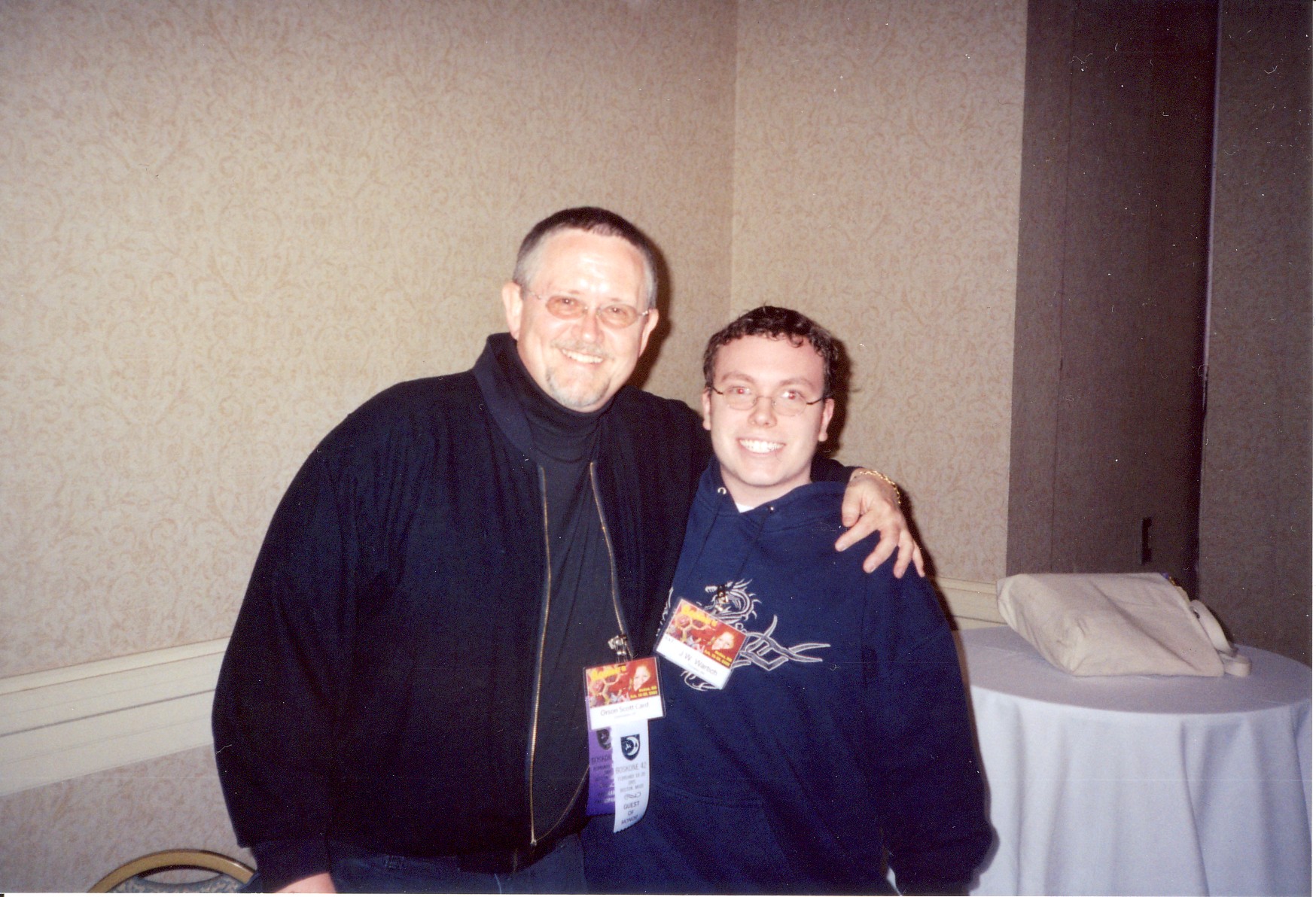
Mormonism and God: A Philosophical Challenge to Mormonism
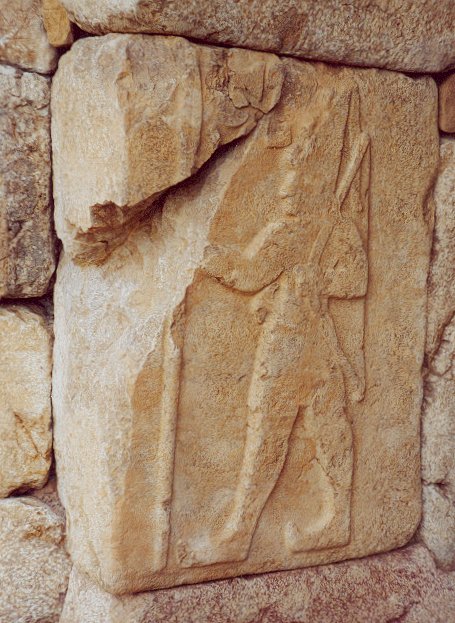 Central to discussions about God is the very concept of God itself. What does one mean when they refer to “God”? Suppose one is debating about the existence of God and in the course of that debate, one finds out that the other, when using the term “God” is thinking of a contingent, powerful but limited, and embodied deity; yet the other person has been trying to argue for the God of classical theism–infinite in power, wisdom, love, etc., omnibenevolent, omniscient, and omnipotent, transcendent, and the like. Clearly, there is a difference over who “God” is. Now talk about God can be meaningful between these two because they can choose to use “God” as a title, similar to that of “King” (this is suggested by Paul Moser in The Evidence for God, 22ff).
That said, for this post I will not assume that “God” refers exclusively to the God of classical theism. Rather, I’m going to turn to the Mormon concept of God and examine its coherence. If Mormonism’s concept of God is incoherent, then Mormonism faces a serious philosophical challenge. (As has been argued elsewhere, coherence is a central test of a religion’s truth claims.)
It is important to note that there is no single “Mormon concept of God.” As with Christianity, there is an array of beliefs about specific attributes of God. Thus, for this post, I’ll focus on just two concepts of deity within Mormonism.
 Monarchotheism (Also Known as Henotheism)
Explication
Stephen Parrish and Carl Mosser take Mormon teaching to expound the concept of God known as Monarchotheism, “the theory that there is more than one God, but one God is clearly preeminent among the gods; in effect, he is the monarch or ruler of all the gods” (Parrish and Mosser, 195, cited below). This concept of God is embodied (see Teachings of the Prophet Joseph Smith cited in P+M, 201). Furthermore, this God is contingent, the organizer of a world that was originally chaos, and one of many gods (Ibid, 201). Furthermore, Joseph Smith himself taught that this “God himself was once as we are now, and is an exalted man…” (TPJS 345, cited in P+M, 202).
Critique
There are many difficulties with this Mormon concept of God. Perhaps most crucial is the inclusion of contingency in the concept of God. If God is contingent, then it does indeed beg the question “Who Made God?” Consider this against classical theism, which holds that God exists necessarily. Classical theists can respond to this question by simply saying, “No one made God, because God, as necessarily existent, never came into being.” Yet Mormons who hold God is contingent must answer this question.
That’s not the only difficulty with God as contingent either, for holding that God is contingent removes several of the reasons to believe that such a deity exists. Consider one of the classical arguments for the existence of God: that contingent things have all come into being, so there must be something which has always existed in order to terminate the infinite regress. Of course, if this deity which terminates the regress is, itself, contingent, then one must continue the regress to the next step. Thus, this Mormon concept of God provides no grounding for the universe itself.
Further, this Mormon concept of deity has no way to ground objective morals. While Mormons tend to hold that God is all good/omnibenevolent, they have no way to ground this goodness in God Himself. Rather, because God is contingent, there must exist some measure by which God is judged, and so one is left with all the difficulties of grounding morality without God. If, instead, morality is still to be based upon God, then it could only really be some form of extreme occamism/voluntarism–whereby things are moral just because God says so. The difficulties with such a view are extreme.
Of course, once more classical theism can explicate objective morality by grounding them in the nature of God. Because God is necessarily the greatest possible being, God is necessarily the source of all goodness, and therefore the grounds of morality are found in God.
 Finally, there is the question of the problem of evil. Classical theism has a number of answers to this problem, but none of them are effective upon a monarchotheistic view of God. First, because there can be no grounding for objective morality on Mormonism, there remains the difficulty of explaining how actions could truly be evil to begin with (Parrish and Mosser, 215, see similar difficulties with naturalism here). Second, because evil is part of the universe and God himself is part of the eternal universe, evil can be seen as a natural part of the order of the cosmos (ibid, 215). Third, and most poignantly, because God is contingent and part of the universe, it seems that there is great difficulty with the notion that God would one day overcome evil. Because evil is part of the universe, and has therefore existed eternally rather than as a corruption of the goodness of nature, it seems that there is no way to finally overcome evil. Thus, the problem of evil is exacerbated exponentially on Mormonism (ibid, 216).
So, to sum up, monarchotheism appears to be one plausible interpretation of the Mormon concept of God. This concept is expounded by Joseph Smith in his Teachings and is also found in various theological works of Mormons (cf. McMurrin, Theological Foundations; Ostler, “Mormon Concept of God”; Paulsen, “Comparative Coherency”–these are noted in P+M, 457). However, this concept has been shown to be riddled with difficulties. It cannot explain many of the central features of our world, such as the existence of objective morality. Furthermore, it undermines reasons to believe in the existence of a God. Finally, this Mormon concept of God fails to even explain the existence of the universe itself. Thus, it seems to me this concept of deity is incoherence.
 Polytheism
So much for Monarchotheism. But what about other Mormon concepts of God? There is one other concept which is attested in Brigham Young’s writings along with other Mormon writers. This view can fairly be referred to as polytheism.
Explication
Once more we find that the eternal existence of the universe is central to this view of Mormonism. Matter is eternal. God the Father organized the universe, but at least some laws of nature are outside of god’s control (see the discussion in Francis Beckwith and Stephen Parrish, See the Gods Fall, 99ff, cited fully below).
Furthermore, the notion that there are innumerable contingent “primal intelligences” is central to this Mormon concept of god (P+M, 201; Beckwith and Parrish, 101). That there is more than one god is attested in the Pearl of Great Price, particularly Abraham 4-5. This Mormon concept has the gods positioned to move “primal intelligences along the path to godhood” (Beckwith and Parrish, 114). Among these gods are other gods which were once humans, including God the Father. Brigham Young wrote, “our Father in Heaven was begotten on a previous heavenly world by His Father, and again, He was begotten by a still more ancient Father, and so on…” (Brigham Young, The Seer, 132, quoted in Beckwith and Parrish, 106).
The rest of this concept is similar to the Monarchotheistic view, although rather than God the Father being a “monarch” over the others, he is more like one of many. As already stated, he is just one of a string of “Fathers.”
Critique
The logic of the Mormon polytheistic concept of God entails that there is an infinite number of gods. To see this, it must be noted that each god him/herself was helped on the path to godhood by another god. There is, therefore, an infinite regress of gods, each aided on his/her path to godhood by a previous god. There is no termination in this series. Now because this entails an actually infinite collection of gods, the Mormon polytheistic concept of deity must deal with all the paradoxes which come with actually existing infinities (for some problems with the actual infinite search “infinite” and check out the problems Craig points out in his Q+A’s section).
Now, polytheistic Mormonism would also seem to have to deal with all the difficulties of Monarchotheism, for this concept also carries with it the contingency of deity and eternity of the world.
Finally, it seems polytheistic Mormonism has a difficulty at its heart–namely the infinite regress of deity. While on Monarchotheism, the infinite regress was merely hinted at (and still extremely problematic), polytheistic Mormonism has infinite regress at its heart and soul. Each god relies upon a former god, which itself relies upon a former god, forever. Certainly, this is an incoherence at the core of this concept of deity, for it provides no explanation for the existence of the gods, nor does it explain the existence of the universe. Polytheistic Mormonism, it seems, fares even worse than its Monarchotheistic counterpart.
Addendum: The “Standard Works” and Classical Theism
It is worth noting that those who wish to adhere to a strict “Standard Works only” approach to Mormonism may object to the critiques I’ve given above. The reason being that in the Standard Works, it seems like a view much closer to classical theism is expounded. For example, God is referred to as “Lord God Omnipotent” (Mosiah 3:5 [and “Lord Omnipotent” in 3:17-18]; Mosiah 5:2). Further, God’s infinite goodness and mercy are affirmed (Mosiah 28:4, Moroni 8:3, 2 Nephi 1:10).
It is indeed the case that were one to only operate from this explication, one might come to believe in a God very similar to classical theism. There are three responses I would offer: first, I’d be very happy to welcome any others who do affirm mere classical theism. In that case, I’d like to discuss the finer points of differences between Christianity and Mormonism.
However, I think it is the case that many who object by showing a Standard Works reading of Mormonism do not themselves hold to a “Standard Works only” belief. Any who holds that, for example, humans can be exalted to godhood must accept the implication that God the Father would therefore be contingent, and would then most likely fall into one of the categories listed above. Second, I already noted how in Abraham 4 and 5 it seems quite apparent there are many “Gods” (any who disagree, feel free to simply read the Pearl of Great Price, Abraham 4… literally any verse between 5-31; it explicitly states “the ‘Gods'”). Because classical theism holds that there is only one who can occupy the title “God,” this places even the Standard Works alone reading outside the realm of orthodoxy regarding classical theism.
Finally, I’ve already quoted Brigham Young and Joseph Smith in other writings outside the “Standard Works” both affirming that God the Father is an exalted man and that God the Father was preceded by another Father. If Mormonism is to be conceived in a form akin to classical theism, Mormons must reject these writings, and with it discredit their prophets.
Conclusions
Central to the Mormon faith is God, just as God is central to any theistic religion. Yet, as has been seen, two of the major explications of the Mormon concept of deity fall victim to insurmountable philosophical problems. The third, closer to classical theism, must contend with the fact that other Mormon writings (and indeed, even the Pearl of Great Price) are contrary to their position. The fact that Momonism’s concept of God is incoherent strikes a major blow to the truth claims of the Mormon faith. Without coherence in that which is central to the religion: God, the entire theological system falls apart.
Links/Sources
Check out other posts in my series on Mormonism:
The Book of Mormon: Introduction and Importance– This post is pretty self descriptive.
Genetic Evidence and the Book of Mormon: Did any Native Americans come from the Middle East?– Argues that the Native Americans are not Middle Eastern in ancestry. Because the Book of Mormon claims they are, the Book of Mormon is false.
Sources
Stephen Parrish with Carl Mosser, “A Tale of Two Theisms” in The New Mormon Challenge: Responding to the Latest Defenses of a Fast-Growing Movement ed. Beckwith et. al, 193-218 (Grand Rapids, MI: Zondervan, 2002).
Francis Beckwith and Stephen Parrish, See the Gods Fall: Four Rivals to Christianity (Joplin, MO: College Press, 1997).
[I have edited this post to put back in several references to Mormon scriptures that I initially omitted for length. Further, I modified it to make more clear the difference between “finite” in mathematical terms and “contingent” in philosophical meaning.]
SDG.
——
The preceding post is the property of J.W. Wartick (apart from citations, which are the property of their respective owners) and should not be reproduced in part or in whole without the expressed consent of the author. All content on this site is the property of J.W. Wartick and is made available for individual and personal usage. If you cite from these documents, whether for personal or professional purposes, please give appropriate citation with both the name of the author (J.W. Wartick) and a link to the original URL. If you’d like to repost a post, you may do so, provided you show less than half of the original post on your own site and link to the original post for the rest. You must also appropriately cite the post as noted above. This blog is protected by Creative Commons licensing. By viewing any part of this site, you are agreeing to this usage policy.
Really Recommended Posts 01/14/2012
 It’s been a while since I’ve posted one of these. The holiday season had me a bit too busy to explore other sites! Sorry all! But here’s a new slew of posts I really recommend for your reading!
Did Jesus even exist?– the title is pretty self-explanatory. Rather than focusing on varied historical accounts, though, this post surveys several non-believers quotes on the topic.
Undesigned Scriptural Coincidences: The Ring of Truth– One of the old, forgotten arguments of historical apologetics is experiencing a major revival thanks in large part to the contributions of philosopher Tim McGrew. Christian Apologetics UK has this simply phenomenal post on the topic. Basically, the argument shows that without intending to do so, writers in the Bible omit and fill in each others’ details that they wouldn’t have seen as all that important. In doing so, however, they demonstrate the truth of the Biblical account. Check out this post!
Does the Bible teach that faith is opposed to logic and evidence?– Check out this post on the Biblical view of faith.
What if God were really bad?– Glenn Peoples is one of my favorite philosophers. He’s insightful, witty, and just plain interesting. In his latest podcast, he confronts Stephen Law’s “Evil God challenge” head on. Check it out!
William Lane Craig rebuts the “Flying Spaghetti Monster”– Self-explanatory. Check out Craig’s answer to a question about the FSM.
Nicolas Steno: bishop and scientist– I love posts that are mini-biographies of Christians who also did science. Check this one out, I bet you didn’t know about this guy!
Stephen Hawking: God Could not Create the Universe Because There Was No Time for Him to Do So– Jason Dulle provides an analysis of Hawking’s argument against creation. This is an excellent post and I highly recommend it.
Modal Realism, the Multiverse, and the Problem of Evil– Considerations of the multiverse with the problem of evil. Succinct and interesting!

 J.W. Wartick - Reconstructing Faith

