science fiction
“All You Need Is Kill” by Hiroshi Sakurazaka – Truth, Human Nature, and Sacrifice
 Once in a while, you read a book and you set it down on your chest after finishing it, just contemplating what happened. You are forced to think in new categories, to explore new dimensions. All You Need Is Kill
Truth and Taste
Right at halfway through the book, Sakurazaka shifts the focus from the main character, Keiji Kiriya, to Rita Vrataski, the American special forces operative who is known as the “Valkyrie” or “Full Metal *****.” There’s a photographer attached to her unit, who realizes the importance of taste and imagery in the matter of truth:
“Great lighting. Days like today can make even a steel-and-rivets airplane look like a da Vinci…”
“I take great pride in the role I play conveying the truths of this war to the public. Of course, 90 percent of the truth is lighting.” (100, cited below)
The somewhat cynical comments echo with our society which is obsessed with appearances. Models are photoshopped, a good logo keeps products in our memories, and a photo is able to shift entire perceptions of a conflict or event. The notion that 90% of truth may be determined by lighting certainly cannot refer to objective truth, but as far as perceived truth goes, it may be on-target in its emphasis on the way imagery can be manipulated to change our perceptions of truth. It is something to guard against.
Later, the same cameraman notes that a picture of a corpse may inspire revulsion or lawsuits, but “on the homepage of the New York Times, it could win you a Pulitzer Prize” (102). Again, these lines speak to the need to be wary of how our perceptions can shape reality as we see it. A self-critical attitude may help prevent some of the pull that someone may exert over us simply by shifting the perspective or lighting just a bit. I’m not calling for a shunning of imagery or anything of the sort–instead, I’m merely pointing out we need to be aware of how the way we view things visually may impact our beliefs, and be aware of the way that visuals may be manipulated.
The Shifting Sand of Human Experience
Keiji, as he experiences the looping of time, begins to contemplate the notion that humanity really is fleeting:
“Our lives should be written in stone. Paper is too temporary–too easy to rewrite.” (85)
The human condition is at the forefront in All You Need Is Kill because there is an urgency throughout the entire novel–how does Keiji end the loops, how might he escape the cycle, how could he end the threat to humanity? Put against the stark backdrop of extinction, Keiji’s reflection on human nature is poignant: humanity fades away. Our stories may be rewritten. If the alien race wins, there could be nothing left. Keiji longs for an experience of transcendence, a way to continue beyond the day-to-day activity of existing. He looks to be written in stone, but even that is not enough.
All You Need Is… Sacrifice
Ultimately, the only way to end the cycle is through sacrifice. Here is where the novel differs most radically from the film it inspired. Keiji is forced to kill Rita in order to break the loop. He must destroy that which he loves in order to save all of humanity. In a moving scene, Rita forces Keiji into battle with her in order to make him destroy her. As she dies from a mortal blow, she speaks to Keiji’s sacrifice:
“The Keiji Kiriya I know wouldn’t sacrifice the human race for himself.”
Keiji is forced to watch her die, realizing that it was the only way to save the human race. It is a sacrifice of the one for the many: a prioritization of the group over the individual. Though it is not explicitly a matter of self-sacrifice, in a way Keiji did just that: he gave up that which he loved most in order to save all of humankind. It is a theme which echoes powerfully with the Christian tradition.
Conclusion
All You Need Is Kill
Links
Be sure to check out the page for this site on Facebook and Twitter for discussion of posts, links to other pages of interest, random talk about theology/philosophy/apologetics/movies and more!
“Edge of Tomorrow” – Sacrifice, Brutality, and Choice– I explore a number of themes found in the film based on this book. The two are very different, but reflect much of the same imagery.
All You Need Is Kill/Edge of Tomorrow– Anthony Weber looks over a number of themes in the book from a Christian perspective. If you read the book (or are planning to), check out this look in addition to the one you just read by me! Follow his site, because it is fantastic.
Source
Hiroshi Sakurazaka, All You Need Is Kill
SDG.
——
The preceding post is the property of J.W. Wartick (apart from quotations, which are the property of their respective owners, and works of art as credited; images are often freely available to the public and J.W. Wartick makes no claims of owning rights to the images unless he makes that explicit) and should not be reproduced in part or in whole without the expressed consent of the author. All content on this site is the property of J.W. Wartick and is made available for individual and personal usage. If you cite from these documents, whether for personal or professional purposes, please give appropriate citation with both the name of the author (J.W. Wartick) and a link to the original URL. If you’d like to repost a post, you may do so, provided you show less than half of the original post on your own site and link to the original post for the rest. You must also appropriately cite the post as noted above. This blog is protected by Creative Commons licensing. By viewing any part of this site, you are agreeing to this usage policy.
“Edge of Tomorrow” – Sacrifice, Brutality, and Choice
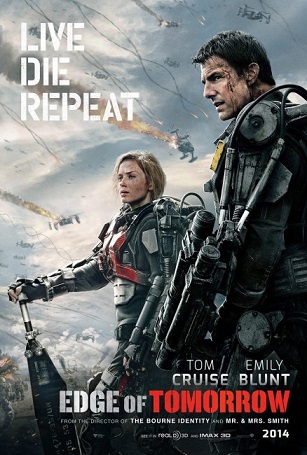 Live. Die. Repeat.
I had the chance to watch “Edge of Tomorrow” this past weekend and I was surprised by how much I enjoyed the film. It was fantastic. Here, I’ll discuss several themes found in the movie from a worldview perspective. There will be SPOILERS in what follows. I will not summarize the plot, but a summary may be found here.
Choice
Major William Cage (Tom Cruise was brilliantly cast for this role) is presented with a number of choices throughout the film, and it becomes clear that he is not a typical save-the-world type of hero. He is flawed, he has passions, he loses hope. But throughout these aspects of the film, we find the notion of choice. Will Cage has been given an extraordinary opportunity to impact the entire human race. When his blood is mingled with that of an Alpha, his death sets off the “Omega” which resets the day. Over and over again, Cage is faced with a choice: what do I do with this day?
He finds Sergeant Rita Vrataski, who is one of the only people who also realizes what’s happening, though she herself doesn’t remember the days. The question, again, is what do I do with this day? Cage’s character is forced to consider that he has the ability to possibly save all of humanity. In such a situation, what choice does he have? But he does make some choices: he chooses to try to save Rita, to save others. But at other times, he gives in to frustration, allowing members of his squad to die despite being able to prevent it. Cage is not a knight in shining armor, but he confronts us with a human thrown into an impossible situation with the highest possible stakes.
Placing the concept of choice against such a backdrop makes for good drama, but it also begs the question: what are you doing with your day? From a Christian perspective, the choices we make are extremely important–we are called to be witnesses, lights to the world–but do our choices each day reflect that? Do we, like Cage, sometimes allow injustices despite having to put forth just a little extra effort? How do our choices impact our life in Christ? The movie demands that we answer questions like these.
Sacrifice
Cage is also confronted with a kind of self-sacrifice. By admitting he is what he is, he must go through a cycle in which he dies continually, in often brutal ways, in order to try to improve, to save humanity. It is sacrifice, but a sacrifice knowing that he will be back the next day. One must ask, I think, whether that actually diminishes the sacrifice. I don’t think it does. Cage must steel himself each day knowing that death will come again, and again, and again. The only way to prevent it is to save all of humanity by destroying the Omega. Though, in the end, Cage ultimately does give up his life for humanity, only to be brought back by having his blood mingled with that of the Omega. One is left wondering whether he will retain the power or not.
The self-sacrifice of Cage (and Rita) for the sake of humanity is clearly a theme which resonates with the central Christian teaching of Jesus Christ as crucified and resurrected Lord. However, beyond the obvious parallels of giving up life for the sake of all (and subsequent resurrection/awakening), the sacrifice of going in knowing one is to die is something that resonates with the story of Christ. I have sometimes seen a challenge issued theologically to the Christian teaching saying Jesus didn’t really sacrifice himself if he knew he was going to be risen by God. But of course that hardly destroys the notion of self-sacrifice and the real price paid of death. Being risen does not destroy the sacrifice of death.
Brutality
Live. Die. Repeat.
The theme is echoed throughout the film. It may cause one to wonder about the brutality of such a story and its appropriateness, but I think that from a Christian perspective one has to incorporate the rest of the themes found in the movie. The brutality of the cross is itself something from which people shy away, but set against the backdrop of salvation, brutality can become sanctified.
Community/Individual
I have not read the manga that “Edge of Tomorrow” was based on, “All You Need is Kill,” but I have heard that there is some juxtaposition over the primacy of the community vs. individual in either. “Edge of Tomorrow” shows this kind of valuation in many ways throughout the film. First, there is Cage’s continued efforts to save Rita, despite what it might cost–including going on one part of the mission alone in order to prevent her death. Second, there is the concept of both Cage and Rita valuing the community of humanity over the self by willingly spending all the time they have left trying to defend humanity rather than find a way to survive themselves. Finally, both Cage and Rita choose to place the community over the self when rather than trying to save one or the other, they both do what needs to be done and give themselves to save humanity.
For Christians, themes of community and individual are extremely important. It is easy in the Western mindset to become obsessed with the self, but a true community of individuals exists in the body of Christ–each as important as the next. How do we go about living our lives in light of this truth?
Conclusion
There are many other themes to be explored from “Edge of Tomorrow”- what of the Alpha/Omega? What happens to Cage and Rita after the end of the film? Were there any efforts to try to make peace or reach out to the “Mimics”–the aliens that they fight against throughout the movie? These are important themes, and I’d love to get discussion of those started in the comments. For now, it should be clear that the film has many themes to reflect upon and it is well-worth seeing. What did you think of the movie? What other themes have you thought of in relation to it? Let’s get your thoughts in the comments below!
Links
Be sure to check out the page for this site on Facebook and Twitter for discussion of posts, links to other pages of interest, random talk about theology/philosophy/apologetics/movies and more!
All You Need Is Kill/Edge of Tomorrow– “Edge of Tomorrow” is based upon this graphic novel. Check out Anthony Weber’s excellent review and critique of the graphic novel from a Christian perspective. I really recommend you follow his blog as well. It’s in my top five must-read blogs, and it is worth your time to browse at length.
Movies– Read other posts I have written on the movies. Scroll down to see more!
The image is a movie poster for the film and I use it under fair use.
SDG.
——
The preceding post is the property of J.W. Wartick (apart from quotations, which are the property of their respective owners, and works of art as credited; images are often freely available to the public and J.W. Wartick makes no claims of owning rights to the images unless he makes that explicit) and should not be reproduced in part or in whole without the expressed consent of the author. All content on this site is the property of J.W. Wartick and is made available for individual and personal usage. If you cite from these documents, whether for personal or professional purposes, please give appropriate citation with both the name of the author (J.W. Wartick) and a link to the original URL. If you’d like to repost a post, you may do so, provided you show less than half of the original post on your own site and link to the original post for the rest. You must also appropriately cite the post as noted above. This blog is protected by Creative Commons licensing. By viewing any part of this site, you are agreeing to this usage policy.
Intelligent Design in Fiction – Ben Bova’s “New Earth” and Intelligent Design
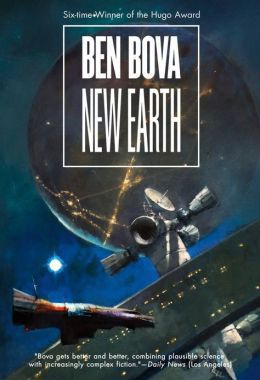 Ben Bova is a six time winner of the Hugo Award. His books hit best seller lists, and he is acknowledged as one of the all-time masters of science fiction. I’ve already explored several themes found in one of his latest books, New Earth. Here, we will look at how one might view the book as a fictionalization of the way to discover intelligent design in unexpected places. I should note that I am highly doubtful that Bova intended the book to be viewed through this lens, which makes the discovery of such a possible theme more surprising. There will be SPOILERS in what follows.
Expectations
When a team from Earth discovered the planet they dubbed “New Earth,” it defied explanation. Between a pair of stars, one of which went nova in the relatively recent past, the timing was off for such a planet to exist. The strangeness of the planet only increased when life was discovered on its surface. Finally, when intelligent life in fairly similar form to humans greet the human visitors in English, the astonishment of the explorers is complete.
But of course that’s not all that is strange about the planet. Under the surface it is actually hollow, with metal mantle that contains a gravity generator. Each of these aspects ultimately leads to the inescapable conclusion: the planet was designed for life, specifically life like that of Earth. The revelation comes from a Precursor–an ancient, sentient machine–the planet was designed to lure humans into first contact so a message of coming destruction could be delivered. The planet and the life on it were indeed designed with purpose. The eeriness of the situation is, in fact, telling.
Finding Design
In New Earth, when things show up with unexpected parameters or where they “should not be,” it is reason for further scientific exploration. Ultimately, this exploration yields the conclusion of design. I must emphasis this aspect of the book: design is not a hypothesis excluded at the outset. Instead, it is the logical outcome of putting the disparate pieces of evidence–unexpected location, age, life, types and forms of life, breathable atmosphere, hollow planet, etc.–together.
Put this in perspective: today one of the major critiques against the notion of “intelligent design” in the origins of life, its diversity, or our universe is that, essentially, one must have an a priori commitment to reject such intelligent causes as some kind of primitive magical reality in which people believe anything. However, in New Earth, epistemic openness to the possibility of design leads to real scientific discovery… of design.
I can’t help but think there is something informative here. The notion that scientific hypotheses must, by definition, exclude design not only would–if consistently practiced–remove any notion of agent causation from any situation (such as a human doing something), but could also hamper actual discovery. Methodological naturalism–the notion that science must operate in such a way as to exclude the possibility of agency–could actually be limiting the scientific enterprise. This is not to say that any unexpected observation should immediately be credited to design. Rather, my point is that if design is the most plausible of competing hypotheses, there is no reason to exclude it from the realm of possibility.
New Earth provides just such an example of how, ultimately, design was a better operating hypothesis than rival theories. When the explorers initially discussed the strange circumstances in the planet (specifically its seeming impossible location), one character remarked that [paraphrased] “It’s here! The models must be wrong!” Ultimately, this exclamation was shown to be incorrect: the models remained correct but did not account for the possibility of design.
Conclusion
One might note that Bova’s work perhaps shows the disjunct between design and naturalistic process. The juxtaposition of New Earth and its unexpected location, age, flora, and fauna against Earth’s more “typical” age and location provides readers with a reduced sense of the wonders of Earth. Moreover, in Bova’s broader canon, even Mars at one point had intelligent life upon its surface.
However, one must look to Earth and consider what we actually do observe rather than simply declaring that Earth “is here” so it must have gotten here through naturalistic means. Does Earth (or our universe) provide evidence for the hypothesis of design? That is, is design a more plausible explanation than naturalistic explanations which are offered? That’s a question which will take much exploration.
Links
Be sure to check out the page for this site on Facebook and Twitter for discussion of posts, links to other pages of interest, random talk about theology/philosophy/apologetics/movies and more!
A Solar System and Cosmos Filled with Life?- A reflection on Ben Bova’s “Farside” and “New Earth”– I explore the notion that life should be expected all over the place in a post that looks at some of Bova’s most recent works.
Our Spooky Universe: Fine-Tuning and God– Here, I present evidence that our universe indeed has been designed.
“Fitzpatrick’s War”- Religion, truth, and forgiveness in Theodore Judson’s epic steampunk tale– I take a look at the book Fitzpatrick’s War, a novel of alternative history with steampunk. What could be better? Check out some of the worldview issues brought up in the book.
I have discussed the use of science fiction in showing how religious persons act. Check out Religious Dialogue: A case study in science fiction with Bova and Weber.
Source
Ben Bova, New Earth (New York: Tor, 2013).
SDG.
——
The preceding post is the property of J.W. Wartick (apart from quotations, which are the property of their respective owners, and works of art as credited; images are often freely available to the public and J.W. Wartick makes no claims of owning rights to the images unless he makes that explicit) and should not be reproduced in part or in whole without the expressed consent of the author. All content on this site is the property of J.W. Wartick and is made available for individual and personal usage. If you cite from these documents, whether for personal or professional purposes, please give appropriate citation with both the name of the author (J.W. Wartick) and a link to the original URL. If you’d like to repost a post, you may do so, provided you show less than half of the original post on your own site and link to the original post for the rest. You must also appropriately cite the post as noted above. This blog is protected by Creative Commons licensing. By viewing any part of this site, you are agreeing to this usage policy.
Star Wars: Fate of the Jedi- a Christian reflection on the most recently completed Star Wars series
 Star Wars is not normally where I go to begin discussions about worldview. The most recently completed mini-series, however, “The Fate of the Jedi,” was full of material for discussing worldview perspectives. Here, I will only touch on a few of the many themes the series brought up. Some of these include world religions, objective morality, and theism. Of course, there will be HUGE SPOILERS for the Star Wars universe prior and up to this point. PLEASE REFRAIN FROM POSTING COMMENTS FROM OTHER STAR WARS STORYLINES.
I’ll not be summarizing the plot of the Fate of the Jedi series, which you may find by following the links for the individual books here.
World Religions and the Force
A huge part of the early stages of Fate of the Jedi involved Luke Skywalker and his son, Ben, traveling around the galaxy and visiting other various Force-using schools. These different Force-using schools paralleled, in many ways, various world religions. For example, the Baran Do Sages held onto a kind of gnostic way of knowing, where secret knowledge was preserved by a select group of masters to pass on from generation to generation. Another example is found in the Mind Walkers, who try to separate body from soul in order to walk in a completely different reality. Not only does this also seem gnostic in its bent, but it also reflects the notion of the extinction of the self found in some Eastern religions like Buddhism and Hinduism. There are a few other schools that the Skywalkers visit throughout their travels, and each has aspects of at least one world religion reflected therein.
Of interest is that the way the series approached the various parallels to world religions is that many of them appeared to be fairly obviously wrong. That is, they had a feel of wrongness to them, but they also seemed to get aspects of reality wrong. The Mind Walkers, for example, allowed their bodies to waste away while they experienced their own way of entering into the Force. One cannot help but sense a kind of aversion to this belief system, in which the body is so totally denigrated. Some of their comments also reflected a lack of concern for distinctions between good and evil. Yet again, this is a distinctive of some Eastern religions, and it is a way in which they are factually mistaken. Those who fail to make distinctions between good and evil, between reality and the mental life; they are operating under a mistaken view of reality.
The Fate of the Jedi, then, does not teach a kind of religious pluralism. Instead, it eschews pluralism for showing that some belief systems do not work. They simply do not line up with reality.
Redemption and Betrayal
The character of Vestara Khai is an extremely interesting figure. She may be the most complex character since Mara Jade. A Sith, she is captured by the Skywalkers, who initially do not trust her whatsoever (and for good reason). Yet, in a kind of typical story of conversion in the Star Wars universe, they begin to turn her to the Light Side of the Force. She realizes that her own life has not been based upon good, and she also acknowledges a distinction between good and evil. Her realization is centered around her relationship with her family and friends (such as they are). For a little while, it seems that Vestara is a true convert.
Yet the reader knows throughout that although Vestara has changed her whole way of viewing the universe, she is not entirely a convert. She still puts herself first. In fairness to her, she does so thinking that she is putting others first, and she often does seem to prioritize the needs of Ben–whom she’s come to love–over herself. But when push comes to shove, she betrays the trust of the Skywalkers in the most dire possible way, by giving away the secret identity of a loved one and dooming her to a life of dodging the Lost Tribe of the Sith. A commentary on the darker side of human nature, Khai’s life in the books also begs the question of where one goes from there: what redemption may be in store for someone who seems to have ruined all chances at salvation?
Prophecy and the Celestials
The notion of prophecy is found throughout the Star Wars universe. There was the prophecy of the “Chosen One”; later, prophecies revolved around the Sword of the Jedi and the Unification of the Force. Each of these prophecies were expected to be fulfilled. In the Star Wars universe, prophecy is the product of the Force. One wonders, however, how this plays out with what is an essentially impersonal force. It seems that in order to give revelation, there must be some kind of personal reality; for prophecy relates to the actions of persons.
Ultimately, readers encounter the Celestials–a group of beings (Father, Son, and Daughter… and later Mother) of extreme power. These beings are tied into the whole plot of the expanded universe books of Star Wars in some ingenious (and sometimes a bit questionable) ways. Although these beings may appear to parallel a kind of pantheon, it becomes clear that they are not. They may be seemingly eternal, but they are also contingent: it was entirely possible for them to be destroyed. Again, it is not these beings who drive reality; it is the Force. The Force is the power in the universe, the ‘all in all’ of the Star Wars universe. Yet, as I’ve argued above, it is hard to envision the force as entirely impersonal. It delivers prophecies and sometimes even answers the call of those in need. The “Trinity” created and driven by the Force ultimately drive the Force themselves in many ways.
Conclusion
The Fate of the Jedi series explores a huge number of issues related to worldview. I didn’t get to nearly all the major issues, let alone the minor ones, which come out throughout the series. Of interest is how the series clearly brought up world religions in such a way as to avoid pluralism, but rather provided ways to distinguish between truth and falsehood in religion. Prophecy begs for a personal being, yet the allegedly impersonal Force provides it. It was great to experience the Star Wars universe in such a way as to have it bring up so many issues of worldview in often thoughtful and, frankly, thought-provoking ways.
Links
Be sure to check out the page for this site on Facebook and Twitter for discussion of posts, links to other pages of interest, random talk about theology/philosophy/apologetics/movies and more!
“Fitzpatrick’s War”- Religion, truth, and forgiveness in Theodore Judson’s epic steampunk tale– I take a look at the book Fitzpatrick’s War, a novel of alternative history with steampunk. What could be better? Check out some of the worldview issues brought up in the book.
I have discussed the use of science fiction in showing how religious persons act. Check out Religious Dialogue: A case study in science fiction with Bova and Weber.
Source
Troy Denning, Star Wars: Fate of the Jedi- Apocalypse (New York: Del Rey, 2012).
Disclaimer: The images in this post are copyright of the Star Wars universe and I use them under fair use. I make no claims to ownership of the images.
SDG.
——
The preceding post is the property of J.W. Wartick (apart from quotations, which are the property of their respective owners, and works of art as credited; images are often freely available to the public and J.W. Wartick makes no claims of owning rights to the images unless he makes that explicit) and should not be reproduced in part or in whole without the expressed consent of the author. All content on this site is the property of J.W. Wartick and is made available for individual and personal usage. If you cite from these documents, whether for personal or professional purposes, please give appropriate citation with both the name of the author (J.W. Wartick) and a link to the original URL. If you’d like to repost a post, you may do so, provided you show less than half of the original post on your own site and link to the original post for the rest. You must also appropriately cite the post as noted above. This blog is protected by Creative Commons licensing. By viewing any part of this site, you are agreeing to this usage policy.
Really Recommended Posts 9/6/13- Dystopia, Poetry, and Creationism (+more!)
 Another look around the internet this week, as we investigate young earth creationism from a few angles, intelligent design, some dead guys, and dystopian fiction. Let me know what you think!
Christian Virtues in Dystopian Fiction– Look, if you read my blog much you’ll know I am an absolute sucker for science fiction. One recurring theme in sci-fi is that of a dystopia: attempts to make a perfect world gone wrong. Most recently, The Hunger Games is a great example of the genre. In this post, Garret Johnson explores Christian Virtues found in this genre. It is a truly fascinating post, and I highly recommend you follow the blog to see more of the like.
Dead Guys, a poem– A very clever poem with a comic about the need to look at the works of the past in order to understand the present more fully. We stand on the shoulders of giants. I have written about the need to read more of the classic defenses of Christianity and theology, along with several ways to direct reading in my post, “On the Shoulders of Giants.”
A Horse is a Horse According to Answers in Genesis– An analysis of a recent attempt to present evidence for the young earth paradigm, this post looks at the genetic lineage of various species of horse. It is pretty awesome.
Stephen C. Meyer debates Michael Ruse about intelligent design and evolution on NPR– A “snarky” summary of a recent debate between Intelligent Design theorist Stephen Meyer and atheist Michael Ruse. Check out the review and listen to the debate.
Compromising Christians Don’t Like “Evolution vs. God” Film– I am “recommending” this post not because I endorse its contents, but because I think it shows how not to interact in “in-house” debates with other Christians. Ken Ham constantly uses the scare word “compromise” as a descriptor for other Christians. Compromise on what? Ham’s preferred interpretation of the text. It is a word he uses as a weapon time and again. As for the film itself, for some other perspectives (both positive and negative), check out my previous RRP.
**As always my linking to a post does not imply I endorse all or even part of that site**
“Star Trek: Into Darkness” – A Christian Perspective
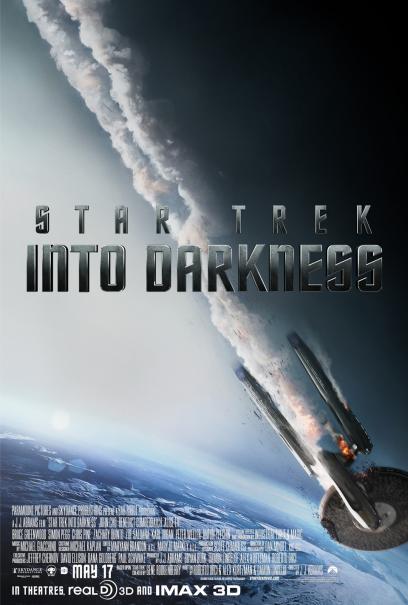 I had the chance to go see “Star Trek: Into Darkness” recently. As a big Trekkie (and Star Wars Fan–I cover all the bases of nerdom), I was extremely excited to see the film. Here, I will survey a number of worldview-level issues in the film. There will, of course, be SPOILERS in what follows.
Primitive Religion
I was a bit taken aback by the portrayal of primitive religion in the movie. At the very beginning, the crew of the Enterprise is engaged in an effort to save a primitive indigenous population. Kirk steals a scroll, to which the natives were giving obeisance. It is apparently something they worship, and when he finally unrolls the scroll to slow them down, which causes them to stop and worship, the situation is shown to be absurd. Once the Enterprise reveals itself, however, the natives immediately forsake this scroll and worship an image they draw in the dirt of the ship.
I may be a bit hyper-critical here, but I can’t help but think that this picture of primitive religion is a bit off. Sure, it’s science fiction, but the people are clearly human-like and it is easy to uncritically imagine the scene as a facsimile for how human religion may have played out. I cannot help but be extremely skeptical of this scenario. First, the notion of a bunch of simplistic idiots whose faith can shift from one moment to the next was odd. Second, the notion that primitive persons automatically worship whatever they see or cannot explain seems inaccurate. I admit that I have not studied the formation of religion as much as I hope to one day, but even what reading I have done reveals an enormous amount of debate on how religions formed and developed. No work I have read, apart from that of those with clear agendas (and little interaction with the archaeological, sociological, and anthropological evidence), has suggested that religion developed just by people seeing a bird and immediately worshiping it. Granted, the Enterprise is more than a bird, but it still seemed odd. Third, I can’t help but think that rather than immediately forsaking their holy scroll, the people would have turned to it to find guidance to discern the meaning of the events they had witnessed.
Again, I realize I am here being extremely critical, but I feel that if a movie is going to engage with religion, it should attempt to do so in an honest fashion. Trek‘s portrayal was, I think, a bit disingenuous.
The Prime Dire… wha?
Star Trek’s metaethical system essentially centers around the “Prime Directive.” The Prime Directive is complex, but essentially boils down to the notion that people should not interfere with lesser-developed cultures. Those who have seen “Into Darkness” know that in no way did the main characters follow this. But as Maureen Moser at Reasons to Believe pointed out, the Prime Directive essentially entails a kind of moral relativism wherein no one is capable of judging other cultures as morally evil. But of course this seems absurd. If, for example, one ran into a lesser-developed society which was exterminating certain groups, it seems obvious that this is a morally wrong action.
In the case of the film, one is forced to wonder–as it seems Kirk did–whether it really is morally satisfactory to allow an entire society to be destroyed simply for the sake of not being seen by that society. Is it morally right to ignore the fates of other societies?
Looking more broadly at the Trek universe one sees again and again that the characters cannot operate within the constrictions of ignoring the ills of other societies. Should we?
 Evil
Evil
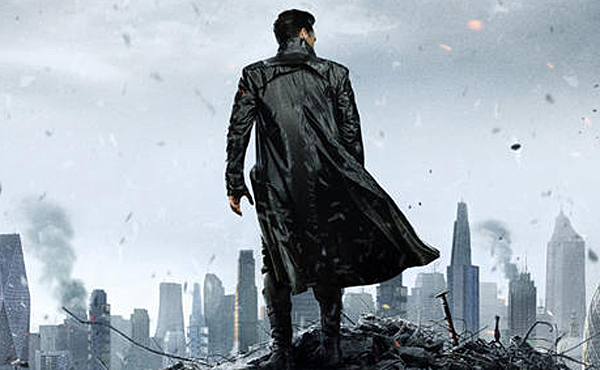
Admiral Marcus seemed to lack any kind of motivation other than a desire for militarizing the Federation. I thought this was particularly hard to believe, especially when that motivation made him not even hesitate to carry out atrocities in front of his daughter. Frankly, I saw no real reason for him to go as insane as he did, which made this part of the film harder to believe.
Khan, of course, was the big “secret” going into the movie. I called it back when the character was first shown. Of course it would be Khan. But why did Khan do what he did? He was fairly clearly motivated by revenge, but there was more to his character behind the scenes.
It was revealed that Khan was a war criminal who was conducting a genocide against any whom he found to be “imperfect.” I can’t help but think that this line, was was basically incidental to the plot, is one of the better talking points from the movie. After all, is the destruction of the “imperfect” is exactly what is taking place within our society with issues such as abortion and euthanasia. On the other side, we see the unwillingness to “give a handout” to those who are hungry or in need. Our culture is steeped in a notion where we do not value the “imperfect,” whether they be elderly, unborn, mentally disabled, or poor. Moreover, one must wonder: who defines perfection? I can’t help but think that a character like Khan is not that different from the evils which are occurring each day within our society.
Miracles
When Kirk has given his life to save the crew of the Enterprise, one crew member comments that “It was a miracle.” Spock responds simply, “There are no such things.” I admit that I was baffled by this comment. After all, the series of events which had just occurred in the space of the previous 5 minutes of the film were so over-the-top that the only reasonable explanations were either Hollywood meddling (of course, this was the case) or the hand of the divine.
I vividly remember someone a few rows down in the theater audibly scoffing when Spock said this. Why would this be a reaction to a line like this? Well, simply put, some things are so beyond probability, luck, and circumstance that they cry out for explanation.
Conclusion
Overall, I enjoyed the film. But I realize that I enjoyed it more as a Trekkie than I did at a worldview level. It seems as though the writers attempted to raise some tough questions, but never got around to providing satisfactory answers. When answers were easy to see (as in the case of miracles), a main character like Spock flatly contradicted it. Those who watch the film with worldview-glasses on will find much to discuss. I think the film is worth seeing simply to start up discussions about miracles, relativism, and even some specific ethical issues. I could see the clip at the beginning used as part of a larger discussion on the history of religion. Of course, as a Trekkie, I also think it is worth seeing for the sake of its place in the Star Trek canon. Let me know what you think.
Links
Like this page on Facebook: J.W. Wartick – “Always Have a Reason.” I often ask questions for readers and give links related to interests on this site.
Be sure to check out my other posts on movies (scroll down for more).
Star Trek’s Prime Directive and Moral Relativism– I found this post fascinating. It explores the Trek universe to discuss the metaethical view of relativism.
Engaging Culture: A Brief Guide for movies– I reflect on how Christians can engage with popular movies in order to have meaningful conversations with those around them.
SDG.
——
The preceding post is the property of J.W. Wartick (apart from citations, which are the property of their respective owners, and works of art as credited) and should not be reproduced in part or in whole without the expressed consent of the author. All content on this site is the property of J.W. Wartick and is made available for individual and personal usage. If you cite from these documents, whether for personal or professional purposes, please give appropriate citation with both the name of the author (J.W. Wartick) and a link to the original URL. If you’d like to repost a post, you may do so, provided you show less than half of the original post on your own site and link to the original post for the rest. You must also appropriately cite the post as noted above. This blog is protected by Creative Commons licensing. By viewing any part of this site, you are agreeing to this usage policy.
Abortion, fundamentalists, physicalism, and evolution: Sawyer’s “Calculating God” and some contentious issues
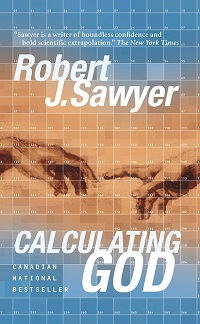 I have already written on Sawyer’s Calculating God
Fundamentalism, Religion, and Abortion
Sawyer lumps fundamentalism in with the discussions about abortion. Unfortunately, fundamentalism is portrayed in the worst possible light, not unlike in the work of Ben Bova. The religious fundamentalists here are extremists bent on destroying anything that counts as evidence against their worldview. As such, they are first introduced as blowing up an abortion clinic (86-87). Frequent readers of my site know that I write often from a pro-life perspective but also that I am very much opposed to violence in this opposition. Unfortunately, such principled opposition is not portrayed as an option in Sawyer’s work.
Interestingly the discussion of abortion in the book–intentionally or not–reveals some important details about the abortion debate. The alien, Hollus, notes the irony in being “pro-life” while also killing people who perform abortions. Yet in this discussion, Hollus reveals something of note:
Hollus looked at me [Tom Jericho, the main character] for the longest time. “These–what did you call them? Fundamentalist extremists? These fundamentalist extremists believe it is wrong to kill even an unborn child?”
“Yes” [Tom responded].
It may take a moment, but think about it: Sawyer expresses incredulity at this notion through the alien Hollus, yet in what may have been a Freudian slip, calls the unborn “children.” Yes, of course I’m opposed to killing an unborn child! In fact, this dialogue reveals exactly what is at stake in the abortion debate: if the unborn is not a human person, then who cares what you do with it? But if it is, then what relevant status difference is there between a child who is located inside the mother as opposed to outside the mother? Again, I’ve written more on this issue elsewhere, but it is important to note that even in expressing incredulity about this, there is a revealing phrase: child. It is an unborn child killed in abortion.
Disturbingly, the book touches on an issue very relevant to the personhood debate: children who are screened for disabilities. In one scene, Hollus is confronted by a child with Down’s Syndrome. He notes nonchalantly that a similar disease is almost always “screened for” in the wombs of the alien mothers (115-116). Unfortunately, this exact thing is happening right now. Unborn children who are shown as having Down’s Syndrome are being aborted inside their mothers at an alarming rate. I can’t help but see this as a modern eugenics movement: killing those we deem unworthy of life for a genetic reason. The logic that this entails is even more disturbing.
Of course the same fundamentalists who bombed the abortion clinic were also out to destroy any evidence for evolution. They sought to destroy a fossil exhibit which they saw as an affront to God. Thus, I can’t help but think that the way Sawyer presents fundamentalists is a bit disingenuous. Not all fundamentalists are incapable of reason and violent. Indeed, almost no fundamentalists are like this! Thankfully, there are positive examples of religious persons in Calculating God, including Tom’s wife.
In one poignant scene, Tom–who is dying from cancer–struggles with the fact that he has been confronted with evidence for the existence of a god. He considers famous atheists who purportedly went to death, all the while denying God’s existence to the end. Yet Tom himself gets down on his knees to pray. When he does so, though, he considers the words of someone from his past: “The Lord works in mysterious ways.” He can’t help but react violently against this:
Such bull. Such unmitigated crap. I felt my stomach knotting. Cancer didn’t happen for any purpose. It tore people apart; if a god did create life, then he’s a shoddy workman, churning out flawed, self-destructing products. “God,” [he prayed] “I wish–I wish you had decided to do some things differently.” (230-231)
Interestingly, in the book, cancer turns out to actually have a purpose… in the sense of being a side-effect of something great: the ability to fuse genetic codes with other intelligently designed species. Here it seems Sawyer has employed a great deal of imaginative techno-babble to explore the notion of a physical god, but it also has hints of a greater good theodicy akin to that of Swinburne.
Physicalism
The discussion of physicalism in Sawyer’s work is very brief, but enlightening. There is a variety of substance dualism here in the sense of emergence. That is, in Sawyer’s fictional world, intelligence and “mind” emerges from matter once complexity reaches a certain threshold. This is similar to the theories of emergence theorists like William Hasker. I can’t help but find this a bit strange. The people who argue for this type of theory are frequently the same who are very hostile to the notion of anything beyond the physical realm, yet they argue that something aphysical can indeed “emerge” from matter itself. Surely this is a leap of the imagination! That matter has creative force simply because it can reach a certain level of complexity seems to me patently absurd.
Not only that, emergence suffers from a second major problem. Namely, if our “mind” is simply a product of complexity in matter, then our “intelligence” is entirely supervenient upon physical complexity. Indeed, our intelligence is a product of that complexity and therefore cannot operate independently of that matter. Therefore, it is hard to see any kind of properties that our minds would have that would be capable of maintaining free will or even rational thought on this theory. Indeed, I have trouble seeing how this theory would be any different from physicalistic monism.
Evolution
The simple notion of evolution is a given in the book. No, it is not friendly to any who are unwilling to accept the notion of “macroevolution,” as the term is used in relevant literature. All the intelligent beings depicted in the book had evolved from a (potentially distinct) distant ancestor.
Darwinian evolution is simply assumed as truth in Calculating God. Or is it? The deity presented in the book is not very conducive to undirected evolution via natural selection and chance. It is portrayed as hurling asteroids at the planets where life was developing in order to press a “reset” button on the creatures that were currently dominant there. It also shown that this deity prevented other catastrophes from happening on these planets, thus interfering with natural selection. Indeed, the evolution depicted here is eerily similar to intelligent design, wherein the process is guided by a deity with a specific aim.
Indeed, one could argue that the entire book is an argument for intelligent design, albeit divorced from much of the theological framework that many of that movement’s frameworks operate within. Yet I can’t help but find this part of Sawyer’s argument (if, indeed, the intention is to make the argument that theists have it all wrong) is completely off. After all, the “god” of Sawyer’s universe is imperfect and concrete in the sense of physically existing. But this works against his concept of deity as being capable of coordinating the events it brings about. Granted, he could perhaps continue to increase the power of this deity beyond what is clearly outlined in the book, but there are hints that the deity is capable of knowing what is happening on places where it is not present, that it is capable of knowing what will happen with certain directions for evolution, and what will happen at the end of the universe. These work against the notion of God as a kind of blundering physical entity that just happens to be supremely powerful. Indeed, the god of calculating God may not be as hostile to Christianity as it initially seems. It serves as a pointer towards the true God of spacetime.
Links
Like this page on Facebook: J.W. Wartick – “Always Have a Reason”
Check out my other post on this book: Aliens that believe in God: The theological speculations of Robert Sawyer’s “Calculating God”
I have discussed the use of science fiction in showing how religious persons act. Check out Religious Dialogue: A case study in science fiction with Bova and Weber.
What would it mean if we discovered life? I have reflected on the possibility: Alien Life: Theological reflections on life on other planets.
Our Spooky Universe– I make the case for the intelligent design argument for the existence of God, which is heavily used throughout Calculating God.
Check out my other looks at popular level books. (Scroll down to see more!)
Source
Robert Sawyer, Calculating God
SDG.
——
The preceding post is the property of J.W. Wartick (apart from citations, which are the property of their respective owners, and works of art as credited) and should not be reproduced in part or in whole without the expressed consent of the author. All content on this site is the property of J.W. Wartick and is made available for individual and personal usage. If you cite from these documents, whether for personal or professional purposes, please give appropriate citation with both the name of the author (J.W. Wartick) and a link to the original URL. If you’d like to repost a post, you may do so, provided you show less than half of the original post on your own site and link to the original post for the rest. You must also appropriately cite the post as noted above. This blog is protected by Creative Commons licensing. By viewing any part of this site, you are agreeing to this usage policy.
Aliens that believe in God: The theological speculations of Robert Sawyer’s “Calculating God”
The interplay between worldviews and science fiction is very strong. In any writing, an author’s viewpoint will show through, but I think that it is particularly true in sci-fi. For in science fiction, the author is most frequently presenting a view of the world as it should be or as it should not be. The speculative future can be used as a foil through which the reader views reality in a new way. Often, science fiction will touch upon theological issues.
Robert Sawyer’s Calculating God
Fine Tuning
The most immediately striking and pervasive theme of Calculating God is that aliens show up on earth, and they believe in God. In fact, they take the existence of God to be a scientific certainty. The main character of the book, a paleontologist named Tom Jericho, is very skeptical throughout. Here’s the kicker, though, the aliens have been convinced of the existence of God through the evidence–specifically, the fine-tuning argument. Said argument is presented throughout the course of the book in interactions between Tom and Hollus, an alien paleontologist.
What is surprising is how much depth the book goes into while exploring the argument. Yes, Sawyer does fudge the argument a bit by allowing the aliens the possibility of a grand unified theory of science as well as a few other fictionalized aspects of the argument, but overall the fine-tuning argument he presents is very similar to the modern fine-tuning argument.
Not only that, but the characters Sawyer created go to great lengths to explore objections to and defenses of the fine tuning argument. For example, there is a discussion on p. 144ff (mass market paperback edition) in which Hollus and Tom discuss some objections to fine tuning. Tom is arguing against the probability of God:
“All the actions you ascribe to God could have been the doing of advanced aliens” [said Tom].
“There are… problems with your argument,” said Hollus, politely. “[E]ven if you dispense with the need for a god in recent events–events of the last few billion years; events after other conscious observers had emerged in this universe–you have done nothing to dispense with the relative strengths of the five fundamental forces [its science fiction, so there is an extra force], who designed the thermal and other properties of water, and so on. And therefore what you are doing is contrary to the razor of Occam you spoke of: you are increasing, not reducing the number of entities that have influenced your existence…”
The book is replete with debates like this, and the inevitable conclusion is that, shock of all shocks, God exists. I don’t say that sarcastically, I mean that I was genuinely surprised that the book affirmed God exists. But what kind of God?
God Exists… but?
It should be clear that in Calculating God, God is nowhere near the God of classical theism. In fact, one could almost argue that what Sawyer has offered here is a materialistic supplanting of God. The “god” of this work is essentially a super-powerful alien which is capable of swallowing the enormous energy output of a supernova, while also capable of designing our biology and fixing the constants of the universe during the early stages of the Big Bang.
God’s action is described purely in non-transcendent language. For example, the aliens confirm that god caused ice ages and mass extinctions on all the planets with intelligent life. The way this was accomplished was a matter of some speculation–perhaps God generated a dust cloud by using particles from across the galaxy to shield the planets from light and lower the temperature, or perhaps God redirected an asteroid or two to send them hurtling at the planets with life that needed a ‘jump start’ of evolution (146ff).
So why think that this is an image of god supplanting the classical theistic God? Well, clearly many who use the teleological argument are intending for it to point towards a creator God. What Sawyer has offered is a more naturalistic explanations of these events. Yes, there is a ‘god’ in the sense of a being capable of tampering with the very fabric of our universe, but that ‘god’ is itself trapped within the spatio-temporal boundaries of the known universe. In fact, god is said to subsist by recreating itself via a kind of reproductive method and passing one generation through a Big Crunch (think of a bouncing universe model).
Now what?
Calculating God offers a unique look at theology from a science fiction perspective. The fine tuning argument is presented in full force–even enhanced by some fudging of the science–and it leads to the inevitable conclusion that god exists. Yet this ‘god’ is not at all amenable to the god of Christianity or classical theism. So what should we do with this book?
Well, it is important to note that it is a work of fiction. The author clearly adds in some extra ‘fluff’ to make the fine tuning argument more powerful than it is (and I think it is quite powerful as it stands). And really Sawyer’s shoehorning in of a materialistic entity that is able to fiddle with physics boils down to hand-waving. Again, it is fiction, but it is important to note that Sawyer’s attempt to supplant the God of classical theism simply doesn’t work. Think of it this way: how would a purely physical being, however powerful, manage to transcend the physical universe in such a way as to literally rewrite the laws of physics? Extremely interesting science fiction? Yes. Compelling argument? No.
So where are we left? Sawyer does present the fine tuning argument in a way that is quite compelling, even when one strips away all the layers of fiction over it. It seems to me that, at a minimum, readers are left with a rock in their shoe: how do we explain away all this fine tuning without going beyond the cosmos? Sawyer’s own proffered answer, while entertaining fiction, remains that: fiction.
Other Issues
I have not yet even begun to delve into the depths of Sawyer’s Calculating God. The book covers an extremely broad array of topics related to science and faith as well as the secular-religious [false] dichotomy. For example, he discusses abortion in a few places, and I think the view the characters favor is very inconsistent. There is also some clear portrayal of the religious “other” as only a fundamentalist who seeks to halt scientific advancements. Yes, Sawyer panders to Christians in a few places, but the overall look at religious persons seems to be fairly negative (apart from Tom’s wife). I wish I could do justice to each of these topics, so I think I may follow this post up with another touching on more. For now…
Conclusion
Ultimately, Sawyer’s work is a simply phenomenal read. The amount of scientific, ethical, and religious issues upon which it touches is stunning, and readers will be forced to deal with the argument. Sawyer has done an excellent job using fiction for what I think it is called to do: inspire, entice, and force thought. Readers will be uncomfortable. The work will challenge people to really think about the arguments, and to think about the offered solutions.
Links
I have discussed the use of science fiction in showing how religious persons act. Check out Religious Dialogue: A case study in science fiction with Bova and Weber.
What would it mean if we discovered life? I have reflected on the possibility: Alien Life: Theological reflections on life on other planets.
Our Spooky Universe– I make the case for the intelligent design argument for the existence of God, which is heavily used throughout Calculating God.
Check out my other looks at popular level books. (Scroll down to see more!)
Source
Robert Sawyer, Calculating God
SDG.
——
The preceding post is the property of J.W. Wartick (apart from citations, which are the property of their respective owners, and works of art as credited) and should not be reproduced in part or in whole without the expressed consent of the author. All content on this site is the property of J.W. Wartick and is made available for individual and personal usage. If you cite from these documents, whether for personal or professional purposes, please give appropriate citation with both the name of the author (J.W. Wartick) and a link to the original URL. If you’d like to repost a post, you may do so, provided you show less than half of the original post on your own site and link to the original post for the rest. You must also appropriately cite the post as noted above. This blog is protected by Creative Commons licensing. By viewing any part of this site, you are agreeing to this usage policy.
Really Recommended Posts 2/1/13
Thinking About ‘Future Things,’ Part 1– One area I will admit I have very little knowledge about in relation to Christian theology is eschatology. This series by Reasons to Believe provides an introductions to many aspects of eschatology and provides a fairly balanced view. I enjoyed it greatly and came away feeling much better informed. I recommend checking out the whole series.
Wukong’s Dilemma– An interesting look at Buddhist philosophy and the dilemma of a works-based religious system. I found this a very fascinating post.
Lance Armstrong, Thor and Ideal Heroism– A comparison of ‘real life heroes’ to the idealized heroes we construct. I found this post very insightful. I highly recommend it.
Christianity and High Beauty (With Pictures!)– A simply excellent post on the relation of the Christian worldview to beauty. There is much to be said about the importance of aesthetics in reality. This post hints at many of these themes.
Tim Keller, Women, and Ignoring your own rules– I found this post really excellent. It evaluates some of the Gospel Coalition’s stance on women in light of the rules that one of its adherents, Tim Keller, holds regarding discussion with other people. The problem is that they make many claims about egalitarians which simply are not true.
Critiquing Mormon Theology: An Innovative Approach– A presuppositional apologist examines various doctrines of Mormonism and offers a critique. It’s an interesting look into how the presuppositional approach can be integrated into a broad apologetic.
The Cross and the Stars– This is a fascinating look at some Roman Catholic science fiction authors. Readers of this site know I love science fiction and write about it frequently under popular books.
“Fitzpatrick’s War”- Religion, truth, and forgiveness in Theodore Judson’s epic steampunk tale
The roar of our guns was more than my ears could hear. The slaughter in the two rivers was more than one man’s mind could absorb… A sort of madness over came us; we had an infinity of bullets and an infinity of Chinese before us. Every one of our men felt he was killing thousands… Death ran wild. How terrible it is, I thought, that the Yukons should be so good at this. (Judson, 319-320)
Fitzpatrick’s War
Brief Overview of the Plot
Fitzpatrick’s War is written as an autobiographic tell-all from the perspective of Sir Robert Mayfair Bruce. He is writing about Lord Isaac Prophet Fitzpatrick, a man who, like Alexander the Great, had conquered the world at a young age and also died young. Bruce was a close friend of Fitzpatrick (whom he calls Fitz) and so reveals a number of less-than-flattering aspects of his personality in his account of the life of the former ruler. It describes Fitzpatrick’s rise to power, his preparations for war during behind his father’s back, and his post-war rule.
Fitzpatrick is revealed as a man who lusted for power and ruled ruthlessly. He participated in assassinations, set up deaths, and mercilessly slaughtered his enemies. He used biological and chemical weapons and burned his enemies to the ground, all simply because of a desire to conquer the world. He had delusions of grandeur, envisioning himself as a kind of modern Alexander who would outdo the other man in every way.
The Timermen are another major player throughout the book. They are mysterious in their motivations and have supreme power over all space travel and most communications. Bruce reveals a number of unflattering details about these people as well.
The book has been edited by Doctor Professor Roland Modesty Van Buren, who is hostile to Bruce’s recounting of the events. Van Buren does not believe that Bruce is telling the truth about the great Fitzpatrick and believes he is instead attempting to make his own name live on through his lies. Thus, the book is footnoted throughout with Van Buren’s corrections to Bruce’s “lies.”
Religion
Religion is pervasive throughout Judson’s work. The characters constantly quote from the Bible to justify their positions which frequently seem unbiblical and evil. Although the society at large seems to think highly of the Bible, the United Yukon Church itself seeks to take over all religion and has repressed other expressions of religion for quite some time.
Yet Bruce is fully aware of how the Christian faith is being abused throughout the work for evil ends. In one scene, he is speaking privately with Fitzpatrick, who asks Bruce whether God can love someone who will wreak such evil on the world. Specifically, he asks about King David in the Bible. Fitzpatrick wants to know whether he himself is like King David and why God would love someone who so frequently strayed from righteousness. Bruce realizes that it is here that he could have influenced Fitzpatrick to turn from the great evils he would perpetuate. Yet, coveting power, Bruce makes the decision he would regret for the rest of his life and backs Fitzpatrick’s notions of glory and God. He writes:
I would today give up my soul if I could go back to that moment and tell Fitz he could still turn back from his awful destiny. I grant that he had at this date already committed murder. It was equally true that he had not yet made his oceans of blood… The world could have still been saved from his wrath… (204)
Instead, Bruce caves into his own lust for power and desire to please Fitzpatrick. He tells Fitzpatrick:
God loves you… There are a few special men… who, like David, walk through History as Angels walk through thunderstorms. Those about them become wet with sin, while they remain untouched. They may seem to be bad men, these special ones. If we judge them by the standards we hold ordinary men to, they are the worst of men. Ordinary standards do not apply to them. They are doing God’s work here on earth, and as we do not know God’s motives or His ends we cannot judge His servants… You [Fitzpatrick] will be said to be God’s beloved. (204-205)
Bruce regrets this discussion with Fitzpatrick for the rest of his life and struggles with the notion that he can be redeemed.
Fitzpatrick himself seeks a kind of syncretism of all religions, but realizes that it will not ultimately work. He keeps his old tutor, Dr. Flag, around mostly to feel superior about himself. But he had initially attempted Dr. Flag’s project of making all faiths equally valid. One discussion in the book is particularly revealing. Dr. Flag is expounding upon the notion that all religions are essentially the same, but Marshal Jeremiah Truth Hood challenges him on this notion:
“Sir, am I to understand you believe all major religions profess the same core beliefs?” [Hood Asked]
“Yes…” [replied Flag]
“Then that would mean, let us say, that the Chinese and the Arabs share the same beliefs on marriage and family?” asked Hood… “Can we say,” asked Hood, “that Arabs and the Chinese value life to the same degree? Or is human life another secondary question?”
“I mean specific, general matters. You see, such as treating others well.” [Responded Flag]
“You say cultures are essentially the same,” continued Hood. “How would you explain, sir, the different Histories of North and South America? Both continents are inhabited by Christians. The majority in both continents are of European descent…” (364-366)
Hood’s point is well taken. The fact of the matter is that all religions are not the same and to say otherwise devalues the religious persons themselves. The way that Judson presents this dialogue allows for some real insight into the issue: how is it possible to say that, at their core, all cultures or religions are the same when they are so radically different?
Evil, Repentance, and forgiveness
There is great evil in the world, and Bruce’s world is no different. Much of the evil is caused by Fitzpatrick and the war which he created in his lust for power.
Ultimately, Fitzpatrick is reduced to a broken, suspicious man who becomes incapable of even doing the simplest tasks on his own. Marshal Hood is greatly distressed over his own incapacity to make amends for the evils he had done during the War. Hood is sitting with Fitzpatrick and several other Lords when they watch a video from an aerial shot of China and see the destruction their war had done to the country. The bodies were strewn about and death was everywhere. Bruce, too, feels the need for repentance: “There were no words in my vocabulary I could utter that could justify this abomination, no act of contrition that could ever take away what I had done” (410). Hood himself begins quoting from the Bible, Joel chapter 1. He relates the evils they have done to the crimes that Joel cries out against. Later, Hood is found among the Chinese, trying to help them by growing food and feeding them. It was his way of making amends.
Bruce himself finds forgiveness only through his wife, who speaks with clarity on God’s will and his grace. It seems to me that this theme of forgiveness is grounded thoroughly in the Christian notion wherein people are to forgive each other. We act as God’s agents here on earth, and so we are called to repentance and forgiveness.
Charlotte
Bruce’s wife, Charlotte, is a paradigm example of a powerful, spiritual, loving woman. Van Buren, the hostile editor of the book, has several choice words to describe Charlotte, whom he believes is overstepping her bounds by attempting to be equal to Bruce. She often seems overbearing, but ultimately she strives to be equal to Bruce, and to temper the poor qualities of Bruce’s character. Charlotte is Roman Catholic, a religion which is violently oppressed in Yukon, until Fitzpatrick allows for religious freedom to endorse his own pluralism. Charlotte’s character is important throughout the work as one who provides the positive example of womanhood and the equality of men and women.
History and Doing History
History (always with a capital “H”) is an area of extreme interest in the world of Fitzpatrick’s War. Fitzpatrick himself continues to utter a recurring theme: History is written by the winners. Above, there was a discussion of King David. Fitzpatrick in that same conversation presses the notion that King David rewrote the history books in order to paint him in the most positive light. Later, in his own life, Fitzpatrick would do the same thing. He had the greatest poets and historians of his age come and write histories about him which were highly favorable in their portrayals of himself.
There is active repression of historical knowledge due to the fact that the culture at the time the book is set in believes that the “Electronic Age” (20th and 21st centuries) was a blight upon all History. During one scene, Bruce is being questioned about the Electronic Age and readers discover that only one history exists from that period. The reason is because “[A]ll other Histories of that era were perverted by the strange ideologies of the day…” (35).
As one who has studied historiography (and written on the method regarding Jesus), I can’t help but think of all the issues these discussions raise throughout the book. Interested readers should check out the post linked in the parentheses for one brief account of historiographic method.
Conclusion
I have read few books which have had such a great depth of knowledge about so many subjects as is demonstrated in Fitzpatrick’s War. The book is just phenomenal, and it touches upon so many areas of great importance for Christians and non-Christians alike. As with all great fiction, it does this without becoming overbearing, but instead focuses upon the story. Judson develops wonderful characters whom the reader can relate to, love, or loathe. He explores heady themes with wit and precision. I highly recommend this book to my readers.
Links
Religious Dialogue: A case study in science fiction with Bova and Weber– I explore two excellent science fiction books alongside each other to see how they speak to religious dialogue.
The Presumption of Pluralism: How religious pluralism devalues all religious persons– I discuss religious pluralism, a topic which is brought up throughout Fitzpatrick’s War and show how it fails.
Check out more of my looks at popular level books. (Just scroll down to see more!)
Hieropraxis is an excellent site which focuses upon a number of cultural issues and how they relate to Christianity. I really cannot recommend this site highly enough.
Empires and Mangers– Another phenomenal site which looks at many popular level works from a Christian perspective. The posts are consistently fantastic. I encourage you to follow this site closely.
SDG.
——
The preceding post is the property of J.W. Wartick (apart from citations, which are the property of their respective owners, and works of art as credited) and should not be reproduced in part or in whole without the expressed consent of the author. All content on this site is the property of J.W. Wartick and is made available for individual and personal usage. If you cite from these documents, whether for personal or professional purposes, please give appropriate citation with both the name of the author (J.W. Wartick) and a link to the original URL. If you’d like to repost a post, you may do so, provided you show less than half of the original post on your own site and link to the original post for the rest. You must also appropriately cite the post as noted above. This blog is protected by Creative Commons licensing. By viewing any part of this site, you are agreeing to this usage policy.

 J.W. Wartick - Reconstructing Faith