apologetics
Does good always eliminate evil?
 One of the key components of the composition of the problem of evil (at least its logical variety)* is the notion that good will eliminate evil. The late J.L. Mackie put it this way:
A wholly good omnipotent being would eliminate evil completely; if there really are evils, then there cannot be any such being. (Mackie, 150, cited below)
Simply put, this statement and any like it seem fairly obviously false if made without any rather major qualifications. After all, it seems clear that the total elimination of evil is not actually a logically necessary end for a good being, even an all-good, all-powerful being.
C. Stephen Evans presented a case to show that Mackie’s statement (and those like it) are simply mistaken. He noted that the principle that good must eliminate evil seems to be blatantly false without a number of qualifications. He argued that there are some evils which good beings will allow in order to bring about a greater good. The analogy he used was that of parents not allowing their children to ride in automobiles. After all, this would ensure that they would never be involved in the evil of a car crash, but surely it would also prevent greater goods of interaction with friends, learning to drive and the responsibility that comes with, and more (127). However, Evans was quick to note that a deity is by no means directly analogous to a human parent. The resources God would have to prevent evil are infinitely greater than that of a human parent.
In the case of God, however, God cannot bring about the logically impossible. Rather than going for a full-on theodicy (an account of why evils exist), Evans argued that certain goods are impossible to achieve without some evil. Thus, courage necessitates some kind of suffering (128). He did not argue that this notion alone provides a comprehensive theodicy; but for our purposes it is enough. It seems clear that the notion that good must eliminate evil is not only unsupported by argument (it is an a priori assumption), but also patently false. That is, we have evidence that at least some evil must be allowed in order for some good to be brought about.
I want to be clear about my thesis in this post: I am not claiming to have a comprehensive explanation for all evil everywhere. My claim is rather that good does not, by necessity, eliminate evil. That’s all. I believe that I have established this thesis. If so, then Mackie’s argument (and those like it) fail.
*The logical problem of evil is basically an argument that there is a contradiction in theistic belief related to God’s power and goodness and the existence of evil.
Links
Be sure to check out the page for this site on Facebook and Twitter for discussion of posts, links to other pages of interest, random talk about theology/philosophy/apologetics/movies and more!
Sources
C. Stephen Evans, Faith Beyond Reason: A Kierkegaardian Account (Reason & Religion)
J.L. Mackie, The Miracle of Theism (New York: Oxford, 1982).
SDG.
——
The preceding post is the property of J.W. Wartick (apart from quotations, which are the property of their respective owners, and works of art as credited; images are often freely available to the public and J.W. Wartick makes no claims of owning rights to the images unless he makes that explicit) and should not be reproduced in part or in whole without the expressed consent of the author. All content on this site is the property of J.W. Wartick and is made available for individual and personal usage. If you cite from these documents, whether for personal or professional purposes, please give appropriate citation with both the name of the author (J.W. Wartick) and a link to the original URL. If you’d like to repost a post, you may do so, provided you show less than half of the original post on your own site and link to the original post for the rest. You must also appropriately cite the post as noted above. This blog is protected by Creative Commons licensing. By viewing any part of this site, you are agreeing to this usage policy.
Really Recommended Posts 2/28/14
 Kids Say the Darnedest Heresies– How should we react when kids don’t understand essentials of Christian doctrine? Jason Wisdom offers some interesting advice for how to deal with the situation… and it’s not just to laugh it off! I’d be curious to see what parents think of this post!
A Critical Review of Myron Penner’s “The End of Apologetics”– “The End of Apologetics” recently received some acclaim from Christianity Today, which I find a bit shocking, to be honest. Rather than declaring the “end” of Apologetics, we should be encouraging its bolstering and spread. I very highly recommend this post for some looks into the issues Penner’s book raised.
Kevin Lewis: Sharing the Gospel with Atheists (VIDEO)- One of my professors from Biola University, Kevin Lewis, here shares his thoughts on how to share the Gospel with atheists. Kevin Lewis is a witty, awesome lecturer, and I think you’ll enjoy this as much as I did!
Option (COMIC)- A fun way to look at the rather famous “trilemma” from C.S. Lewis. Here, it is presented in comic form.
A Smart Movie that Questions Evolution (Yes It’s Possible!)– There’s a movie coming called “I Origins” which explores intelligent design and the New Atheism through… yes! a storyline! Check out this look into the flick. It’s apparently out already but I can’t seem to track it down anywhere. Have you seen it? What are your thoughts?
Book Review: “A Visual Defense” by Robert Velarde
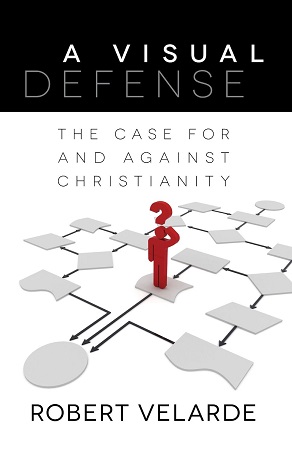 Robert Velarde’s A Visual Defense: The Case for and Against Christianity
Positives
The clear and extremely important benefit of the work is that it really does provide a way for people to envision how a number of arguments related to the truth of Christianity would look mapped out. The way that Velarde brings this out is by making a flow chart with the argument mapped out alongside objections and rebuttals.
The flow charts themselves are extremely helpful, because they really do allow one to sit with the book and use a finger to trace how the argument would work in practice. Although I was familiar with the arguments given, I felt as though I learned some things simply by seeing the arguments lined up in such a way as to follow them pictorially.
The format of the book is also very helpful. Each chapter begins with a flow chart that addresses a specific topic via an argument(s). The different parts of the flow chart have different shapes depending on whether they are the conclusion, assumption, premise, or rebuttal. These flow charts have every bubble numbered. The chapter following the flow chart simply lays out the numbers in order and explains in greater detail the conclusion, the premises, the objections, and the rebuttals. Thus, the format is highly readable and helps to draw out the flow chart more readily. I found myself flipping back to the flow chart very frequently as I read through the book.
Negatives
This book cannot really be used in isolation. One either needs another stack of books to get to the heart of many of the topics introduced or to come to the book with a working knowledge of a wide range of apologetics topics. The numbered outline of each part of the flow chart often gives only a small paragraph in defense of rather major apologetics topics. For example, the defense of the argument from religious experience comprises a page and a half and three bubbles on the flow chart (46-47). The argument itself is an area of major interest for me and, having read ten books and multiple articles on the topic, I realize it is a really massive issue. But due to the format of the book, this diminishes its value somewhat, as it seems like it would best be used as part of an apologetics class or an introduction to the issues related to the defense of the Christian faith. However, in order to do so, one would need a hefty general apologetics book(or a couple more specialized ones) to use alongside it.
I’m sure this was a conscious decision on the part of Velarde and others–the book is surely intended to be used in this fashion–but that doesn’t make the price of entry for newcomer any less.
The “visual” aspect of the visual defense could also be better integrated in the body of the work. The flow charts are extremely helpful, but it perhaps could have been even better to have a few more of them scattered about to use as defenses of various premises or other issues. I’m not a visual learner, so I admit it is hard for me to brainstorm on this, but I also think that the book could have perhaps integrated more pictures to show how the argument moves from one point to the next.
Conclusion
Robert Velarde is to be commended for taking a unique approach to introducing apologetics. The importance of providing a way for visual learners to understand these arguments in a pictorial fashion should not be understated. That said, the book essentially requires others to be read alongside it. I would imagine this book would be most useful for professors or small groups wanting to introduce the topics as opposed to a book to pick up and hand to a friend interested in apologetics. It would be a great tool to utilize in an apologetics class to introduce each major argument and then proceed into lengthier defenses of each.
Links
Be sure to check out the page for this site on Facebook and Twitter for discussion of posts, links to other pages of interest, random talk about theology/philosophy/apologetics/movies and more!
Source
Robert Velarde, A Visual Defense: The Case for and Against Christianity
I was provided with a review copy of the book from Kregel. I was in no way asked or required to offer any specific type of review. My thanks to the publisher for the review copy.
SDG.
——
The preceding post is the property of J.W. Wartick (apart from quotations, which are the property of their respective owners, and works of art as credited; images are often freely available to the public and J.W. Wartick makes no claims of owning rights to the images unless he makes that explicit) and should not be reproduced in part or in whole without the expressed consent of the author. All content on this site is the property of J.W. Wartick and is made available for individual and personal usage. If you cite from these documents, whether for personal or professional purposes, please give appropriate citation with both the name of the author (J.W. Wartick) and a link to the original URL. If you’d like to repost a post, you may do so, provided you show less than half of the original post on your own site and link to the original post for the rest. You must also appropriately cite the post as noted above. This blog is protected by Creative Commons licensing. By viewing any part of this site, you are agreeing to this usage policy.
Book Review: “What’s Your Worldview” by James N. Anderson
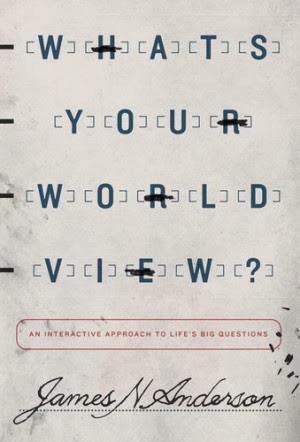 When I first learned about What’s Your Worldview?: An Interactive Approach to Life’s Big Questions
The book’s format is set up such that it outlines something (like what it means to say there is objective truth), then asks whether you believe in it. If you choose yes, you flip to one page; if no, you flip to another. Ultimately, your answers will land you in a worldview. Each worldview has a few pages of brief discussion on how it views reality and what problems might arise with that worldview.
I decided to indeed choose my own adventure and start out reading it from an atheist’s perspective. I figured that would give me a good look into the approach. I quickly realized that answering the questions in such a way got me to “dead ends.” If I said “No” to whether I believed in objective truth, I flipped to the worldview of “Relativism,” had the view explained and some major issues brought up. The end. Full stop. Or is it?
Anderson encouraged readers to go back to the previous question after any worldview evaluation if they didn’t like the conclusions drawn. Thus, continuing the example of relativism, he argued that it is self-defeating: after all, if all truth is relative, is that itself a relative truth? If so, why should I hold to it? Back to the questions! The book encourages such flipping back and forth. It encourages engagement in a way many apologetics books do not.
There is, however, one major drawback to the approach. That is, because it is a book about worldviews, and because it is only just over 100 pages long, there’s not a lot of meat to the discussion. If you’re looking for major critiques and interactions with response-rebuttal-counterpoint on various worldviews, this is not the book you’re looking for. Alongside that, there is a real danger of oversimplification. For example, in the “worldview” section on “nihilism,” it was stated that nihilism is “the view that there are no objective values” (Kindle location 1022). Properly speaking, this only refers to moral nihilism, not nihilism as a full system, which would entail a whole system of “nothings”: no meaning, no objective values, possibly even no reality one can access, etc. Due to the short length, much nuance to each worldview must be lost. Possible objections to Anderson’s brief critiques abound, and readers may be left thinking their own view was perhaps a bit too blithely dismissed.
Of course the length could just as easily be seen as an advantage. One can very easily pick it up and read it in an afternoon; one could hand it to an interested neighbor; it lends itself to use in a brief study period (youth group? adult forum?). These are all advantages. Readers just need to be aware of some disadvantages as well.
I was also very impressed by the depth of insight Anderson gave to rival theist worldviews. Once one answers that there is at least “a” deity, the book still has many more questions to peruse: do you think there is only one?; is Jesus God?; did God communicate with humans? If so, was this communication open?; etc. I found these to be fun to flip through and very informative and on-point. This isn’t an apologetics book that focuses purely on the existence of God; it is, really, a book on worldviews: complete totalities. That said, remember it is not intended to be comprehensive, by any means.
What’s Your Worldview is a really fun apologetics book. The fact that I’m able to write that shows how unique it is. I don’t know of any other book in the same format. It’s refreshing and handy. That said, at times it does feel just like those old “Choose Your Own Adventure” books; you come to the end too quickly. It was a conscious decision on the part of the author/publisher to keep it light and easy to read. And, to that extent, they succeeded. I just found myself wanting a little more. However, I do think this would be an excellent book to pick up and hand off to a friend or relative who may have doubts or may want to explore the beliefs of various worldviews. Just remember the caveat: the book may raise more questions than it answers; so be prepared to have some reasons for the hope within (1 Peter 3:15).
Links
Be sure to check out the page for this site on Facebook and Twitter for discussion of posts, links to other pages of interest, random talk about theology/philosophy/apologetics/movies and more!
Source
James N. Anderson, What’s Your Worldview?: An Interactive Approach to Life’s Big Questions
I received a review copy of the book through Crossway. I was not obligated by the publisher to give any specific type of feedback whatsoever.
SDG.
——
The preceding post is the property of J.W. Wartick (apart from quotations, which are the property of their respective owners, and works of art as credited; images are often freely available to the public and J.W. Wartick makes no claims of owning rights to the images unless he makes that explicit) and should not be reproduced in part or in whole without the expressed consent of the author. All content on this site is the property of J.W. Wartick and is made available for individual and personal usage. If you cite from these documents, whether for personal or professional purposes, please give appropriate citation with both the name of the author (J.W. Wartick) and a link to the original URL. If you’d like to repost a post, you may do so, provided you show less than half of the original post on your own site and link to the original post for the rest. You must also appropriately cite the post as noted above. This blog is protected by Creative Commons licensing. By viewing any part of this site, you are agreeing to this usage policy.
Sunday Quote! – Is Monotheism from Egypt?
 Every Sunday, I will share a quote from something I’ve been reading. The hope is for you, dear reader, to share your thoughts on the quote and related issues and perhaps pick up some reading material along the way!
Is Monotheism from Egypt?
I completed Winfried Corduan’s In the Beginning God: A Fresh Look at the Case for Original Monotheism recently. I have to say, it is one of those books which caused a paradigm-shift for me. It made me realize many mistakes I had made in my assumptions regarding the area of study for origins of religion. I’ll review it in a while when I have time to really sit down and write. Here, we’ll examine the notion that monotheism came from Egyptian polytheism. Corduan wrote:
The people were exhorted to acknowledge Aten, but there was only one way in which they could worship him… the way in which commoners… had always been instructed to worship the gods, by worshipping the pharaoh and his wife… Thus, if Aten were the one and only God, and he could only be worshiped by worshipping the Pharaoh, this was hardly a ‘monotheistic reform.’ Instead, it was the ultimate in egotism and delusions of grandeur. (312)
Corduan’s statement is the climax of several pages of examination of the cult of Akhenaten and the religion of Egypt. Essentially, his point is that one can hardly conclude from this consolidation of worship of deity into one form of worshipping the Pharaoh and his wife that this served as the source for later monotheism, specifically Hebrew/Israelite worship.
What do you know of Egyptian religion and the worship of Aten/the cult of Akhenaten? Have you examined your conclusions regarding this knowledge? What do you think about monotheism and Egypt?
In the Beginning God is an extraordinary study into the origins of religion and the theory of original monotheism. I highly recommend you grab a copy and read it.
Links
Be sure to check out the page for this site on Facebook and Twitter for discussion of posts, links to other pages of interest, random talk about theology/philosophy/apologetics/movies and more!
Source
Winfried Corduan, In the Beginning God: A Fresh Look at the Case for Original Monotheism
SDG.
——
The preceding post is the property of J.W. Wartick (apart from quotations, which are the property of their respective owners, and works of art as credited; images are often freely available to the public and J.W. Wartick makes no claims of owning rights to the images unless he makes that explicit) and should not be reproduced in part or in whole without the expressed consent of the author. All content on this site is the property of J.W. Wartick and is made available for individual and personal usage. If you cite from these documents, whether for personal or professional purposes, please give appropriate citation with both the name of the author (J.W. Wartick) and a link to the original URL. If you’d like to repost a post, you may do so, provided you show less than half of the original post on your own site and link to the original post for the rest. You must also appropriately cite the post as noted above. This blog is protected by Creative Commons licensing. By viewing any part of this site, you are agreeing to this usage policy.
Really Recommended Posts 2/14/14- Rival theism, evidence for faith, apologetics, and more!
The Winter Olympics are on and I am currently experiencing -7 wind chill… which feels warm compared to what we’ve had! Thus, we have an owl post edition of the Really Recommend Posts, which features another round of great reads from across the internet! This week, we peruse rival theism, reasons for apologetics, evidence for faith, and more!
A complex god with a god complex– Edward Feser here discusses some criticisms of classical theism from a rather unexpected avenue: a rival theistic system which does not hold that God is the simplest possible being, among other things. Rather than being an atheistic critique, this is a criticism from a variant on theism. Feser’s comments are insightful and interesting. He is a Thomistic philosopher who continually has extremely insightful thoughts. I’ve been reading through one of his books–The Last Superstition–and a post on a quote from it has spurred much discussion.
J. Warner Wallace: Why are you a Christian?– The importance of apologetics is brought poignantly to the forefront in J. Warner Wallace’s comments in this post. Wallace is the author of Cold-Case Christianity, a simply fantastic apologetics book, and his comments here offer a stirring call to instruction in the faith.
Okay, you’re right. There’s no evidence for faith– Tom Gilson has been at the forefront of responding to Peter Boghossian, the Atheist Tactician. Here, he continues his series of posts regarding Boghossian’s critique of faith in general. The comments are highly insightful.
The Legitimate Use of Thomas Aquinas in Apologetics– What might Thomas Aquinas have to instruct us in apologetics? Here a few major aspects of Aquinas’ continuing contributions to apologetics are discussed.
Gary Habermas- SALT 2013 (VIDEO)- Gary Habermas is a leading expert on Jesus’ Resurrection. Here is a speech he gave at last year’s SALT (Strategic Answers for Life’s Thoughts) conference.
Lawrence Krauss vs. John Lennox on science and faith
 I’ve been catching up on my podcasts and I recently listened to a dialogue between an atheist, Lawrence Krauss, and a theist, John Lennox on questions about science and faith. It was on the Unbelievable? program (something I strongly suggest you listen to weekly) [listen here]. Thus, it was less a debate than it was a moderated discussion. Here, I’ll only focus on a couple questions that came up in their dialogue.
How and Why
According to Lawrence Krauss, science cannot answer “Why” questions but only “how” questions. Lennox brought up the example of a Ford motor car sitting on a driveway [I added this last bit for clarity]. He argued that one can explain the “how” it got there but there still remains the question of “why” it was made. Thus, the “why” questions remain “real” questions whether or not science is capable of investigating them. Interestingly, Krauss took a different tact than I expected in his rebuttal: he argued that the “why” question (at least in the Lennox case) is reducible to a “how” question. That is, one could explain how Henry Ford designed it, had it built, and then someone bought it and drove it to where it is sitting.
But of course redefining terms does little to address the actual questions at hand. Lennox was keen to show that questions about “why” are indeed meaningful. It seems that Krauss’ only response is to either say “no they’re not” or redefine actual “why” questions into “how” questions and argue there still are no “why” questions. The move is not very subtle, nor is it successful.
Purpose in the Universe?
Krauss made several comments regarding purpose in the universe. First, he seemed to suggest that in order to assert the universe has purpose, one must know what that purpose is. Second, he argued that the universe is indeed quite wasteful if it were intelligent designed with purpose. Third–in response to Lennox’s statement that Krauss and other cosmologists admit that for life to exist there would have had to be several generations of stars (to produce enough carbon for carbon-based life)–he alleged that there could be all sorts of other life forms we don’t know about. I’ll address these each briefly in turn.
First, it seems clear that if one wants to suggest the universe has a purpose, one does not have to know what the purpose is. We can see this all the time in our own interactions with the world. Suppose I see a pile of blocks on the floor in an office building stacked in piles of various heights and arranged by color. I can immediately recognize that there must have been some purpose behind it–for the arrangement by color is quite telling–but I may not be able to pinpoint the exact reason. Perhaps some five-year-old was amusing herself by stacking blocks by color. Perhaps an adult was making art by stacking them in that way–a kind of reminiscence on childhood. There could be any number of other reasons. But the fact that I don’t know the reason doesn’t mean there is no reason. Similarly, I may claim the universe has a purpose even without claiming to know what said purpose is.
Second, Krauss seems to make the error that if the universe were designed for humans, that would have to be the only purpose involved in the entire universe. I’ve addressed this claim in some detail elsewhere, so for now I’ll just say that Krauss’ mistake lies in assuming that if there is a purpose behind the universe it must be the only purpose.
Third, Krauss missed the point of Lennox’s rebuttal. For the life we are dealing with is clearly carbon based. For Krauss to stretch the question to possible scenarios of non-carbon based life is to miss the thrust of his own argument. He was asking for purpose in this universe; he was not asking for purpose in any possible universe. Thus, his statement is off base. Moreover, I tend to agree with scientists like Iris Fry and the like who agree that it is implausible to suggest life could be based on silicon or other things apart from carbon. That is a debate that would take us far afield, so I’ll leave it at that.
Science Doesn’t Care About Philosophy
Lennox, towards the end of the discussion, pointed out that Krauss’ claim to define nothing as something is nonsense. Krauss’ response? He jettisoned philosophy immediately: “Science doesn’t care about philosophy,” he said [he may have said “Scientists don’t…” but after listening to it a few times, I couldn’t tell which he said]. If you don’t see a problem with this, you should. First, the statement itself is philosophical. Second, any number of claims he made throughout his discussion with Lennox were philosophically grounded. Third, science depends upon philosophy to operate. Fourth, as I’ve demonstrated elsewhere, Krauss’ own work is directly dependent upon philosophy.
Documents Aren’t Evidence
Krauss said that documents don’t count as evidence. His assertion was based upon the notion that a book like The Great Gatsby is a document, but it is not taken as factually true. Apart from purely begging the question regarding the genre of the Bible alongside The Great Gatsby, Krauss is also severely mistaken in his claim that documents aren’t evidence. According to Krauss’ claim, we should essentially dissolve our government, because our system of government is based upon a document: the Constitution. But the Constitution cannot count as evidence for anything! So this begs the question: why should we go to it to see whether or not Lawrence Krauss should have freedom to express his vitriol against religious people?
The problem is that Krauss is just wrong here. Documents do count as evidence. One needs to acknowledge the genre, intent, etc. regarding a document, but for Krauss to utterly dismiss documents as evidence is absurd. One may ask whether Krauss wrote any books. He could, presumably, produce documents to show that he did indeed write books. But on his own standard of proof, he hasn’t presented any evidence whatsoever. Thus, on Krauss’ definition of evidence, I conclude that Krauss has never written anything.
Conclusion
There is much more that I could interact with in regards to this conversation between Krauss and Lennox, but I’ll leave it for now with the comments I have. I suggest readers go listen to the dialogue themselves. It seems to me clear that Krauss continues to flounder in areas outside his expertise. He misused the notion of an “appeal to authority” when he applied it regarding Lennox’s citation of Nagel, he continued to make errors regarding non sequitors, he dismissed his own books as evidence that he wrote anything, and his comments on purpose betray a lack of reflection on the topic. Krauss continues to show that he is basically ignorant of even the implications of his own claims.
Links
Be sure to check out the page for this site on Facebook and Twitter for discussion of posts, links to other pages of interest, random talk about theology/philosophy/apologetics/movies and more!
Shoulders of Giants? -Philosophy and Science in Context, or “Krauss Jumps off!”– I argue that Krauss is mistaken to claim that philosophers know nothing. I further argue that Krauss’ own work is dependent upon philosophy, so he ironically (ignorantly?) dismisses the very basis for his work.
William Lane Craig vs. Lawrence Krauss- Thoughts and links– I summarize and analyze a debate between Lawrence Krauss and the Christian philosopher and theologian William Lane Craig. I think this debate was devastating to Krauss’ positions regarding his atheism.
Follow this link to access the audio for the dialogue between Lennox and Krauss.
SDG.
——
The preceding post is the property of J.W. Wartick (apart from quotations, which are the property of their respective owners, and works of art as credited; images are often freely available to the public and J.W. Wartick makes no claims of owning rights to the images unless he makes that explicit) and should not be reproduced in part or in whole without the expressed consent of the author. All content on this site is the property of J.W. Wartick and is made available for individual and personal usage. If you cite from these documents, whether for personal or professional purposes, please give appropriate citation with both the name of the author (J.W. Wartick) and a link to the original URL. If you’d like to repost a post, you may do so, provided you show less than half of the original post on your own site and link to the original post for the rest. You must also appropriately cite the post as noted above. This blog is protected by Creative Commons licensing. By viewing any part of this site, you are agreeing to this usage policy
“Peter Boghossian, Atheist Tactician”- A brief look at the e-book by Tom Gilson
 I recently downloaded Tom Gilson’s evaluation of Peter Boghossian’s epistemology for my Kindle. The work is witty but also to the point. Gilson launched a full-on attack against Boghossian’s mission to create atheists. The best parts of the book–and let me be clear, I think the entire work is essential reading–were his critique of Boghossian’s view of faith and his appeal to Christians regarding the importance of the topic.
Gilson makes it clear how important it is to provide a reasoned answer to Boghossian’s view. However, he goes much further than that; he notes that Boghossian’s mission is specifically to destroy the faith of Christians. For any Christian, this should be a disturbing thing to hear. Unlike many other atheists, Boghossian seems to have a plan: he’s going to actively work to proselytize Christians for atheism. He may be called an atheist missionary. Gilson called Christians to see this as a serious threat for Christianity. It’s not that Christianity doesn’t have the resources to answer Boghossian’s arguments; instead, it is that we have not equipped ourselves to do so. The average Christian-in-the-pew is basically incapable of refuting Boghossian-esque reasoning, and so will, possibly, have their faith seriously challenged by arguments which are basically vacuous.
Part of Boghossian’s mission, Gilson notes, is to redefine the meaning of faith. For Boghossian, faith should always be understood as “pretending to know what one does not know” (kindle location 118). Gilson notes that not only would such a redefinition be catastrophic for people of faith [of “pretending to know…”], but it is also a completely invented definition with no basis in reality. That is, Boghossian sems to be pretending to know what he doesn’t know. On his own definition, he is very faithful.
Why think that Boghossian’s definition is wrong? Gilson offers a number of points. Among them is the fact that the redefinition of the term cannot account for its usage among the faithful. Gilson shows how the redefined “faith” would lead to an absurd meaning for any number of texts in the Bible. Not only that, but he also cites a number of Christian thinkers to demonstrate that the usage of “faith” is much more grounded in evidence and true belief than it is grounded in a “pretend” world. By the time Gilson has finished dismantling Boghossian’s usage, it becomes clear that the latter is truly living in his own fantasy. The problem is that if Christians do not equip themselves to combat it, the dream may become reality.
There are a number of other excellent portions of this quick read, such as Gilson’s direct interaction with a number of Boghossian’s interviews and writings. He also approaches Boghossian’s work from several angles, providing a solid ground for the refutation of the atheistic work.
In short, I implore you to pick up and read this work by Gilson. He has done an excellent job of showing how Boghossian’s work may prove to be a challenge to Christianity. But the greater service he has done is provided a tool to equip believers to combat this challenge. Read it, spread it. Keep the faith.
Links
You may get Gilson’s e-book for free at this link [I am unsure of how long this offer will last]. You may also support the ministry of Ratio Christi by purchasing the e-book.
Be sure to check out the page for this site on Facebook and Twitter for discussion of posts, links to other pages of interest, random talk about theology/philosophy/apologetics/movies and more!
Source
Tom Gilson, Peter Boghossian, Atheist Tactician (2014).
SDG.
——
The preceding post is the property of J.W. Wartick (apart from quotations, which are the property of their respective owners, and works of art as credited; images are often freely available to the public and J.W. Wartick makes no claims of owning rights to the images unless he makes that explicit) and should not be reproduced in part or in whole without the expressed consent of the author. All content on this site is the property of J.W. Wartick and is made available for individual and personal usage. If you cite from these documents, whether for personal or professional purposes, please give appropriate citation with both the name of the author (J.W. Wartick) and a link to the original URL. If you’d like to repost a post, you may do so, provided you show less than half of the original post on your own site and link to the original post for the rest. You must also appropriately cite the post as noted above. This blog is protected by Creative Commons licensing. By viewing any part of this site, you are agreeing to this usage policy.
Really Recommended Posts 1/17/14- Gospels, Abolish Human Abortion, the Kalam, and more!
 Here we have another round of really recommended posts. This one features a couple posts directed inwards at fellow Christians or people with whom we agree alongside a range of interesting topics. It is important to maintain a high standard, so sometimes it is necessary to give criticism where it is due. Drop a comment, let me know what you thought.
A Fundamental Flaw Behind Abolish Human Abortion– A group which I came out strongly in support of some time ago has really started to take a few turns with which I cannot agree. The group is known as Abolish Human Abortion. I think a lot of what they were doing is quite excellent, but I cannot abide by a few of their primary beliefs. Check out this great analysis of one of the major issues with the group.
The kalam cosmological argument defended in a peer-reviewed science journal– The title says it all, though the post does have some nice quotes and bits of information. The kalam cosmological argument is an extremely powerful argument for the existence of God. I have a few posts on it myself.
Dear Parents with Young Children– The importance of bringing your children to church is inestimable. Moreover, choosing a church where Law and Gospel are clearly proclaimed, and a basis for belief is preached is essential. Thank you to those parents who bring their children to church! Check out this great post about the topic.
The Case for the Eyewitness Status of the Gospel Authors– Are there any reasons to think those who wrote the Gospels knew what they were talking about? Here, J. Warner Wallace–who, as a homicide detective, has some experience with eyewitness accounts–argues that the Gospels show good evidence for thinking they are eyewitness accounts.
A Review of 5 Views of Biblical Inerrancy– I do not agree with everything Norman Geisler has to say, but I think portions of this review are of critical importance. I haven’t quite finished the whole article, and I’ve only just started reading the book, but I thought this post was worth passing along for others who find the topic of interest.
Really Recommended Posts 1/10/14- Divergent, marriage, Boghossian, and more!
Dear readers: As a thank you for stopping by, check out my latest “Really Recommended Posts.” Here, we’ll look at the Young Adult book Divergent (coming to theaters soon!), marriage, Augustine, abortion, Boghossian’s atheist propaganda, and some great free Bible inserts for apologetics. Check ’em out. As always, feel free to drop your own Really Recommended Posts by leaving a comment with your recommendation (and why). Also, feel free to leave a comment on your thoughts on any of these posts.
Free E-Book Download: Peter Boghossian, Atheist Tactician– Let me tell you right now, you should immediately download and start reading this free e-book. It is a response to Peter Boghossian’s A Manual For Creating Atheists. Boghossian is intentionally trying to destroy Christianity and proselytize for atheism. I have not finished the book yet, but what I have read has been excellent. It comes with my recommendation.
Divergent– Anthony Weber over at Empires and Mangers, one of my favorite sites (and one you should follow!), reviewed the YA Book Divergent. He examined it from a worldview perspective. The book is being made into a major motion picture and has been hailed by some as the “next Hunger Games.” That means we’re going to run into it everywhere. What questions can we bring to the table? There are SPOILERS in this linked post.
Modern Marriage Concerns– How might egalitarianism play out in marriage? Here, a brief post explores the nature and possible concerns regarding marriage in an egalitarian system.
A Free Bible Insert to Say Thanks for a Great 2013– Check out this link to get some great printable Bible inserts related to apologetics to tuck into the pages for quick access. I highly recommend checking them out.
Augustine’s Confessions: Some Lessons for apologetics– Augustine’s work, Confessions, is an autobiographical account of parts of his life. In it, he provides some insights into what is needed for an apologetic approach even in our church today.
‘He killed my baby !’: The day I lost my daughter to the Culture of Death– A powerful story about awakening to the wrongness of abortion.

 J.W. Wartick - Reconstructing Faith