ethics
Response to an Article on Welfare Recipients in Seattle
 The purpose of this blog is to discuss things related to the Christian worldview. I tend to try to avoid political issues, but I recently saw a number of friends sharing an article entitled “Workers in Seattle Have Their Precious $15 Minimum Wage. But Now They Want Fewer Hours” and I wanted to respond. I will be analyzing the article from the Christian worldview perspective.
Summary of Article
The article in question points out that Seattle’s minimum wage was raised, but some who are working minimum wage have asked to work fewer hours so they do not lose their government benefits. The author writes:
[E]mployees of a non-profit group in Seattle who’ve achieved their glorious goal of the $15 minimum wage are actually asking their employers for FEWER hours. The reason? Now that they make more money, they no longer qualify for subsidized housing. So they figure if they work fewer hours, they’ll make less money and they can stay in their government-provided cheap apartments –
After sharing a few quotes, the author comments:
HOLY SOCIALISM, BATMAN!
Basically, they want a “living wage” (whatever the heck THAT means) AND they still want all the freebies the government gives them. Because that’s TOTALLY the point of working hard and being independent.
A Response
First, I ran the numbers given in the article regarding minimum wage and cost of living in Seattle. It’s fairly straightforward, as the author shared a quote (without disputing it) of the prices involved. According to the article, the cost of a one-bedroom apartment is 1200$ a month. The cost of child care was about 900$ a month. That adds up to 2100$. Now we do the math on the wages. $15 an hour, 40 hours a week, about 4.5 weeks per month = 2700$. Now this is basically granting the most possible money because some months do only get 4 pay checks, but we’ll go with it.
The math therefore shows that, ignoring any taxes whatsoever, there would be 600$ left over a month for utilities, food, auto/renters/life/health insurance, transportation and related costs, and the like.
Whatever else might be in question here–whatever economic theories one favors–these are the numbers the article itself acknowledges. For Christians, this is the kind of data that we should seek out and try to form our opinions around. Of course we need to have economic practices which are sustainable, but as Christians we must also keep in mind the demands on our conscience towards the “other” in need. We should seek more information and be cautious about making broad statements on either side; whether we agree or disagree. Misrepresenting liberals is just as bad as misrepresenting conservatives.
A Christian Moral Response
The bottom line is that there is absolutely no way around the biblical teaching about caring for the poor and needy–even if we don’t like their “life choices.” Thus, the tone of this article is highly inappropriate as it mocked those who were in need throughout with phrases like “I’m not addicted to government welfare…” thrown in as snide remarks towards those who are on some kind of welfare.
A Christian response to this should be to immediately shut down any kind of mockery of other persons, period. There is no space in the Christian moral system for carelessly decrying those who are in need. Regarding the exact phrase in question, suppose we take it literally–what is the Christian response to addiction? Should it be to point out how we ourselves are not addicted and move on from the one who is? I don’t think so. I believe that we must continue to help those in need–even if addicted. That said, the dubiousness of taking the meaning literally is of course clear. It, like the rest of the article, was directed as mockery of those in need and those who have rival economic theories trying to help them.
I’m not trying to favor one theory over another–whether pure capitalism or pure socialism or some mix is best is a topic for a completely different day and post–the issue involved is rather the tone we should carry even in disagreement. Rather than mock, should we not aid and instruct as needed?
A Rejoinder
The most frequent response I received when I shared concerns related to the article was that I needed to be instructed on economic theory.
Note that I have not commented on whether we need to raise minimum wage or whether we need to make it a “living wage.” I don’t particularly want to enter that debate and the quagmire that follows it. My comments have been on the ethical concerns with the article and its tone. We have looked at the numbers involved, and I suggested those should be a consideration regarding a Christian response to such issues. Other than that I think that we must at all costs avoid the kind of tone present in the article. We ought to treat others as we would be treated.
Conclusion
Finally, as a practical concern, would not a reasoned response sharing one’s own disputes about the economic theory(ies) involved in the article be more convincing than poking fun at the specifics of another’s situation? I believe so. I certainly don’t respond well when the beliefs I hold are mocked. That is a surefire way to shut down conversation rather than spur it forward. If the intent is to convince, would not a winsome approach work better?
Links
Be sure to check out the page for this site on Facebook and Twitter for discussion of posts, links to other pages of interest, random talk about theology/philosophy/apologetics/movies and more!
SDG.
——
The preceding post is the property of J.W. Wartick (apart from quotations, which are the property of their respective owners, and works of art as credited; images are often freely available to the public and J.W. Wartick makes no claims of owning rights to the images unless he makes that explicit) and should not be reproduced in part or in whole without the expressed consent of the author. All content on this site is the property of J.W. Wartick and is made available for individual and personal usage. If you cite from these documents, whether for personal or professional purposes, please give appropriate citation with both the name of the author (J.W. Wartick) and a link to the original URL. If you’d like to repost a post, you may do so, provided you show less than half of the original post on your own site and link to the original post for the rest. You must also appropriately cite the post as noted above. This blog is protected by Creative Commons licensing. By viewing any part of this site, you are agreeing to this usage policy.
Abortion, the Violinist Analogy, and Body Parts

A Pro-Life Demonstration at the Supreme Court. Courtesy Wikimedia Commons.
The “violinist analogy” is an argument for the permissiveness of abortion. It is based on granting that the unborn is a human person, but argues that it is still permissible to kill the unborn because it may be justified as “non-intentional killing.” The argument originated with Judith Jarvis Thomson, to the best of my knowledge. She put the analogy like so:
You wake up in the morning and find yourself back to back in bed with an unconscious violinist. A famous unconscious violinist. He has been found to have a fatal kidney ailment, and the Society of Music Lovers has canvassed all the available medical records and found that you alone have the right blood type to help. They have therefore kidnapped you, and last night the violinist’s circulatory system was plugged into yours, so that your kidneys can be used to extract poisons from his blood as well as your own. [If he is unplugged from you now, he will die; but] in nine months he will have recovered from his ailment, and can safely be unplugged from you. (Thomson, cited below)
The argument seems to have much force. After all, who wouldn’t agree that you may be well within your rights to unplug yourself from this violinist. You aren’t obligated to him in any way.
There are a number of glaring difficulties with this argument (see this post for one argument against it), but the one I want to focus on now is tied to the recent controversy over the allegations of Planned Parenthood selling body parts. I’ve already pointed out one of the biggest problems is the question of “Whose body parts are they?” However, we may see that this controversy also undercuts the violinist analogy in a very brutal way.
Thomson has clearly massaged the analogy to make it seem fairly innocuous. After all, unplugging the violinist is fairly non-violent, right? You’re just having him removed from you so that you are no longer in the state of having to support him with your own body. But Thomson’s analogy needs to be amended. After all, Planned Parenthood itself acknowledges that they’re getting body parts from abortions and donating them. Thus, we might now fix Thomson’s argument for her to make it more accurate.
When the choice is made to “unplug” the violinist, it isn’t just unplugging him. Instead, those doing the unplugging are concerned with making sure that the violinist’s body parts come unplugged intact. They thus break his body apart in such a way as to preserve the heart, liver, brain, and other parts which might be used for science or saving the lives of other people. The violinist is not merely unplugged, but torn quite literally limb-from-limb in order to remove him.
Clearly, Thomson’s analogy has missed this point–a point Planned Parenthood itself acknowledges. For some reason, Thomson decided to smooth over these clinical facts in her “defense of abortion,” choosing instead to present it as something as simple and innocent as an “unplugging.” But the reality is that the analogy should point out that the choice involved is not merely to unplug the violinist but rather to have him effectively ripped from the one to whom he is hooked up in such a way that dismembers him.
There is good news, though: the parts of the violinist can now be used for research!
Source
Thomson, J. “A Defense of Abortion”. Philosophy and Public Affairs 1:1 (Autumn 1971): 47–66. Citation and quote found on Wikipedia.
Links
Be sure to check out the page for this site on Facebook and Twitter for discussion of posts, links to other pages of interest, random talk about theology/philosophy/apologetics/movies and more!
Be sure to check out my other posts in which I argue for the pro-life position. Particularly relevant to the present discussion are “From conception, a human” and “The issue at the heart of the abortion debate.”
SDG.
——
The preceding post is the property of J.W. Wartick (apart from citations, which are the property of their respective owners, and works of art as credited) and should not be reproduced in part or in whole without the expressed consent of the author. All content on this site is the property of J.W. Wartick and is made available for individual and personal usage. If you cite from these documents, whether for personal or professional purposes, please give appropriate citation with both the name of the author (J.W. Wartick) and a link to the original URL. If you’d like to repost a post, you may do so, provided you show less than half of the original post on your own site and link to the original post for the rest. You must also appropriately cite the post as noted above. This blog is protected by Creative Commons licensing. By viewing any part of this site, you are agreeing to this usage policy.
Whose body parts are they?
The recent revealing of a video that purports to show a Planned Parenthood employee talking about selling the body parts of aborted fetuses has caused a stir around the web. There have been, predictably, many different reactions to this video. Some have been skeptical, noting that Planned Parenthood itself claims to only receive reimbursement for the transportation of this “tissue.” Others have jumped to accuse Planned Parenthood of human trafficking. Tired labels rejected by those being labeled have been tossed back and forth, like “anti-abortion activists”; “murderers”; and the like.
I’m not going to dive into the controversy over whether careful editing made the video say more than it actually does, or whether Planned Parenthood needs to be shut down. It seems like investigations are already underway to look into this issue more deeply.
What I instead want to offer is a brief discussion of the question that is behind all of this controversy: “Whose body parts are they?”
To whom do these hearts, livers, lungs, and the like belong? Which body are they a part of? How you answer these questions is extremely important. If these are part of the mother, then the controversy may still stand–selling one’s own body parts would be questionable ethically. But if they’re not, then what?
The position that maintains these are just parts of the mother cannot be maintained. Does a mother, upon pregnancy, begin to grow an extra heart, extra limbs, an extra brain? How many brains do human beings have?
To maintain that this “tissue” is merely part of the mother that is being donated or sold for research (or whatever purposes) is absurd on its face. One would have to actually believe–not just argue for the sake of maintaining their position–that during pregnancy, a mother grows new parts of her body such as a brain, legs, and the like, which are all characterized by different DNA (unless cloned) and around 50% of the time has a different gender. That is, not to put too fine a point on it, one would have to actually claim that women grow penises.
So I ask you, dear readers. Whose body parts are they?
The outrage for selling these body parts may be on point. But how much greater should the outrage be at the fact that the body parts in question are those not of the mother, but of a distinct living organism with separate DNA?
Links
Like this page on Facebook: J.W. Wartick – “Always Have a Reason.”
Be sure to check out my other posts in which I argue for the pro-life position. Particularly relevant to the present discussion are “From conception, a human” and “The issue at the heart of the abortion debate.”
SDG.
——
The preceding post is the property of J.W. Wartick (apart from citations, which are the property of their respective owners, and works of art as credited) and should not be reproduced in part or in whole without the expressed consent of the author. All content on this site is the property of J.W. Wartick and is made available for individual and personal usage. If you cite from these documents, whether for personal or professional purposes, please give appropriate citation with both the name of the author (J.W. Wartick) and a link to the original URL. If you’d like to repost a post, you may do so, provided you show less than half of the original post on your own site and link to the original post for the rest. You must also appropriately cite the post as noted above. This blog is protected by Creative Commons licensing. By viewing any part of this site, you are agreeing to this usage policy.
Sunday Quote!- Drizzt Do’Urden on Equality

Every Sunday, I will share a quote from something I’ve been reading. The hope is for you, dear reader, to share your thoughts on the quote and related issues and perhaps pick up some reading material along the way!
Drizzt Do’Urden on Equality
For those who don’t know, Drizzt Do’Urden is a chracter from a fantasy series by R.A. Salvatore set in the “Forgotten Realms.” Drizzt is a Dark Elf who rejected the evil ways of his race and went to the surface in order to avoid their constant attempts to kill him. The books are mostly made up of standard swords and sorcery types of action, but there are occasional thoughtful interludes. In one, Salvatore, writing as Drizzt, discusses the concept of “equality” and how it might best be done:
Beware the engineers of society, I say, who would make everyone in all the world equal. Opportunity should be equal… but achievements must remain individual. – Drizzt Do’Urden (572, cited below)
I found this a fairly poignant statement in the midst of what is generally “light” reading for me. In our world, we have all kinds of inequality: there is income inequality, racial inequality, and all kinds of other ills. But a world in which all inequality is eliminated would be horrifying. In such a world, how could we appreciate things like sports, for all people would be forced to perform at the same level? How could we appreciate heroism? Moral fortitude? Any number of “inequalities” are actually good things. I couldn’t code a program to save my life; thank goodness people who are unequal to me at coding are in charge of maintaining this website!
The quote, then, has several subtle messages in it. I think it is worth Christians contemplating on. We should be working to reduce the inequalities of opportunity. People should not be unable to pursue their God-given gifts simply because of their circumstances. But we must beware the danger of trying to crush all inequality and make the world into a sea of sameness.
What are your thoughts? What inequalities should me most actively be working to combat? Is it true that opportunity should be equal?
Links
Be sure to check out the page for this site on Facebook and Twitter for discussion of posts, links to other pages of interest, random talk about theology/philosophy/apologetics/movies and more!
Sunday Quote– If you want to read more Sunday Quotes and join the discussion, check them out! (Scroll down for more)
Source
R.A. Salvatore, Streams of Silver in The Legend of Drizzt, Book II (Wizards of the Coast, 2013).
SDG.
Book Review: “Bulls, Bears, and Golden Calves” by John Stapleford
 John Stapleford’s Bulls, Bears and Golden Calves
Often, when I read about someone putting forward a “Christian” view of economics, I get worried because what happens all too frequently is that the “Christian” view is taken to be equivalent to some existing economic theory and then anyone who disagrees with that theory is seen as being sub-biblical. By contrast, Stapleford does a fantastic job of never giving into the temptation to endorse wholly any one system, noting the impact of human sin and the real injustices that are possible in any economic system. Thus, he successfully navigates a kind of balancing act between liberal and conservative economic views throughout the book.
That said, his often incisive criticism of various economic systems from different angles is sure to challenge almost any reader. In favor of pure free market economies? Stapleford notes that these are the best way to increase overall wealth in a system, but calls them out for often falling victim to greed or ignoring the poor. All in favor of socialist systems? Stapleford argues that these systems can trample the rights of the individual while also making it difficult to anticipate and plan for the needs of societies. No one is safe from the cogent analysis offered in this book.
After outlining numerous ethical theories and practices that Christians can apply to the public square and economics, the book proceeds with a number of practical chapters that apply these to specific situations, whether it is international economics, the environment, and more. The topics treated are extremely wide-ranging and the analysis offered continues to be challenging and insightful throughout. Just as an example, the chapter on gambling points out the failure of several arguments put forth to attempt to ethically justify the practice, while also pointing to numerous injustices in the system. This kind of detailed analysis is found throughout the book on every topic Stapleford touches.
That said, the main downside of the book just is its broadness. At times, readers may feel blown away by how much information is being fed to them. The sheer amount of data can feel a bit overwhelming. Also, because of the broadness of the book, some of the solutions offered feel over-simplified and may leave readers wishing for more analysis.
Overall, Bulls, Bears, and Golden Calves is a simply phenomenal read that will challenge all readers to live out a Christian life in the realm of economics.
The Good
+Eye-opening facts about numerous economic practices
+Excellent chapters on specific economic issues with applicable insights
+Bridges the seeming gap between liberal and conservative views in multiple places
+Consistently puts forth a Christian and holistic view of economics
The Bad
-Sheer amount of data can be overwhelming
-Some solutions offered seem over-simplified
Conclusion
I would highly recommend Bulls, Bears and Golden Calves
Disclaimer: I received a review copy of this book from InterVarsity Press. I was not obligated to provide any specific type of feedback or review nor was I required to give a positive review.
Source
John Stapleford, Bulls, Bears and Golden Calves
Links
Be sure to check out the page for this site on Facebook and Twitter for discussion of posts, links to other pages of interest, random talk about theology/philosophy/apologetics/movies and more!
Book Reviews– There are plenty more book reviews to read! Read like crazy! (Scroll down for more, and click at bottom for even more!)
SDG.
——
The preceding post is the property of J.W. Wartick (apart from quotations, which are the property of their respective owners, and works of art as credited; images are often freely available to the public and J.W. Wartick makes no claims of owning rights to the images unless he makes that explicit) and should not be reproduced in part or in whole without the expressed consent of the author. All content on this site is the property of J.W. Wartick and is made available for individual and personal usage. If you cite from these documents, whether for personal or professional purposes, please give appropriate citation with both the name of the author (J.W. Wartick) and a link to the original URL. If you’d like to repost a post, you may do so, provided you show less than half of the original post on your own site and link to the original post for the rest. You must also appropriately cite the post as noted above. This blog is protected by Creative Commons licensing. By viewing any part of this site, you are agreeing to this usage policy.
The “Dependency” Argument for Abortion: A Dilemma
 One common argument for the pro-choice position is what I shall call the “dependency” argument for abortion. This argument suggests that because the unborn is dependent in a unique way upon the mother, abortion is permissible. For example, one might argue that because a fetus cannot survive without the direct use of the mother’s body, the unborn does not have a right to life. The status of dependency upon another being in such an intimate and unique fashion means that abortion is permissible, according to this argument.
One way to respond to this argument is to show that the dependency of the unborn upon the mother is not relevantly unique. For example, one may cite the dependency of a newborn upon his or her parents, of a person hooked up to an artificial heart or some other dependency-creating situation. However, here we will consider what I think is a more direct and intractable problem for the abortion advocate. Namely, that the dependency argument yields an inescapable dilemma for their position.
The Thought Experiment
Suppose we were able to create artificial wombs–something which doesn’t seem all that preposterous given that it’s being worked on right now–to which we were able to move the unborn at any point up to birth and allow to grow there. In this case, the growing being is not dependent upon its mother or even any woman or person. We may cut out the people doing maintenance on the artificial wombs by having some kind of automated maintenance system.
The Dilemma
Would it be permissible to terminate the unborn within the artificial womb?
If so, then the grounding for abortion on the notion that the unborn is in a relevantly dependent situation related to the mother cannot be correct. For in this case the unborn is not in that dependent situation, yet the pro-choice advocate still maintains a right to abort. If it is not permissible, then there must be some reason why it is not permissible to abort once the unborn is no longer within the mother, and this reason would have to be one that could, in a way that is not ad hoc, not apply to the unborn when inside the mother.
I think this is a serious dilemma for those who use the “dependency” argument in order to ground objections to abortion.
Answering the Dilemma
Perhaps one might try to answer the dilemma by embracing the second horn of the dilemma and suggesting that once the dependency situation is removed, then the right to abort is also removed. However, the same type of dependency which the unborn is in with the mother has simply been transferred to an artificial womb. Perhaps, however, one cannot be relevantly (morally) dependent upon a machine. But this is to effectively beg the question, for the very grounds of the pro-choice argument is that it is dependency which creates a state of permissive abortion. Perhaps they could modify their stance and say that it is actually dependency upon the mother alone. But here is where the danger of an “ad hoc” stance rears its ugly head, because the relevant criterion–dependency–is maintained while it is the location of the unborn which has shifted. If dependency is alleged to be enough to ground abortion rights, then smuggling in additional premises alongside dependency defeats the initial argument.
The point needs to be emphasized: I think this is the best route for the pro-choice advocate to try to go to avoid the conclusions of the dilemma, but if they do go down this route it raises even more questions for their position. First, if we suppose that dependency must be on a person to be morally relevant, than it undermines the notion of dependency as the reasoning for allowing abortion to begin with. For, in this case, it would be the person grounding the moral status, not the dependency. Second, to embrace this horn means that the pro-choice advocate is effectively granting that the unborn has some right to live, so long as it is not in this relevant state of dependency. This is a startling admission, and it must be emphasized that this means, frankly, that according to the pro-choice advocate a being with a right to live has that right suspended so long as a valid “dependency criterion” can be met. The implications of this would be enormous.
Moreover, if we grant that the second horn may be embraced by means of saying that if dependency is removed, then it follows that any possible way to remove the dependency situation, if such a way could become reality, makes abortion impermissible.
Free Wombs?
Now, suppose further there were a foundation that was willing and able to pay for anyone (anywhere and anytime) to move their unborn into an artificial womb rather than abort the fetus. For the sake of argument, we will assume this is a risk-free type of procedure, with relevant clinical test results, etc., etc. This strengthens the dilemma posed above because at this point, there is effectively no dependency upon mothers beyond conception. For, the moment a woman finds she is pregnant, she could phone this foundation and transfer the unborn to an artificial womb, relinquish any claim to parental rights, and be done. But if this were the case, then dependency would in a sense no longer exist. The unwanted pregnancy could immediately be ended without the termination of the fetus.
Once again, it seems that in this situation only the location of the unborn remains relevant, should the pro-choice advocate wish to maintain the right to abort. The mother could choose to end her pregnancy by transferring the unborn and all rights/knowledge of/etc. thereof elsewhere at any point.
I realize that some may object and say that having a surgical procedure is an inconvenience, no matter how safe, quick, successful, secret, etc. it might be. But at that point I must wonder where the line is drawn for abortion. After all, if the scenario envisioned above really did exist, and someone really did want to maintain the right to abort, what they would have to be saying is that something thought to be inconvenient alone is enough to abort. Setting aside the fact that abortion is also a procedure–and one with risks–at this point I think I would point out that the dependency argument has been shown to be mistaken, because the pro-choice advocate must now base his or her argument upon the “convenience” of the mother.
Conclusion
It appears to me that the only recourse the pro-choice advocate has with regard to the dependency argument is to argue that location really is a relevant criterion for allowing for abortion. But in that case, dependency ceases to be the factor which grounds the right to abort, and thus the dependency argument fails.
I’m fairly sure I’ve read a similar argument to the one I present here somewhere. However, I do not remember where I may have read it and regret to omit a reference to it here.
Links
Be sure to check out the page for this site on Facebook and Twitter for discussion of posts, links to other pages of interest, random talk about theology/philosophy/apologetics/movies and more!
Pro-life– I have written a number of posts advocating the pro-life position. See, in particular, “From conception, a human” and “The issue at the heart of the abortion debate.”
The image is courtesy of Wikipedia Commons.
SDG.
——
The preceding post is the property of J.W. Wartick (apart from quotations, which are the property of their respective owners, and works of art as credited; images are often freely available to the public and J.W. Wartick makes no claims of owning rights to the images unless he makes that explicit) and should not be reproduced in part or in whole without the expressed consent of the author. All content on this site is the property of J.W. Wartick and is made available for individual and personal usage. If you cite from these documents, whether for personal or professional purposes, please give appropriate citation with both the name of the author (J.W. Wartick) and a link to the original URL. If you’d like to repost a post, you may do so, provided you show less than half of the original post on your own site and link to the original post for the rest. You must also appropriately cite the post as noted above. This blog is protected by Creative Commons licensing. By viewing any part of this site, you are agreeing to this usage policy.
Another Pro-Choice Meme – Does it Succeed?
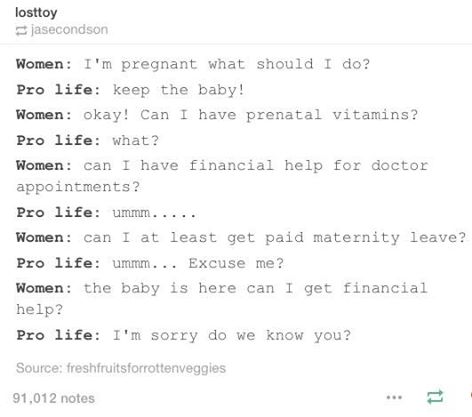
Recently, I saw a few people on Facebook posting this image. It’s a bit hard to see on here so here’s a transcript (skip this if you already read it and go to the “Analyzing the Meme” section [I typed it as it is without correcting punctuation):
Women: I’m pregnant what should I do?
Pro life: keep the baby!
Women: okay! Can I have prenatal vitamins?
Pro life: what?
Women: can I have financial help for doctor appointments?
Pro life: ummm…..
Women: can I at least get paid maternity leave?
Pro life: ummm… Excuse me?
Women: the baby is here can I get financial help?
Pro life: I’m sorry do we know you?
Analyzing the Meme
The meme is clearly aimed at the notion that pro-life advocates are inconsistent. They claim to be “pro-life” but when it comes down to the details of life, they jump ship.
I am not speaking for all who are pro-life (that would be impossible), but I do think it is extremely important to be consistently pro-life. That is, an argument like this can show that a position like pro-life is inconsistent, and that does discredit the pro-life position. We need to be consistently pro-life if we are to consider ourselves pro-life at all. But–and this is a really big “but”–the meme completely misses the point.
Missing the Point
It should be clear, however, that the argument presented in this meme is a bit off target. The point is that the real question at issue is whether the unborn is a person.
Think about the meme this way:
Women: I have a toddler what should I do?
Pro life: keep the toddler!
Women: okay! Can I have health care?
Pro life: what?
Women: can I have financial help for doctor appointments?
Pro life: ummm…..
Women: can I at least get paid leave if he/she is sick?
Pro life: ummm… Excuse me?
Women: the toddler is here can I get financial help?
Pro life: I’m sorry do we know you?
What conclusion could be drawn from this? That women (or men) have the right to kill the toddler if they don’t receive those things? I should hope the answer is obvious: no, that does not follow at all. Whether one thinks the answers to the questions the women ask in this scenario should be affirmative or not, suppose it was no to all of them: does that mean we’d go ahead and green light the parents killing the toddler?*
Thus, the argument begs the question. No one should take seriously the notion that if someone can’t pay for supporting a human being they should kill him or her. The only way the argument makes any sense is if one has already assumed that the unborn is not a human being/person. And that is an issue that should be discussed more thoroughly. I have written numerous articles in defense of the pro-life position, so I won’t repeat my arguments here.
Conclusion
One of the comments on Facebook a user posted from the group that put up this image was “How true..
They are not pro life…they are pro birth…then wash their hands afterwards..”
I think this comment demonstrates how much of an emotional impact a meme like this can have. We as pro-life individuals need to be consistently pro-life, lest people reject our reasoning because they see us as “hypocrites.”
However, the ultimate point–the one at the heart of the debate–is whether the unborn is a person. And a meme like this does nothing to discredit the pro-life position whatsoever. It does not follow that if I can’t pay to support my son, I should be allowed to kill him. Neither does it follow that the interlocutor of the meme has demonstrated the pro-life position is mistaken.
Links
Be sure to check out the page for this site on Facebook and Twitter for discussion of posts, links to other pages of interest, random talk about theology/philosophy/apologetics/movies and more!
Pro-life– I have written a number of posts advocating the pro-life position. Particularly relevant to the present discussion are “From conception, a human” and “The issue at the heart of the abortion debate.”
*This is an example of the “trot out the toddler” defense of the pro-life position. It was coined by (I believe) Scott Klusendorf.
I am not sure who was the original user that put the image up, so I can’t cite it appropriately. I make no claim to owning the image and use it under fair use.
SDG.
——
The preceding post is the property of J.W. Wartick (apart from quotations, which are the property of their respective owners, and works of art as credited; images are often freely available to the public and J.W. Wartick makes no claims of owning rights to the images unless he makes that explicit) and should not be reproduced in part or in whole without the expressed consent of the author. All content on this site is the property of J.W. Wartick and is made available for individual and personal usage. If you cite from these documents, whether for personal or professional purposes, please give appropriate citation with both the name of the author (J.W. Wartick) and a link to the original URL. If you’d like to repost a post, you may do so, provided you show less than half of the original post on your own site and link to the original post for the rest. You must also appropriately cite the post as noted above. This blog is protected by Creative Commons licensing. By viewing any part of this site, you are agreeing to this usage policy.
Book Review: “In Search of Moral Knowledge” by R. Scott Smith
R. Scott Smith’s In Search of Moral Knowledge: Overcoming the Fact-Value Dichotomy
Smith begins by providing overviews of various historical perspectives on ethics, including biblical, ancient (Plato and Aristotle), early (Augustine through Aquinas), and early modern (Reformation through the Enlightenment) systems. This survey is necessarily brief, but Smith provides enough information and background for readers to get an understanding of various ethical systems along with some difficulties related to each.
Next, the major options of naturalism, relativism, and postmodernism for ethics are examined in turn, with much critical interaction. For example, Smith argues that ethical relativism is deeply flawed in both method and content. He argues that relativism does not provide an adequate basis for moral knowledge, and it also undermines its own argument for ethical diversity and, by extension, relativism. Moreover, it fails to provide any way forward for how one is to live on such an ethical system and is thus confronted with the reality that it is unlivable. Ultimately, he concludes that “Ethical Relativism utterly fails as a moral theory and as a guide to one’s own moral life” (163).
For Naturalism, however, Smith contends the situation is even worse: “we cannot have knowledge of reality, period, based on naturalism’s ontology. Yet there are many things we do know. Therefore, naturalism is false and we should reject it not just for ethics, but in toto” (137). His argument for this thesis is, briefly, that naturalism has no basis for mental states–and therefore, for beliefs–and so we cannot have knowledge (see 147ff especially).
Various postmodern theses are also examined, including the highly influential views of Alasdair MacIntyre and Stanley Hauerwas. Ultimately, Smith argues that there are several issues with these ethical positions, and primary among them is the difficulty that without any facts which are un-interpreted, there is no way to have moral knowledge, dialogue, or grounding (see 264ff, esp. 265; 277-278).
Finally, the book ends with Smith’s proposal for grounding moral knowledge: namely, Christian theism. First, he notes that there is a “crisis of moral knowledge” which is that it seems we really do have moral knowledge, but no solid basis for this knowledge. However, to solve the difficulty, we may find another ethical stance which can support this fact of moral knowledge. For supporting this thesis, he both presents arguments for Christian theism and notes the paucity of rival positions.
One major strength of Smith’s work is that he doesn’t merely outline or only critique the ethical systems with which he interacts. Instead, each system is allowed to present its theses on its own terms before Smith turns to a critical assessment. This is particularly evident in his interactions with Alasdair MacIntyre and Stanley Hauerwas–each of whom has a dedicated chapter to their own systems and then a shared chapter of analysis and critique–but is the case in each instance of a system which he evaluates. This strength is increased when one considers the number of ethical systems Smith interacts with throughout the book. Although no work of this length (or any length, really) could be truly comprehensive, here is offered a broad enough variety of ethical theories that readers will be able to engage with those which are not mentioned.
There are tables scattered throughout the book which actually add quite a bit to the readability and argument. I commend Smith for a great use of these tools throughout the work.
I would have liked to see more development of the positive notion of exactly how Christian theism serves as the basis for moral knowledge. Smith does provide some clear insight into this, but it seems that after the significant development given to so many rival theories, the case for the Christian perspective could have gone deeper.
R. Scott Smith has accomplished an enormous achievement with In Search of Moral Knowledge both by providing an excellent survey and critique of relevant ethical systems and by coupling it with a positive case for a theistic–Christian–grounding for morality. The book can serve as an excellent text for a class on ethics, but may also be used by those interested in exposure to and critical insight into various ethical systems. Smith’s argument for Christian metaethics is compelling and strong, and his criticisms leveled against other systems–particularly naturalism and relativism–are crucial.
Disclaimer: I was provided with a review copy by the publisher. I was not obligated by the publisher to give any specific type of feedback whatsoever.
Links
Be sure to check out the page for this site on Facebook and Twitter for discussion of posts, links to other pages of interest, random talk about theology/philosophy/apologetics/movies and more!
Source
R. Scott Smith, In Search of Moral Knowledge: Overcoming the Fact-Value Dichotomy
SDG.
——
The preceding post is the property of J.W. Wartick (apart from quotations, which are the property of their respective owners, and works of art as credited; images are often freely available to the public and J.W. Wartick makes no claims of owning rights to the images unless he makes that explicit) and should not be reproduced in part or in whole without the expressed consent of the author. All content on this site is the property of J.W. Wartick and is made available for individual and personal usage. If you cite from these documents, whether for personal or professional purposes, please give appropriate citation with both the name of the author (J.W. Wartick) and a link to the original URL. If you’d like to repost a post, you may do so, provided you show less than half of the original post on your own site and link to the original post for the rest. You must also appropriately cite the post as noted above. This blog is protected by Creative Commons licensing. By viewing any part of this site, you are agreeing to this usage policy.
“X-Men: Days of Future Past” – A Christian Perspective
 The X-Men franchise has been my favorite of the Marvel franchises for some time, largely because of the worldview questions it brings up. Here, we’ll take a look at the themes in “X-Men: Days of Future Past.” There will be SPOILERS for the film in what follows.
Evolution
Evolution continues to be at the heart of many of the questions raised by the X-Men franchise. What does it mean to say that Mutants are perhaps the next step in evolution for humanity? For some, it means that Mutants should overthrow humanity; after all, they are the lesser-evolved form of life. How should humans and Mutants interact? Are they really a step of evolution, or is it simply a different expression of humanity?
These questions are obviously speculative, but I think the most poignant of them center around the notion of an evolutionary morality. If all we see is merely the product of naturalistic evolution without any sort of grounding for objective morality, who is to say that those Mutants and humans who say that there is a fundamental war between Mutants and humanity are wrong? It seems as though they are exactly right: it is a competition for resources, pure and simple. Yet the questions the movie brings up go beyond such simplistic reasoning. After all, it seems, there is right and wrong that goes beyond the reasoning centered around survival-of-the-fittest. Again, we must wonder: why? Moreover: how is it grounded? These questions get at the heart of worldview questions, and viewers who are left thinking that it is wrong to perpetuate a war between Mutant and human should wonder what grounds they have for thinking it is wrong.
The Heart of Hum…utant?
Many strands of Christian expression view humanity as depraved. That is, humans are sinful at heart, rather than being generally good. “Days of Future Past” aligns with this vision of humanity in a number of ways, but it also, interestingly, portrays mutants as just as frequently evil-leaning as humankind.
The inherent fear of the “Other” was felt throughout, as both Mutant and human worked to destroy each other. However, Mystique’s quest for revenge was a deeper look at aspects of character and worldview. Her quest, despite it being a futile gesture, was telling: she sought revenge despite the possibility that it could destroy all of her own kind. Professor X’s words, however, echoed through time: “Just because someone stumbles and loses their way doesn’t mean they are lost forever.” Mystique, through her choice to refuse to pursue the way of violence into oblivion, ultimately plays a kind of figure of reconciliation. The theme of darkness in the heart which may be redeemed is one which resonates powerfully with the Christian worldview.
A Spectrum of Morality
I think one area that is not explored frequently enough is the notion that there really is a spectum when it comes to that which is moral. I’m not advocating any kind of relativism, but rather the notion that there aren’t always (or even often) black and white moral choices. “Days of Future Past” brings this to the forefront as viewers are confronted with various ways to approach the question of the Mutant. Does one opt for a warfare model which is put forth by Magneto and Dr. Trask, a model which allows for coexistence with separation/secrecy as was generally being followed in the 1970s of the film, or perhaps even cooperation as Dr. X seeks? Perhaps instead, one should forge one’s own way like Mystique or (old) Wolverine, seeking a personal agenda in order to follow one’s own ends.
These aspects are front-and-center throughout the film, as viewers most likely will unconsciously lean towards a certain expression themselves. We discussed above the aspects of evolutionary morality, but I think the movie goes even deeper, trying to get at more basic questions like “What is truth?” and “What is moral/right?” The way viewers answer these questions may lead to further conversations. It seems to me the film clearly favored the kind of mediation road in which Mutant and Human could coexist. But what does that mean for those who favored evolutionary morality or a warfare model? Perhaps such notions are themselves outdated and put to rest because they are of a “Future Past.”
Conclusion
The latest X-Men movie has received much critical acclaim and box-office success. I think that’s for a good reason. It has a compelling plot, great action, and excellent pacing. Our analysis of various themes throughout the movie shows there is thoughtfulness behind it as well. Issues of morality are front and center, though many other themes are worth discussing as well. This is a movie that could be used to start discussions about the faith from many different aspects.
There are many more issues which could be explored in the movie. What are some that resonated with you? Let me know your own thoughts in the comments.
Links
Be sure to check out the page for this site on Facebook and Twitter for discussion of posts, links to other pages of interest, random talk about theology/philosophy/apologetics/movies and more!
Movies– Read other posts I have written on the movies. Scroll down to see more!
The image is a movie poster for the film and I use it under fair use.
SDG.
——
The preceding post is the property of J.W. Wartick (apart from quotations, which are the property of their respective owners, and works of art as credited; images are often freely available to the public and J.W. Wartick makes no claims of owning rights to the images unless he makes that explicit) and should not be reproduced in part or in whole without the expressed consent of the author. All content on this site is the property of J.W. Wartick and is made available for individual and personal usage. If you cite from these documents, whether for personal or professional purposes, please give appropriate citation with both the name of the author (J.W. Wartick) and a link to the original URL. If you’d like to repost a post, you may do so, provided you show less than half of the original post on your own site and link to the original post for the rest. You must also appropriately cite the post as noted above. This blog is protected by Creative Commons licensing. By viewing any part of this site, you are agreeing to this usage policy.
Really Recommended Posts 8/2/13
 After a brief hiatus, “Really Recommended Posts” are back. This go-round I have found for your reading/viewing pleasure a debate on sola scriptura, Buddhism, fear, the Shroud of Turin, and presuppositional apologetics. As always, let me know what you liked/didn’t like! Send me your own recommendations!
Is the Bible the only infallible rule of faith? Tim Staples vs. James White (Video)- A (lengthy) debate between a Roman Catholic and a Calvinist regarding the rule of faith. Should we hold to sola scriptura, or do we need the Magisterium in order to preserve teaching? The debate is really worth listening to.
A Comparison of the Ethical teachings and Impact of Jesus and Buddha– A brief insight into comparative religions between Buddhism and Christianity. What of truth in other religions? I found this a very interesting post.
Fiction and Fear– A really excellent post over at Hieropraxis which notes the importance of an element of fear in fiction. The post ties this back to the relevance of the Christian teaching of Christ’s redeeming work.
Shroud of Turin Blog– I am not convinced that the Shroud of Turin is authentic. However, I do find some of the work being done regarding its authenticity is very interesting. This blog has a constant string of posts related to various evidences in favor of the Shroud’s authenticity. I recommend it for those interested in reading on the topic, with the caveat of my own (hopeful) skepticism.
What is pre-suppositionalism? What is presuppositional apologetics?– Over at Wintery Knight, this interesting post turned up with a critique of presuppositionalism as an epistemology (largely based on this post at The Messianic Drew). I found it interesting, though I do not fully agree with all the critiques leveled therein. For balance, I would also direct readers to Janitorial Musings for a counter-argument to the first major contention against presuppositionalism- Presuppositionalism and Circularity. I think readers should read all the posts involved for a more complete picture. Judge for yourselves what to think of the presuppositional “worldview” (to use Drew’s term–I would lean towards saying “epistemology” instead).

 J.W. Wartick - Reconstructing Faith