ken ham
Really Recommended Posts 8/8/14- 666 and the Beast, Evidentialism, Pascal, and more!
 I have set up another round of great posts for your reading pleasure, dear readers! Check out posts on eschatology, egalitarianism, apologetics, creationism, and more! Let me know if you liked a post in the comments below, and if you liked theirs, be sure to let them know! Comments keep us going! This edition is an “owl post” because I’m watching Harry Potter while I write this.
The Mark of the Beast Demystified; or, “I’ve got 666 problems but the rapture ain’t one of them”– A post which discusses the various interpretations of the “Mark of the Beast” among various eschatological views. A very good read!
Different but Equal? Giving Words their Real Meaning– What is entailed by a position which suggests that men and women have different but equal roles in marriage and the church (and society)? Check out this evaluation of the position.
Why I’m a Christian Evidentialist– J. Warner Wallace explains the benefits of an apologetic method like evidentialism and the reasons he chose this method over any other. It’s a fascinating post with some solid insights. While you’re at it, why not answer the “Question of the Week” about your own favorite apologetic method?
Ken Ham’s Ark Adventure to Usher in a Modern Reformation?– Ken Ham of Answers in Genesis was recently in the news for his views on aliens, but he’s also been working to build Noah’s Ark, kind of. Check out this post which analyzes Ham’s comments about this project and the history of creationism.
Betting on Pascal’s Wager, Kind of– Pastor Matt Rawlings explains Pascal’s Wager in a brief, basic way. I recently also outlined and defended a version of the Wager, which I think has more credence than many people grant it.
Ken Ham Rescinds Alien Damnation?
 I wrote very recently about Ken Ham declaring aliens eternally doomed. Now, however, Ken Ham is claiming that headlines like my post (or those declaring aliens are going to hell) are mistaken. I just want to briefly look at this claim. In his most recent blog article, he states:
So, “is there intelligent life in outer space?” After reading the Huffington Post article and the other items on secular websites responding to my article, my answer is this: “there doesn’t seem to be much intelligent life left here on earth—let alone to find any in outer space!”
Well, that’s all well and good, but I’m curious as to how someone could say that I would be mistaken for thinking that this would somehow make invalid the analysis I made of his site regarding aliens being doomed. But it seems Ham is responding by simply saying that there are no intelligent beings elsewhere, and so we are supposed to conclude that that somehow means aliens would not be doomed (because there are none). But that doesn’t really meet the analysis of some of those who are critiquing Ham’s position.
What it comes down to is Ken Ham’s own words:
You see, the Bible makes it clear that Adam’s sin affected the whole universe. This means that any aliens would also be affected by Adam’s sin, but because they are not Adam’s descendants, they can’t have salvation.
Thus, according to Ken Ham himself, if aliens do exist, “they can’t have salvation.” I’m not sure exactly what distinction is to be made between this and going to hell, but it seems that Ham’s only answer is that there are no aliens, so this doesn’t apply. Again, that doesn’t meet the critique I’ve already leveled against his view.
But, perhaps I’m mistaken and Ham is merely trying to assert that only certain headlines are mistaken. He cites these specifically: “Creationist Ken Ham Says Aliens Will Go To Hell So Let’s Stop Looking For Them”; “Creationist Ken Ham: Aliens are going to hell so just stop looking for them.” I think it’s fair to say that these headlines are not exactly accurate representations of Ham’s view. Instead, Ham seems to be saying 1) Aliens don’t exist; 2) Because they don’t exist, we shouldn’t bother to spend time looking for them; 3) a theological reason for thinking they don’t exist is that they “can’t have salvation.”
It is point 3 which I took issue with in my post, but the headlines Ham cites seem to combine all 3 points into one without any clarity. Thus, I appreciate Ham clarifying his position. The points I brought up in my critique, however, still stand.
Links
Be sure to check out the page for this site on Facebook and Twitter for discussion of posts, links to other pages of interest, random talk about theology/philosophy/apologetics/movies and more!
Ken Ham Declares Aliens Eternally Doomed– I analyze Ken Ham’s statements about aliens and the possibility for their salvation.
Alien life: Theological reflections on life on other planets– I engage in some [highly] speculative theology related to the possibility of aliens.
Did God Create the Universe for Humans?-Some Thoughts on God’s purposes for creating– I argue that God’s purposes in creating are needlessly limited when people object that God created the universe [only] for humankind.
Aliens that believe in God: The theological speculations of Robert Sawyer’s “Calculating God”– I reflect on a science fiction book, Calculating God, which has aliens that believe in God.
SDG.
——
The preceding post is the property of J.W. Wartick (apart from quotations, which are the property of their respective owners, and works of art as credited; images are often freely available to the public and J.W. Wartick makes no claims of owning rights to the images unless he makes that explicit) and should not be reproduced in part or in whole without the expressed consent of the author. All content on this site is the property of J.W. Wartick and is made available for individual and personal usage. If you cite from these documents, whether for personal or professional purposes, please give appropriate citation with both the name of the author (J.W. Wartick) and a link to the original URL. If you’d like to repost a post, you may do so, provided you show less than half of the original post on your own site and link to the original post for the rest. You must also appropriately cite the post as noted above. This blog is protected by Creative Commons licensing. By viewing any part of this site, you are agreeing to this usage policy.
Ken Ham Declares Aliens Eternally Doomed
 Ken Ham, a prominent young earth creationist and the founder of Answers in Genesis, recently lamented on his blog about the money being spent on the search for extraterrestrial life in space. Interestingly, part of his objection was that aliens probably don’t exist because they would not be saved:
I do believe there can’t be other intelligent beings in outer space because of the meaning of the gospel. You see, the Bible makes it clear that Adam’s sin affected the whole universe. This means that any aliens would also be affected by Adam’s sin, but because they are not Adam’s descendants, they can’t have salvation.
That’s correct: according to Ken Ham, we can speculate about whether aliens may or may not exist (though both he and I agree that we think it is very improbable), but we can know for sure that aliens cannot be saved. Keep this in mind through the rest of my post: Ken Ham did not say that aliens may not be saved, but rather that they “can’t” be saved.
Space and Cost
Ken Ham was concerned with the notion that we’re spending so much money on space travel: “I’m shocked at the countless hundreds of millions of dollars that have been spent over the years in the desperate and fruitless search for extraterrestrial life.”
I would first point out that the money being thrown at this is hardly exclusively dedicated to the search for ET. Rather, much of it goes to new technology like new telescopes, listening devices, etc. which actually bring benefits for the rest of society. Thus, the money is not being spent in a “fruitless” fashion.
One might come back and say: “What if all that money was instead spent on feeding the hungry, clothing the needy, etc.?” I think that’s a valid point and it is one with some initial force. One wonders, though, about the notion of division of effort. There is a real sense in which not all of human effort may be directed towards one end. As a Christian, I certainly desire to aid those in need, but I would not say that means every dollar I spend should be directed towards that end. There are other evils than need in the world (such as abortion) to direct effort towards, and there are also other goods to promote (evangelization would be one I would list). As such, my activity must be divided. Similarly, on a national level, there are numerous ends to pursue, and an argument which reduces national spending to a single issue is simplistic.
I’m open to disagreement here and would love to hear from those who are either pro-space exploration or con. I lean pro- but I think there is some force to arguments against.
 Doomed Aliens
The thrust of Ken Ham’s post, however, was that aliens would not be saved. He acknowledged that “[T]he Bible doesn’t say whether there is or is not animal or plant life in outer space.” Given his nod to the fact that the Bible is clearly not concerned with the broader universe, it is then shocking to find that Ham asserted without qualifications that “[aliens] can’t have salvation.” I wonder: where is that found in the Bible? Where might I find the notion that: “If aliens exist, they can’t have salvation” implied in the Bible?
Ham’s argument was an implicit one: because “The Earth was created for human life” (an example of the single-end fallacy regarding God’s creation which I discussed elsewhere), and “Adam’s sin affected the whole universe. This means that any aliens would also be affected by Adam’s sin, but because they are not Adam’s descendants, they can’t have salvation.”
The argument depends upon a number of hidden and explicit premises. First, one must ask in what way Adam’s sin affected the whole universe. Does that mean that intelligent aliens instantly became cursed and condemned by the Fall? It seems Ham’s argument depends upon that premise, but there is surely no bibical data to back that up. Rather, Ham is assuming that the Fall means that any other life in the universe would necessarily be sinful and in a state of rebellion against God. Although the Bible speaks of humans being in rebellion against God, and it speaks of “all creation groan”ing awaiting for God’s coming to reconcile all things, it is surely a massive inference to leap from that to the notion that any aliens anywhere are eternally doomed.
Second, the argument assumes that God did not or would not (can not!?) mediate between other sentient beings and God. Surely it is a major assumption to state that God would not operate in a certain fashion about speculative aliens who have speculatively been included in the Fall and are speculatively doomed for eternity! For Ham to turn around and just assert that God would not save these aliens (or again, perhaps cannot, because he states that they “can’t have salvation), is a major theological error.
Third, and perhaps most importantly, the question of how Ham reconciles his first premise with his premise that “because [aliens] are not Adam’s descendants, they can’t have salvation.” After all, the same proof-texts which may be cited to try to imply that all of creation groans under the Fall (Romans 8) could also be taken, when read with the same presumptions, to mean that aliens will be saved or at least have hope of salvation: “For the creation was subjected to frustration, not by its own choice, but by the will of the one who subjected it, in hope the creation itself will be liberated from its bondage to decay and brought into the freedom and glory of the children of God [Romans 8:20-21 NIV].”
Thus, Ham’s argument has a faulty conclusion: if it is true that all of the universe fell through Adam and is therefore doomed, then it equally follows that, according to the same text, it will all be saved through Jesus as the new Adam (not universalism, but rather the “hope of salvation”). There are no grounds for Ham’s assumptions.
Conclusion
Ken Ham has overstated his case to the extreme. Although he may have some force to his argument about the needless spending of money on various space exploration projects (and again, I think these aren’t needless but that perhaps his side has some a priori power), he has committed some major blunders when it comes to speaking of the possibility of alien salvation.
As always, I’d love to have your thoughts in the comments. What do you think about Ham’s statements? Be sure to check out his blog post to get his side of the argument.
Links
Be sure to check out the page for this site on Facebook and Twitter for discussion of posts, links to other pages of interest, random talk about theology/philosophy/apologetics/movies and more!
Alien life: Theological reflections on life on other planets– I engage in some [highly] speculative theology related to the possibility of aliens.
Did God Create the Universe for Humans?-Some Thoughts on God’s purposes for creating– I argue that God’s purposes in creating are needlessly limited when people object that God created the universe [only] for humankind.
Aliens that believe in God: The theological speculations of Robert Sawyer’s “Calculating God”– I reflect on a science fiction book, Calculating God, which has aliens that believe in God.
SDG.
——
The preceding post is the property of J.W. Wartick (apart from quotations, which are the property of their respective owners, and works of art as credited; images are often freely available to the public and J.W. Wartick makes no claims of owning rights to the images unless he makes that explicit) and should not be reproduced in part or in whole without the expressed consent of the author. All content on this site is the property of J.W. Wartick and is made available for individual and personal usage. If you cite from these documents, whether for personal or professional purposes, please give appropriate citation with both the name of the author (J.W. Wartick) and a link to the original URL. If you’d like to repost a post, you may do so, provided you show less than half of the original post on your own site and link to the original post for the rest. You must also appropriately cite the post as noted above. This blog is protected by Creative Commons licensing. By viewing any part of this site, you are agreeing to this usage policy.
“Oceans of Kansas,” Unexpected Fossils, and Young Earth Creationism
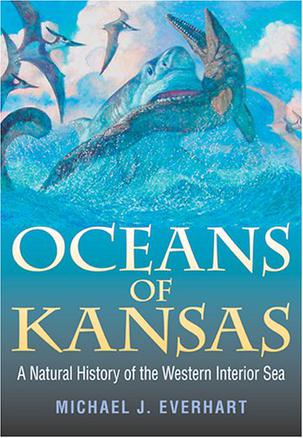 Recently, I reviewed the debate between Bill Nye and Ken Ham. In that debate, Bill Nye challenged Ken Ham to come up with just one fossil that was in the wrong place in the fossil sequence. In that review, I mentioned polystrate fossils as one possibility for the YEC rejoinder. Strictly speaking, these fossils are not “out of sequence” in a formal sense and so do not qualify as such evidence. Are there other possibilities? Michael J. Everhart’s fascinating look at the natural history of the Western Interior Sea brings up another possibility which may draw some looking for out-of-sequence fossils. After an introductory narrative about how a mosasaur (pictured on the cover of the book getting chomped by a shark) fossil could end up broken up in the middle of the sea, he wrote:
“Bloating and Floating” is certainly the case in many instances and is the only reasonable explanation for how the remains of large dinosaurs, such as Niobrarasaurus coleii…could have found their way into the middle of the Western Interior Sea… (48)
There have been, he noted, discoveries of dinosaurs in the middle of what should have been fossils of only aquatic creatures in the chalk and limestone that covers much of the central states–what was in ancient times the Western Interior Sea. His proposed explanation is that a dinosaur might die on the shore and get swept out to sea, bloated and floating until coming to rest at the bottom and becoming fossilized. Though not necessarily the “only reasonable” explanation, Everhart’s scenario provides an interesting test case for rival hypotheses.
Young Earth Creationists (YECs) tend to view evidences like these as proof of the Flood. That is, given a catastrophic global flood, one would expect that different life forms, all killed together by the flooding of the whole Earth, would be mixed together. Thus, a dinosaur in the middle of what should be sea creatures is alleged to provide evidence for the YEC Flood hypothesis.However, Everhart’s scenario does seem to be more plausible than a young earth account for several reasons.
First, Everhart’s proposed scenario is much simpler an explanation than the hypothesis that a global flood swept the dinosaur(s) into the position they are found among so many aquatic remains. This point is not to be understated; on a purely historical level, without any a priori assumptions of what should be the case given a specific reading of Genesis, it seems more reasonable to suppose that a dinosaur died and had its carcass swept out to sea before it was scavenged and sank to the bottom of the sea to be deposited than to suppose that a global catastrophe led to the dinosaur being found in its present location.

A picture I took at “Castle Rock” in central Kansas. This beautiful formation has huge amounts of deposited limestone and shells layered atop each other. One can walk to the walls and literally pull slabs of fossils out of the sides. If the YEC account of the flood were correct, one would expect to find multiple varieties of creatures found throughout these layers.
Second, and perhaps more problematic for the YEC position, is the fact that such finds as these are extremely rare, when, given a global flood, the expectation should be to constantly find such mixing of types of fossils. Simply finding one dinosaur fossil (or even several) among countless numbers of mosasaurs, icthyosaurs, fish, and of course limestone deposits from sea life (alongside shells of all sorts of varieties, etc.) does not actually provide sufficient evidence for the YEC account of the flood. We should instead find primates, dinosaurs, mosasaurs, trilobites, mammoths, and archaeopteryx fossils jumbled together. What we do find is a stunning uniformity of fossils such that the find of a dinosaur is means for speculation regarding how it got there rather than a commonality which demonstrates a planetwide flood.
Third, the dinosaur in question was contemporaneous with the aquatic life. That is, it lived at the same time as the creatures in the chalk in which it was deposited. Again, on a YEC scenario, one would expect instead to find all sorts of mixing of fossils from different time periods. The fact that these dinosaurs lived on land in the same time in which we find them at the bottom of the sea does not suggest a massive global flood which mixed all life (which all lived at the same time) together in one death pool; instead, it counts as direct evidence for the gradual diversification and extinction of life. The finds are consistent with what one would expect with longer periods of time instead of a global flood. Thus, it does not seem that fossils found in unexpected places may serve as evidence for Young Earth Creationism. Indeed, given the second point in particular (and in conjunction with the third), it seems that they serve as yet another evidence against the notion of a young earth and global flood. There are better options for Christians than Young Earth Creationism.
Links
Be sure to check out the page for this site on Facebook and Twitter for discussion of posts, links to other pages of interest, random talk about theology/philosophy/apologetics/movies and more!
What options are there in the origins debate? – A Taxonomy of Christian Origins Positions– I clarify the breadth of options available for Christians who want to interact on various levels with models of origins. I think this post is extremely important because it gives readers a chance to see the various positions explained briefly.
Shells and the Biomass of Earth: A serious problem for young earth creationists– I argue that the sheer amount of living organisms we can discover weighs against a young earth position.
My thanks to fellow blogger “The Natural Historian” for some comments on the topic of this post prior to publication.
Source
Michael J. Everhart, Oceans of Kansas: A Natural History of the Western Interior Sea (Indiana University Press, 2005).
SDG.
——
The preceding post is the property of J.W. Wartick (apart from quotations, which are the property of their respective owners, and works of art as credited; images are often freely available to the public and J.W. Wartick makes no claims of owning rights to the images unless he makes that explicit) and should not be reproduced in part or in whole without the expressed consent of the author. All content on this site is the property of J.W. Wartick and is made available for individual and personal usage. If you cite from these documents, whether for personal or professional purposes, please give appropriate citation with both the name of the author (J.W. Wartick) and a link to the original URL. If you’d like to repost a post, you may do so, provided you show less than half of the original post on your own site and link to the original post for the rest. You must also appropriately cite the post as noted above. This blog is protected by Creative Commons licensing. By viewing any part of this site, you are agreeing to this usage policy.
Really Recommended Posts 2/7/14- Ken Ham/Bill Nye, Russell Wilson, creationism, and more!
 Two huge stories this week: the Super Bowl and the Bill Nye vs. Ken Ham debate. As such, I’ve brought up some links related to each. As always, let me know your thoughts! If you’re interested in the debate, be sure to check out my overview and analysis.
Notable Christians Open to an Old-universe, Old-earth perspective– In the debate, Ken Ham kept mentioning various scientists who were Christian and young earth creationists. Here, there is a list of many notable Christian thinkers who are open to an old-earth perspective instead.
Origins Science and Misconceptions of Historical Science– Over at Naturalis Historia, this extremely relevant post was offered up which contests Ken Ham’s presentation of a major gap between historical sciences and observational sciences.
ESPN spots a ghost in the Seattle-Russell Wilson lovefest– One thing that has received little coverage regarding the Seahawks is Russell Wilson’s faith. Perhaps that’s because he is not so in-your-face as Tim Tebow, but both Wilson and Robert Griffin III are faithful men. Here, the author explores the popularity of Wilson in a fairly secular city.
All 32 NFL Teams Crossed with Star Wars– I love football, and I love Star Wars. These are some awesome Star Wars crossovers for NFL Teams. Check it out!
How about checking out some reviews of the debate between Ken Ham and Bill Nye? Here are a couple:
Ken Ham vs. Bill Nye post-debate analysis– The GeoChristian has a brief overview of the debate with a focus on what each got right or wrong.
Ken Ham vs. Bill Nye: The Aftermath– Luke Nix over at Faithful Thinkers has another thoughtful review. His post focuses much more on the topic of the debate as opposed to a broad overview. Highly recommended.
Be sure to check out my own review of the debate, which gives a lengthy overview as well as specific analysis on the debate- Ken Ham vs. Bill Nye: Analysis of a lose-lose debate.
Ken Ham vs. Bill Nye- An analysis of a lose-lose debate
 Today, Ken Ham, a young earth creationist, debated against Bill Nye an agnostic famous for “The Science Guy” program, on the topic: “Is creation a viable model of origins in today’s scientific era?” The debate was watched by over 500,000 people and generated a huge amount of interest. Here, I’ll review the debate section by section. Then, I’ll offer some thoughts on the content as well as a concluding summary. If you watched the debate, you may want to just skip down to the Analysis section. The debate may be watched here for a limited time (skip to 13 minutes in to start debate).
Ken Ham Opening
Ham began by noting that many prominent scientists argue that scientists should not debate creationists. He wondered aloud whether that might be because creationism is indeed a viable model and some don’t want that to be shown. He then showed a video of a creationist who was a specialist in science and an inventor, noting that creationism is not mutually exclusive from science.
The three primary points Ham focused on were 1) the definitions of terms; 2) interpretation of the evidence; and 3) the age of the universe is not observational science. Regarding the first, Ham noted that science means knowledge and so evolutionists cannot claim to be doing science. Regarding the second, he argued that both creationists and evolutionists observe the same evidence; they simply interpret that evidence differently. Regarding the third, Ham observed that “We weren’t there” at the beginning of the Earth and so we can’t know through observational science what happened.
Bill Nye Opening
Nye noted that the primary contention of the topic was to see whether the creation model lined up with the evidence. Thus, we must compare Ken Ham’s creation model to the “mainstream” model of science (his word). There are, he contended, major difficulties with Ham’s model, including the fossils found in layers in the Grand Canyon. He noted that there is “not a single place” where fossils of one type cross over with fossils of a different type or era. Yet, on a creation model, one would expect vast amounts of mixing. Thus, the creation model fails to account for the observational evidence.
Nye also noted that there are “billions of people ” who are religious and do not hold to creation science.
Ham Presentation
Ham again emphasized the importance of defining terms. He then presented a few more videos of creationists who are active scientists in various fields. One, a Stuart Burgess [I think I typed that correctly] claimed that he knew many colleagues who expressed interest in creationism but were afraid for their careers.
Non-Christians, Ham alleged, are borrowing from the Christian worldview in order to do science. The reason for this is because their own worldview cannot account for the laws of logic, the uniformity of nature, or the laws of nature. He asked Nye to explain how to account for these aspects of reality without God.
The past cannot be observed directly, he said, and concluded that we can’t be certain that the present is like the past. Thus, we must only deal with the observed facts that we can see now. On this point, the disagreements are over the interpretation of the evidence. That is, there is a set of evidence that both people like Nye and Ham approach. According to Ham, it is their worldviews which color their interpretation of the evidence such that they use the same evidence and get entirely contradictory conclusions.
The diversity of species which is observed is only, Ham argued, difference in “kind.” Thus, it cannot be used as evidence for evolution. The word “evolution” has been “hijacked” and used as evidence for unobservable phenomena extrapolated from that which is observed. The various species demonstrate a “creation orchard” as opposed to an “evolutionary tree.” One may observe different creatures, like dogs, each stemming from an a common origin, but none of these are traceable back to common descent, rather they exhibit discontinuity in the fossil record.
There is a major difference, Ham alleged, between “observational sciences” which looks at the things we can see in repeatable events now and “historical sciences” which extrapolates from the evidence gathered what happened in the past. We can never truly have “knowledge” regarding the historical sciences.
Nye Presentation
Nye began his presentation by noting that the debate took place in Kentucky and “here… we’re standing on layer upon layer upon layer of limestone.” The limestone is made of fossils of creatures which lived entire lives (twenty or more years in many cases) and then died, piled up on top of each other, and formed the limestone underneath much of the state. The amount of time needed for this is much longer than just a few thousand years.
Nye also turned to evidence from ice cores, which would require 170 winter/summer cycles per year for at least a thousand years to generate the current amount of ice built up. In California, there are trees which are extremely ancient, and some trees are even older, possibly as old as 9000 or more years old. Apart from the difficulty of the age of these trees, one must also wonder how they survived a catastrophic flood.
When looking at a place like the Grand Canyon, one never finds lower layer animals mixed with higher level animals. One should expect to find these given a flood. Nye challenged Ham to present just one evidence of the mixing of fossils of different eras together; he said it would be a major blow to the majority sciences.
If the flood explains animal life and its survival, one should observe the migration of animals across the earth in the fossil record; thus a Kangaroo should be found not just in Australia but along the way from wherever the Ark rested. However, these finds are not observed. Finally, the Big Bang has multiple lines of evidence which confirm it as the origin of the universe.
Ham Rebuttal
Ham argued that we can’t observe the age of the Earth. No science can measure it through observational evidence; rather it falls under historical sciences. One should add the genealogies in the Genesis account in order to find the age of the Earth. Whenever a scientist talks about the past, “we’ve got a problem” because they are not speaking from observation: they were not there.
Various radiometric dating methods turn up radically divergent ages for artifacts from the same time period and layer of rocks. The only infallible interpreter of the evidence is God, who provided a record in the Bible.
Nye Rebuttal
Rocks are able to slide in such a way as to interpose different dated objects next to each other.
Nye noted that Ham kept saying we “can’t observe the past,” but that is exactly what is done in astronomy: no observation of stars is not observing the past. Indeed, it takes a certain amount of time for the light to get to Earth from these various stars. The notion that lions and the like ate vegetables is, he argued, preposterous. Perhaps, he asserted, the difficulty is with Ham’s interpretation of the biblical text.
Nye then compared the transmission of the text of the Bible to the telephone game.
Ham Counter-Rebuttal
Ham again pressed that natural laws only work within a biblical worldview. There only needed to be about 1000 kinds represented aboard the ark in order to represent all the current species. Bears have sharp teeth yet eat vegetables.
Nye Counter-Rebuttal
Nye asserted that Ham’s view fails to address fundamental questions like the layers of ice. The notion that there were even fewer “kinds” (about 1000) means that the problem for Ham is even greater: the species would have had to evolve at extremely rapid rates, sometimes even several species a day, in order to account for all the differences of species today.
Q+A
I’ll not cover every single question, instead, I wanted to make note of two major things that came up in the Q+A session.
First, Nye’s answer to any question which challenged him on things like where the matter for the Big Bang came from was to assert that it’s a great mystery and we should find out one day. Second, Ham’s response to any question which (even hypothetically) asked him to consider the possibility that he would be wrong was to assert that such a situation was impossible. In other words, he presupposed he was correct and held to the impossibility that he could be wrong.
Analysis
Ken Ham
Ken Ham’s position was based upon his presuppositional apologetic. He continued to press that it is one’s worldview which colors the interpretation of evidence. The facts, he argued, remained the same for either side. It was what they brought to the facts that led to the radically different interpretations.
There is something to be said for this; it is surely true that we do have assumptions we bring to the table when interpreting the evidence. However, apart from the problem that Ham’s presuppositional approach with creationism is unjustified, Ham failed to deal with facts which really do shoot major holes in his theory. For example, it simply is true that, as Nye noted, when we observe the stars or distant galaxies, we are observing the past. Ham was just wrong on this regard. Moreover, other observational evidence (though not directly showing the past) does demonstrate that the Earth cannot be so young as Ham supposes. Furthermore, his hard and fast distinction between historical sciences and observational sciences is more of a rhetorical device than anything.
Ham’s position, I would argue, fails to account for the evidence which Nye raised (along with a number of other difficulties). Moreover, he continued to paint a picture of the Bible which rejects any but his own interpretation. In other words, he presented a false dichotomy: either young earth creationism or compromise with naturalism. However, I did appreciate Ham’s focus on the Gospel message. It was refreshing to have him present a call to belief in Jesus Christ as Lord and savior in front of such a massive audience.
Bill Nye
Nye did an okay job of trying to show that there may be more to the debate than simply creationism-or-bust for Christianity. Indeed, he actually went so far as to say there is “no conflict” between science and faith. Instead, he argued that Ham’s position is the one which generates such a conflict. His rebuttals provided some major reasons to think that Ham’s creationism could not account for the evidence. In particular, the difficulties presented by the proliferation of species after the flood and the fossil record were solid evidences.
However, Nye’s presentations had a couple difficulties. First, he failed to account for polystrate fossils: the very thing he challenged Ham to present. There really are such things as fossils which are found out of sequence (thanks to ElijiahT and SkepticismFirst on Twitter for this). That’s not to say they prove young earth creationism. Far from it. So Nye seems to have been mistaken on this point. Second, he presented the Big Bang theory as though Fred Hoyle somehow came up with the hypothesis, yet Hoyle is well known for denying the Big Bang. Third, the notion that the interpretation, translation, and transmission of the Bible through time is anything like the telephone game is a tiresome and simply mistaken metaphor.
Both
Both men were extremely respectful and I appreciated their candor. Each had several good points; each had some major flaws in their positions. The dialogue as a whole was interesting and helpful.
Conclusion
Readers by now should realize that I have to confess my title is a bit misleading. I was impressed by the tone of both speakers, though I thought they each made major gaffes alongside some decent points. The bottom line is that I find it unfortunate that we were exposed to a false dichotomy: either creationism or naturalism. There is more to the story. As far as “who won” the debate, I would argue that because of this false dichotomy, neither truly won. However, it seemed to me Ham had a more cohesive 30 presentation. That is, his presentation stayed more focused. Nye’s presentation jumped around quite a bit and had less directness to it. So far as “debate tactics” are concerned, one might chalk that up to a win for Ham. However, Nye successfully dismantled Ham’s presentation in the rebuttal periods. Thus, one was left with the impression that Ham’s view was indeed based upon his presupposition of its truth, while Nye was more open to the evidence. Again, I think both are wrong in many areas, but I hope that Nye’s tearing down of Ham’s position will not demonstrate to some that Christianity is false. As Nye noted, it may instead be Ham’s interpretation which is wrong.
There was much more to cover here than I could get to, so please do leave a comment to continue the discussion.
Links
Be sure to check out the page for this site on Facebook and Twitter for discussion of posts, links to other pages of interest, random talk about theology/philosophy/apologetics/movies and more!
Naturalis Historia– This site is maintained by a biologist who presents a number of serious difficulties for young earth creationism.
Gregg Davidson vs. Andrew Snelling on the Age of the Earth– I attended a debate between an old earth and young earth creationist (the latter from Answers in Genesis like Ken Ham). Check out my overview of the debate as well as my analysis.
Debate Review: Fazale Rana vs. Michael Ruse on “The Origin of Life: Evolution vs. Design”– Theist Fazale Rana debated atheist Michael Ruse on the origin of life. I found this a highly informative and respectful debate.
Reasons to Believe– a science-faith think tank from an old-earth perspective.
Other Reviews of the Debate
Ken Ham vs. Bill Nye post-debate analysis– The GeoChristian has a brief overview of the debate with a focus on what each got right or wrong.
Ken Ham vs. Bill Nye: The Aftermath– Luke Nix over at Faithful Thinkers has another thoughtful review. His post focuses much more on the topic of the debate as opposed to a broad overview. Highly recommended.
Ken Ham vs. Bill Nye: The Debate of the Decade?- Interested in what led up to this debate? Check out my previous post on the topic in which I urged Christians to write on this debate and also traced, briefly, the controversy leading up to this debate.
The image used in this post is was retrieved at Christianity Today and I believe it’s origin is with Answers in Genesis. I use it under fair use to critique the views. I make no claims to owning the rights to the image, and I believe the image, as well as “The Creation Museum” are copyright of Answers in Genesis.
SDG.
——
The preceding post is the property of J.W. Wartick (apart from quotations, which are the property of their respective owners, and works of art as credited; images are often freely available to the public and J.W. Wartick makes no claims of owning rights to the images unless he makes that explicit) and should not be reproduced in part or in whole without the expressed consent of the author. All content on this site is the property of J.W. Wartick and is made available for individual and personal usage. If you cite from these documents, whether for personal or professional purposes, please give appropriate citation with both the name of the author (J.W. Wartick) and a link to the original URL. If you’d like to repost a post, you may do so, provided you show less than half of the original post on your own site and link to the original post for the rest. You must also appropriately cite the post as noted above. This blog is protected by Creative Commons licensing. By viewing any part of this site, you are agreeing to this usage policy.
Ken Ham vs. Bill Nye- The Debate of the Decade?
Why care about something written about a debate that hasn’t happened yet? Well frankly, because you need to be prepared for whatever happens afterwards, and the best way to do so is to reflect upon the issue at hand. I decided to do a little research, and I put together this post to help frame the upcoming debate. I also have a few comments on it throughout.
Be Prepared
Fellow Christians, we need to be prepared for this debate. We need to be posting on it beforehand, during, and afterwards. Why? A simple look at Google Trends shows that the search traffic for Ken Ham has spiked hugely since the debate was announced. Side-by-side comparison of Bill Nye and Ken Ham shows both have seen an increase of search traffic from it. To put it simply: people are talking and thinking about this. We need to have a response ready throughout so that the we may demonstrate the reason for the hope within us.
Bill Nye Starts the Fire
The origins of this debate go back all the way to the 17th and 18th century, but we’ll go a bit more modern here and start with Bill Nye’s strong words against creationism. In a video, he began by saying that “Denial of Evolution is unique to the United States…” Such a denial is like “trying to do geology without believing in tectonic plates.” A worldview which denies billions of years, which explains much of the data we see, becomes “untenable” and “inconsistent.” He then addressed the “grown ups” and said “if you want to deny” the scientific evidence for the age of the universe… “that’s fine, but don’t make your kids do it… we need scientifically literate voters [for the future].” Regarding the case for a young earth “there’s no evidence for it.” Nye noted that he believes the young earth worldview won’t exist within a couple centuries.
Answers in Genesis Responds
The young earth creationist group, Answers in Genesis, was quick to respond to Nye’s comments. In a video entitled “Ken Ham Responds to Bill Nye ‘The Humanist Guy,'” Ham was quick to denounce Nye’s attack on creationism. First, he called out Nye for having an “Agenda to teach children not to believe in God…” He went on to say that Bill Nye doesn’t actually understand science. Tying evolutionism to engineering, Ham argued, is nonsensical. Ham felt that Nye’s comments made creationism seem equivalent to child abuse. Instead, he said one should view the teaching that children are “just animals” and there’s no God is the real child abuse. “It’s really people like Bill Nye that are damaging kids. Creationists are telling children that they’re special… made in the image of God.”
Ham alleged that if evolutionism were true, then people should just be able to see it. Instead, he argued that people like Nye have to protect children from hearing any alternative theories so that they don’t question what they’re being taught. “You don’t teach them to think critically… you just want to make sure they only hear about evolution.” Creationists, Ham said, should be happy to teach their children about evolution so that they are able to think critically about it.
False Dichotomy
My primary issue with this debate is that it seems both sides are putting forth a false dichotomy: the only two options, it is alleged, are either naturalistic evolutionism or young earth creationism. However, this does not even begin to exhaust the range of possibilities regarding the origins debate. There are theistic evolutionists, old earth creationists, progressive creationists, and more.
The problem is that when the average person on the street sees a debate like this, they’re going to assume the options they observe are the only positions out there. Suppose Ken Ham gets beaten badly in this debate; in that case, Christians who now think young earth creationism is the only option will believe that it cannot stand up to scrutiny, and–by extension–their faith cannot stand up to scrutiny either. Similarly, suppose Bill Nye gets beaten badly; in that case, Christians may attach their belief to young earth creationism, a position which does not seem viable.
Other Problems
Bill Nye’s comments regarding what parents should or should not do sounds quite a bit like indoctrination. That is, he urged creationist parents not to teach their parents creationism. Now, even though I disagree with Ham’s form of creationism, I do think that parents should be allowed to pass their beliefs on to their children. To say otherwise seems to me an affront to freedom of expression.
As far as Ken Ham’s comments go, I’m not convinced by his assertion that one’s desire to teach evolution must be linked to a desire to teach kids not to believe in God. After all, later in the same video he urges creationist parents to teach their kids about evolution. Surely he’s not saying that creationist parents are trying to teach their children there’s no God when they teach them about evolution! Ham’s comments seem to do the same thing Nye’s did: paint a picture of a false choice between naturalism and his brand of creationism.
Conclusion
I’m not secret about my views regarding young earth creationism. I simply do not think it accounts for the biblical text or the natural record. Neither do I think a naturalistic perspective is capable of dealing with all the data at hand. However, whatever your view, I still strongly encourage you to consider 1) writing on this topic from your perspective. The more Christian voices we have talking about this, the better. Also, 2) don’t fall victim to the false dichotomy offered by this debate. The extremes are not the only options.
Links
Be sure to check out the page for this site on Facebook and Twitter for discussion of posts, links to other pages of interest, random talk about theology/philosophy/apologetics/movies and more!
Check out the live stream of the debate here (the debate is on 2/4/14 at 7PM ET).
The image used in this post is was retrieved at Christianity Today and I believe it’s origin is with Answers in Genesis. I use it under fair use to critique the views. I make no claims to owning the rights to the image, and I believe the image, as well as “The Creation Museum” are copyright of Answers in Genesis.
SDG.
——
The preceding post is the property of J.W. Wartick (apart from quotations, which are the property of their respective owners, and works of art as credited; images are often freely available to the public and J.W. Wartick makes no claims of owning rights to the images unless he makes that explicit) and should not be reproduced in part or in whole without the expressed consent of the author. All content on this site is the property of J.W. Wartick and is made available for individual and personal usage. If you cite from these documents, whether for personal or professional purposes, please give appropriate citation with both the name of the author (J.W. Wartick) and a link to the original URL. If you’d like to repost a post, you may do so, provided you show less than half of the original post on your own site and link to the original post for the rest. You must also appropriately cite the post as noted above. This blog is protected by Creative Commons licensing. By viewing any part of this site, you are agreeing to this usage policy.
Really Recommended Posts 9/6/13- Dystopia, Poetry, and Creationism (+more!)
 Another look around the internet this week, as we investigate young earth creationism from a few angles, intelligent design, some dead guys, and dystopian fiction. Let me know what you think!
Christian Virtues in Dystopian Fiction– Look, if you read my blog much you’ll know I am an absolute sucker for science fiction. One recurring theme in sci-fi is that of a dystopia: attempts to make a perfect world gone wrong. Most recently, The Hunger Games is a great example of the genre. In this post, Garret Johnson explores Christian Virtues found in this genre. It is a truly fascinating post, and I highly recommend you follow the blog to see more of the like.
Dead Guys, a poem– A very clever poem with a comic about the need to look at the works of the past in order to understand the present more fully. We stand on the shoulders of giants. I have written about the need to read more of the classic defenses of Christianity and theology, along with several ways to direct reading in my post, “On the Shoulders of Giants.”
A Horse is a Horse According to Answers in Genesis– An analysis of a recent attempt to present evidence for the young earth paradigm, this post looks at the genetic lineage of various species of horse. It is pretty awesome.
Stephen C. Meyer debates Michael Ruse about intelligent design and evolution on NPR– A “snarky” summary of a recent debate between Intelligent Design theorist Stephen Meyer and atheist Michael Ruse. Check out the review and listen to the debate.
Compromising Christians Don’t Like “Evolution vs. God” Film– I am “recommending” this post not because I endorse its contents, but because I think it shows how not to interact in “in-house” debates with other Christians. Ken Ham constantly uses the scare word “compromise” as a descriptor for other Christians. Compromise on what? Ham’s preferred interpretation of the text. It is a word he uses as a weapon time and again. As for the film itself, for some other perspectives (both positive and negative), check out my previous RRP.
**As always my linking to a post does not imply I endorse all or even part of that site**
Really Recommended Posts 8/30/13- Dinosaurs, Mumford and Sons, Design, and more!
 Another search of the internet has turned up a number of excellent posts. I have found another diverse array of topics for you to browse at your leisure. This week, we’ll look at dinosaurs, Ray Comfort’s Evolution vs. God, cave diving, preterism, design, the economy, and Mumford and Sons!
Dinosaurs, Dragons and Ken Ham: The Literal Reality of Mythological Creatures– Often, the claim is made that legends about dragons sprang from humans living alongside dinosaurs. Young earth creationists cite this as evidence for their position. Here, the Natural Historian sheds some light on these claims in a well-researched post with plenty of pictures for those of us with short attention spans. I highly recommend following this blog as it remains an outlet for great analysis of young earth claims.
Evolution vs God– Another issue which has been making the rounds on apologetics/Christian sites has been the recent video by Ray Comfort, “Evolution vs God.” The video is available to watch for free on youtube. Feel free to check it out yourself (you can find a link to it here). My good friend over at No Apologies Allowed seems to endorse it to a limited extent (see his comment on this post), and his comments have touched off a great discussion: [DVD] Evolution vs. God. On the other hand, the Christian think-tank Reasons to Believe has offered their own brief video review (the link will stat playing instantly) of the movie which has a very different perspective. What are your thoughts?
Some Questions Concerning my Preterism– I am not a preterist, but I appreciate well thought out positions and the insights they provide into their positions. Here, Nick Peters shares a number of question-and-answers related to his preterist views. Preterism is the view that the majority of the prophecies found in Revelation and the like have been fulfilled, usually in the destruction of the Temple in AD 70.
The theory of intelligent design (Video)- As one friend sharing this video put it: “A video on MSN featuring Michael Behe narrated by Morgan Freeman? What world did I wake up in?” My thoughts exactly. This video is a very basic exposition of the theory of intelligent design. Check it out.
Cave Diving and Apologetics– I like caves, though I have never done cave diving and almost certainly never will. I found this post to be fairly helpful in regards to drawing out some of the dangers of apologetics and going everywhere at once. I wasn’t terribly appreciative of the explicit appeal to defense of Catholic dogma, but apart from that the post is pretty solid.
Mumford & Sons: Five Songs With All Sorts of Christian Undertones– A really excellent look into several Mumford & Sons songs. I admit I’m not a big fan of the style of music, but I found this post fascinating nonetheless. Check it out.
What happened to the economy after Democrats won the House and Senate in 2007?– People who know me personally realize that I am a complete mishmash of political views. I frankly despise both major political parties because I think they are both ridiculously partisan and do little correctly. That said, I found this post to be a pretty interesting look at the economics of policy. Let me know what you think.
Ken Ham, honesty, and AiG’s Reformation- A lesson in careful reading and hermeneutics
I recently responded (Ken Ham on “Compromise” and Stand to Reason) to a blog post–really a rant–by Ken Ham, young earth creationist. Well, Ken Ham apparently took issue with my own posts (and others’–see links at the end), and has offered another response. All block quotes are from Ken Ham’s post “To Help Bring Reformation” and all credit goes to him for the writing of said quotes. For a shorter response to Ham’s latest post, check out Unrecognized Agreement and Unity.
First, it is worth noting that Ham doesn’t cite any specific sources for the views he attacks, so it may be difficult to draw out all the points. To be fair, it seems that at least a few of his points respond directly to my own blog post. I will try my best to draw out Ham’s points while offering another critique.
In my initial post on the topic, I pondered the notion that AiG is seeking to start a reformation. I mean, Ken specifically stated such in his blog. To whit:
Thus, as part of the mission of AiG, we believe we have been called to challenge the church to return to taking God at His Word from the very first verse—we liken this to helping bring in a new Reformation. -Ken Ham
Leaving aside the hidden assumption that any view which is not exactly the same as AiG’s position is, by implication, not “taking God at His Word”… I wondered what exactly it was that Ken Ham and AiG is seeking to do with a reformation–is it a reformation simply pressing YEC or is it a comprehensive, whole-church reformation. Ham responded:
A few Christians reacted to my comments with blogs falsely accusing me (and AiG) of equating such “Reformation” as getting people to believe in young-earth creationism. That is not our motive—and never has been (despite the numerous times we have been accused of such). Really, believing in a young earth is a consequence of believing God at His Word in Genesis. In other words, our efforts are not directly to get people to believe in a young earth, but to get God’s people to take God at His Word in Genesis. -Ham
That’s fair. Ken Ham–and many other young earth creationists–tend to argue that if one takes the Bible at “its Word,” then one will end up as a YEC as well. But how is it that Ham and others assert their position is the position at which one will arrive if one takes the Bible as true? Well, clearly, it is through a specific hermeneutic. In fact, Ham cites it himself as part of the AiG mission statement:
We relate the relevance of a literal Genesis to the church and the world today with creativity. -AiG Mission statement as cited by Ken Ham
Right! Well then it is part of the mission of the group to endorse, legitimize, and put forward as the truth the hermeneutic of reading a “literal Genesis”–by which it is meant a Young Earth view. But of course others read a “literal Genesis” and have no problems with old earth positions and indeed see absolutely nothing in the account as contradicting an old earth position. So, it seems that if YEC is supposedly a consequences of the position AiG holds, then YEC is absolutely part of the “reformation of the church” that AiG is trying to bring about. It is a consequence of their hermeneutic.
But then there is the question of whether or not their are readings of Genesis which allow for or even call for an old earth position. Other inerrantists like C. John Collins or G.K. Beale argue that the passages do not necessitate a young earth position. Thus, it seems like, without argument, we once more have a YEC dismissing other positions as against “believing God at His Word.” This is the kind of subtle ad hominem attack that people who can sense logical fallacies will react against. Notice the dichotomy that is set up: if you “believe God at His Word” you will hold the same position as AiG; but if you don’t hold the young earth position, you therefore do not believe God at His Word. One can’t make a worse accusation against other evangelicals than this.
But hey, why stick with subtlety?
These bloggers and others who falsely accuse us of being focused on young earth creationism are themselves undermining the authority of the Word of God, for which they will be held accountable before the God of creation. -Ken ham
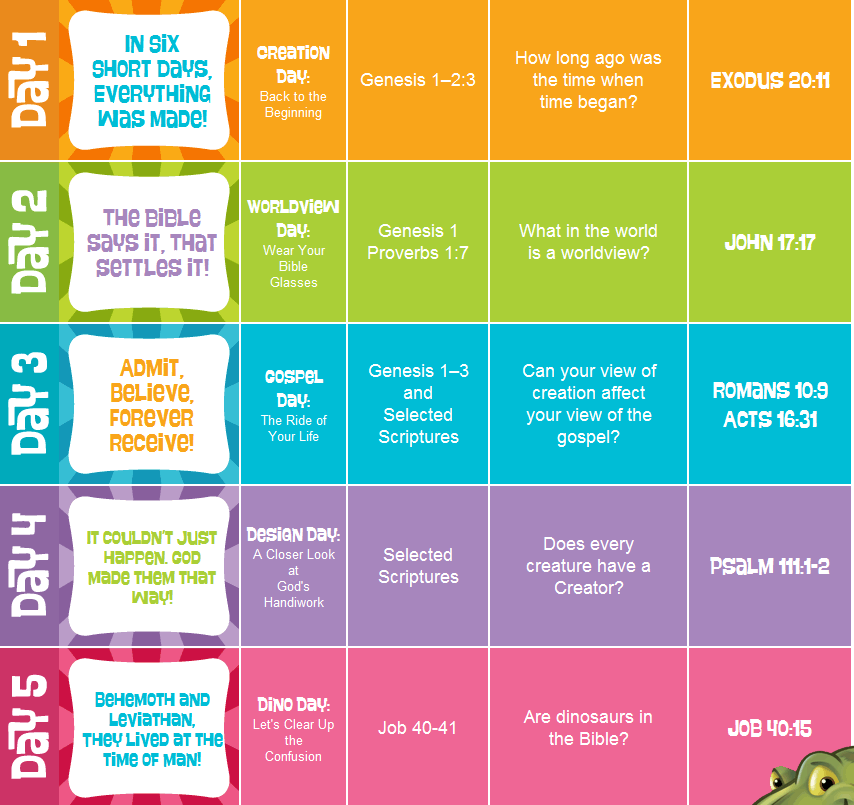 Yes, that’s right. Apparently I (and others) falsely accuse a group named “Answers in Genesis” which actively promotes young earth creationism through books (including children’s books), a magazine, a research journal, and even a VBS program [image on right all credit to answersvbs] (notice that the entire curriculum is focused on Young Earth Creationism: day 1 is in six short days, everything was made; day 2 is the bible says it, that settles it [and note that in Ham’s other post he argued we should teach our children how to think, not what to think–or at least in addition to ‘what to think’]; day 3’s main question is “Can your view of creation affect your view of the gospel?”; day 4 is on intelligent design [admittedly this doesn’t specifically mean young earth]; day 5 is going to teach children there are dinosaurs in the Bible) of focusing on a young earth.
Seriously, you did read that right. I and others are accused of falsely stating that Answers in Genesis is focused on young earth creationism.
Look, I’m not saying it’s a bad thing to have your ministry focused on a specific area. In fact, I think that Christians who are strong in science, the arts, philosophy, and other areas of knowledge need to step up and do what they’re best at for the glory of the Lord, whether that means making new discoveries in a lab or going and working at a retail job. Do it well! The problem is that Ken Ham is saying we’re falsely accusing Answers in Genesis of being focused on young earth creationism. Sorry, but they are.
Moving on:
Thus it is obvious that millions of years is incompatible with God’s Word. And one does not get millions of years from the Bible—it comes from fallible man’s interpretation of the past.- Ken Ham
Honestly, this has to be the favorite line YECs use: “man’s fallible __________” or some variant. Again, all it does is subtly poison the well. Isn’t it equally possible that man’s fallible interpretation could lead to a young earth view? Let me answer the question: YES. People are fallible, and they make hermeneutical mistakes, science mistakes, and other mistakes. Thus, one could equally say: “It is obvious that the young earth position is not necessitated by the text. To say that it is necessitated is to use man’s fallible interpretations of Scripture.”
Suddenly YEC looks like it is the evil “compromiser.” But I’m not going to take that route. Rather, I want to consider arguments, not attacks on character; I want to consider the text, and not bring eisegesis into it by assuming my position is the only possible interpretation.
Moving on:
I would also be prepared to say that those church leaders who condone “gay” marriage will have compromised Genesis! – Ken Ham
Another classic YEC scare tactics. I pointed it out in my last post responding to Ken Ham. Basically, you take the position you want to refute and then associate it with anything people who already agree with you will think is bad. For example, you could say “Hugh Ross believes in an old earth, just like evolutionists.” Suddenly, the people who read things like AiG’s website know that Hugh Ross is evil.
Here’s the problem: Hugh Ross isn’t evil. The statement is no argument. It’s guilt by association. It’s poisoning the well, and it’s unChristian.
Hey look, he does it again:
Those in the church who compromise Genesis with millions of years and evolutionary ideas are really saying that man’s word is infallible, and God’s Word is fallible! It is the other way round!- Ken Ham
Scare words abundant throughout. No argument, just assertions.
So no, the “Reformation” we are calling the church to is not (as some critics have been recently claiming) to get people to believe in a young earth— it’s having them accept the full reliability of the Bible. Believing in a young earth is a consequence of accepting God at His Word in Genesis.- Ken Ham
Honestly, this is the best piece of the entire blog post. It sums up Ham’s position well. Basically, he goes in with the assumption that the young earth is the only possible reading of Genesis. Thus, if anyone does not hold to a young earth position, they do not “accept God at His Word.” Now, what he’s saying is that it’s not that the reformation is young earth creationism; rather, the reformation is to re-evangelicalize the church: sola Scriptura! Amen!
Here’s the problem: a young earth is not the only possible reading of Genesis, and by putting it forth as such, and explicitly stating that it must be a consequences of “accepting God at His Word,” Ham and others who make similar claims have therefore put their views as God’s views. Their view is, in fact, a consequences of an ultra-literal hermeneutic which they espouse. The text itself does not warrant it. The fact that there is almost limitless reading from authors who argue that the Genesis account is Ancient Cosmology; or that it lines up with one week as part of creation; etc.; alone speaks to the fact that AiG’s position is not necessarily a consequences of the text, but of their hermeneutic: it’s a consequences of their method, not the source.
Bottom Line: Let’s focus on the issues involved in Genesis and the world that God has revealed to us, which is a reliable guide to truth (Psalm 19). The only reason I spend time responding to Ken Ham and others like this is because I do not want such statements to go unchallenged. When a Christian goes around accusing other Christians of being “compromisers” or other scare-words simply because they differ in their interpretation of a passage of Scripture, that Christian needs to carefully rethink the issues and realize “In essentials, unity, in non-essentials, liberty.” Stop throwing out the accusations. Focus on the issues.
Frankly, I pray this will happen, but I doubt that it will. As long as one holds one’s own methodology and hermeneutic is the only way to do it, there can’t really be thoughtful dialog. I hope I’m wrong, and I hope that maybe Ken Ham and AiG will be willing to work with others who have different views but still hold to inerrancy of Scripture in order to bring about a whole-church reformation towards inerrancy. But that would require AiG dropping the position that only they are right.
Links to Other Responses to Ken Ham’s “Compromise” Posting
Ken Ham on ‘Compromise’ and Stand to Reason– my response to Ham’s initial post.
Compromising the Kingdom– Faithful Thinkers offers a really in-depth critique of Ham’s use of emotional and ad hominem attacks.
A Brief Word on Ken Ham, Stand to Reason, and the OEC/YEC Debate– two really good points raised in this post. How do our attitudes drive people away?
SDG.

 J.W. Wartick - Reconstructing Faith