atheism
The Unbeliever Knows God: Presuppositional Apologetics and Atheism
[A]ll men already know God–long before the apologist engages them in conversation–and cannot avoid having such knowledge… People lack neither information nor evidence… [A]ll men know that God exists… In a crucial sense, all men already are “believers”–even “unbelievers” who will not respond properly by openly professing and living obediently in accordance with the knowledge they have of God. (Greg Bahnsen, Van Til’s Apologetic
, 179-180, emphasis his, cited below).

One crucial point of presuppositional apologetics is that even the unbelieving atheist really does know God. All people have knowledge of God. None can turn from it, none can escape it: everyone knows God. This knowledge is not saving knowledge. Instead, it is knowledge which is suppressed. The knowledge is ignored or even reviled. The quote above from the famed presuppositionalist Greg Bahnsen is just one example. C.L. Bolt, a popularizer of presuppositional apologetics, says similarly:
It is in the things that have been created that God is clearly perceived. This perception is, again, so clear, that people have no excuse. Not only do all of us believe in God, but we know God. (C.L. Bolt, cited below)
What are we to make of this claim? What is the point from the presuppositionalist perspective? The claim is firmly rooted in Paul’s discussion of God’s wrath against evil in Romans 1-2 (see the text at the end of this post). Therefore, it behooves all Christians to reflect upon the notion that God is known to all people. Presuppositional Apologists have done much reflecting on these subjects, and here we shall reflect upon their insights.
 What is meant by ‘knowledge of God’?
It is important to outline what exactly it is that this knowledge is supposed to be. Greg Bahnsen notes in Van Til’s Apologetic
Note that there is an important distinction within presuppositional thought about what this knowledge of God means. John Frame makes it clear that there is a sense in which the unbeliever knows God and yet another sense in which the unbeliever does not know God (Frame, The Doctrine of the Knowledge of God
Frame also makes clear the reasons why all people know God in at least the limited sense: “God’s covenental presence is with all His works, and therefore it is inescapable… all things are under God’s control, and all knowledge… is a recognition of divine norms for truth. Therefore, in knowing anything, we know God” (18). Frame elaborates: “[B]ecause God is the supremely present one, He is inescapable. God is not shut out by the world… all reality reveals God” (20).
Therefore, this knowledge should be understood as the blatant, obvious awareness of God found in the created order. It is not saving faith or saving knowledge; instead, it is knowledge which holds people culpable for its rejection. All are accountable before God.
 The Implications of the Knowledge of God
The Practical Implications of the Knowledge of God
Of primary importance is the notion that there is no true atheism. Instead, atheism can only be a kind of pragmatic or living atheism: a life lived as though there were no God. All people know that God exists. The eminent Calvinist theologian, William Greenough Thayer Shedd writes, “The only form of atheism in the Bible is practical atheism” (Shedd, Dogmatic Theology
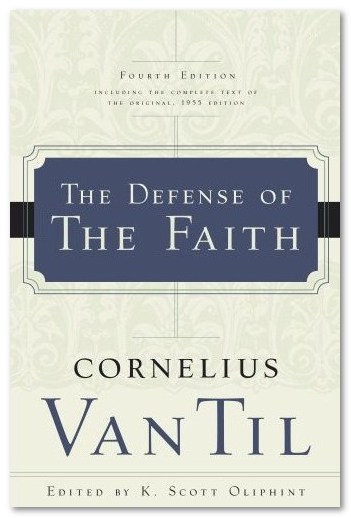
Van Til notes, “It is… imperative that the Christian apologist be alert to the fact that the average person to whom he must present the Christian religion for acceptance is a quite different sort of being than he himself thinks he is” (The Defense of the Faith
Furthermore, this knowledge of God is of utmost importance. Bahnsen writes, “Our knowledge of God is not just like the rest of our knowledge… The knowledge that all men have of God… provides the framework or foundation for any other knowledge they are able to attain. The knowledge of God is the necessary context for learning anything else” (181). As was hinted at above, without God, there is no knowledge. Even the unbeliever relies upon God for any true beliefs he has. Van Til notes, “our meaning… depends upon God” (63).
Apologetics in Practice
For presuppositionalists, this means that apologetics is reasoning with people who already know and use their knowledge of God to ground whatever knowledge they do have and bringing them to an awareness of their double-standards. They reject God in practice, but accept God in their epistemology. Thus, presuppositional apologists use the transcendental argument: an argument which seeks to show that without God, the things which we take for granted (knowledge, logic, creation, etc.) would not exist.
Can evidentialists use the insights of presuppositionalists here as well? It seems they must; for the Bible does clearly state that everyone knows God. However, the way evidentialists may incorporate this insight is by using an evidential approach to bring the unbeliever into an awareness of the knowledge they are rejecting in practice. Thus, a cosmological argument might be offered in order to bring the unbeliever into an awareness that their assumptions about the universe can only be grounded in a creator.
Conclusion
We have seen that presuppositional apologetists makes use of the knowledge of God attested in all people by Romans 1 in order to draw out a broadly presuppositional approach to apologetics. I have also given some insight into how evidentialists might use this approach in their own apologetic. We have seen that the core of this argument is that all people know God. Therefore, there are no true atheists; only practical atheists. All true knowledge must be grounded on the fact of God. There are none with an excuse to offer before God at judgment. God’s existence is clear. The unebeliever knows God.
I end with the Biblical statement on the state of the knowledge of the unbeliever, as written by Paul in Romans 1:
The wrath of God is being revealed from heaven against all the godlessness and wickedness of people, who suppress the truth by their wickedness, since what may be known about God is plain to them, because God has made it plain to them. For since the creation of the world God’s invisible qualities—his eternal power and divine nature—have been clearly seen, being understood from what has been made, so that people are without excuse.
For although they knew God, they neither glorified him as God nor gave thanks to him, but their thinking became futile and their foolish hearts were darkened. Although they claimed to be wise, they became fools…
Links
Like this page on Facebook: J.W. Wartick – “Always Have a Reason”
Unbeliever’s suppression of the truth-A brief overview of the notion that unbelievers are suppressing the truth from a presuppositional perspective.
The Presuppositional Apologetic of Cornelius Van Til– I analyze the apologetic approach of Cornelius Van Til, largely recognized as the founder of the presuppositional school of apologetics.
Choosing Hats– A fantastic resource for learning about presuppostional apologetics.
Sources
C.L. Bolt, “An Informal Introduction to Covenant Apologetics: Part 10 – Unbeliever’s knowledge of God.”
Greg Bahnsen, Van Til’s Apologetic
John Frame, The Doctrine of the Knowledge of God
Cornelius Van Til, The Defense of the Faith
Shedd Dogmatic Theology
SDG.
——
The preceding post is the property of J.W. Wartick (apart from citations, which are the property of their respective owners, and works of art as credited) and should not be reproduced in part or in whole without the expressed consent of the author. All content on this site is the property of J.W. Wartick and is made available for individual and personal usage. If you cite from these documents, whether for personal or professional purposes, please give appropriate citation with both the name of the author (J.W. Wartick) and a link to the original URL. If you’d like to repost a post, you may do so, provided you show less than half of the original post on your own site and link to the original post for the rest. You must also appropriately cite the post as noted above. This blog is protected by Creative Commons licensing. By viewing any part of this site, you are agreeing to this usage policy.
Really Recommended Posts 3/22/2013- Rob Bell, Loftus, and Dawkins, oh my!
 Very often, I am just taken aback by the consistent high quality of posts I turn up in a search across the web. Check out the posts I bring to your attention this week! The topics include Loftus’ “outsider test” of faith, John Carter, Farmers, Richard Dawkins, morality, and Rob Bell with the emergent church.
Loftus vs Marshall I: An Alphabet of Errors (on Science and Faith)– I can’t tell you how much I recommend this for reading. Loftus is one of the up-and-comers in the “New Atheist” movement, and he is in love with his own devised argument against theism: “The Outsider Test of Faith.” Marshall exposes numerous flaws in Loftus’ latest work on the topic, as well as showing many of the difficulties which persist in his position.
A “John Carter” Calendar: Twelve Months, Twelve Reasons to Visit Barsoom– A great look at reasons to watch “John Carter,” a film I feel has been very underrated. I have written an analysis of the movie itself, in which I discuss many of the themes found therein: “A Christian look at ‘John Carter.'”
God Made a Farmer (Video)– A video recognizing women farmers, which is itself a companion to the original, a Dodge Super Bowl commercial which lauds farmers generally but doesn’t show any women. That original version, itself very much worth watching, can be found here. I found the message here to be very endearing.
Richard Dawkins defends the moral goodness of infanticide and adultery– I’ll be one of the first to say atheists are perfectly capable of being moral people. God’s moral law is clear to anyone. Yet, once someone denies that grounding for morality, it is permissible for them to develop all kinds of random moral systems. Dawkins’ comments about infanticide and adultery are just one example of the kind of hedonism which can occur when the basis for morality is jettisoned.
The Submergent Church– A powerful image showing the way some “emergent” people have put holes into the notion of orthodoxy and thus undermined their own credibility. This is one of my favorite websites, and I highly recommend that you follow it: No Apologies Allowed.
The Crusades: Wanton Religious Violence?
 The Crusades are often cited as the prime example of the evils of religion and of Christianity specifically. The picture is often painted of an innocent world on which Christians came in violent fervor, raping and pillaging as they went. But this picture of the Crusades is inaccurate on a number of levels. Here, I’ll explore the historical context of the Crusades with an eye towards seeing why they occurred. I’ll wrap it up with a discussion on violence and religion.
The Historical Context of the Crusades
The Crusades were not just some bubbling up of violence latent within all religions. Instead, they were part of a history of conquest across the Asian and European continents. Prior to the Crusades, there was a sweeping conquest by the Muslims of territory formerly possessed by various Christian nations.
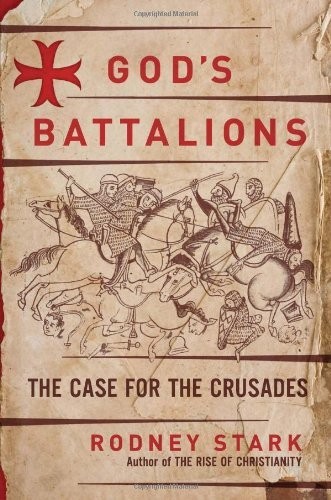
Muslim invasions had pressed in on all sides. Rodney Stark, in his extremely important work on the Crusades, God’s Battalions
Many critics of the Crusades would seem to suppose that after the Muslims had overrun a major portion of Christendom, they should have been ignored or forgiven… This outlook is certainly unrealistic and probably insincere. Not only had the Byzantines lost most of their empire, the enemy was at their gates… (32-33)
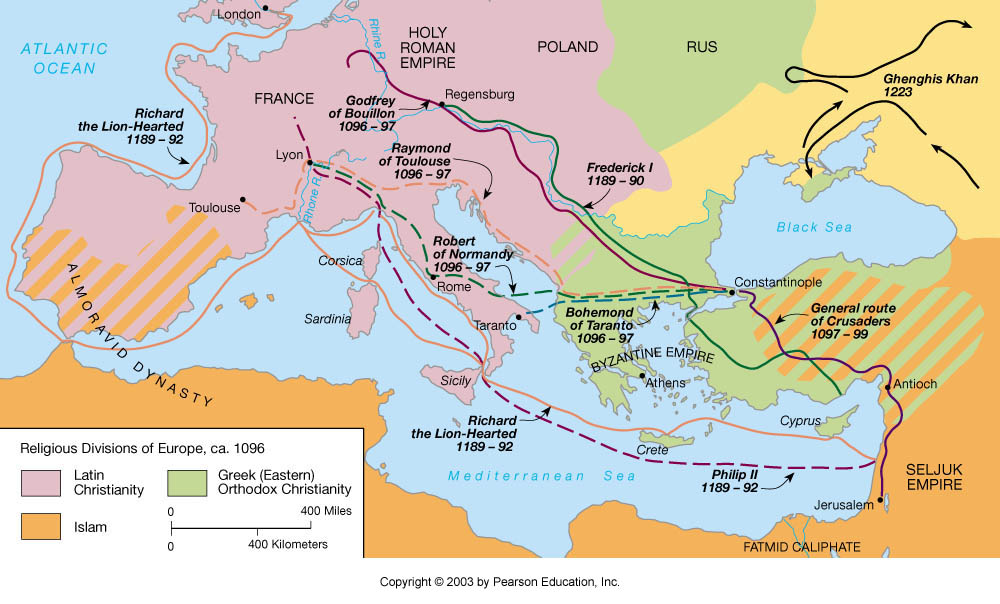
Prior to the Crusades, it is absolutely essential to note that the invaders were, quite literally, at the gates. Constantinople was threatened in the East, and Spain was overthrown in the West. Europe was under assault. The map below illustrates the situation in the time during and before the Crusades well.
The question of the Crusades must be understood within this historical setting: much of the land which European countries had controlled had been taken, by force. Furthermore, those who had taken these lands were knocking on the very gates of Europe, having already crossed into Europe in many places. Stark’s words, therefore, seem to ring true: is it really genuine to assume that these invaders should have been ignored or forgiven? Is that the reality of “secular” nations? It seems to me the very fact that so much land had been lost, as well as so much wealth, would lead many to war for “secular” reasons rather than religious reasons.
Regarding the beginning of the Crusades, Stark writes:
[T]hat’s when it all [The Crusades] started–in the seventh century, when Islamic armies swept over the larger portion of what was then Christian territory: the Middle East, Egypt, and all of North Africa, and then Spain and southern Italy, as well as many major Mediterranean islands including Sicily, Corsica, Cyprus, Rhodes, Crete, Malta, and Sardinia. (9)
So the Crusades were not unprovoked mass murders of innocents. But they were indeed quite brutal, and involved no small amount of very un-Christian activities. Raping and pillaging has no part in the Christian worldview. But Stark once again has a sobering point: war was hell. “[I]t was a brutal and intolerant age” (29). The criticism of brutality equally applies to both sides, but it is also equally anachronistic about the realities of that time. This is not to say that the horrors which occurred were not awful; it is to say that to criticize the Crusaders or Muslims as though they were doing something extraordinarily brutal for their time period is extremely short-sighted.
The Crusades as a Polemic Device
The Crusades were not all-good or all-evil affairs. Like virtually any part of human history, both good and evil intentions and outcomes were involved. To view the Crusades as either an entirely evil affair showing how religion is ultimately prone to violence or as a benevolent attempt by loving people to liberate lands that were rightfully theirs is to grossly oversimplify the historical reality. Unfortunately, modern looks at the Crusades have largely leaned towards the former of these positions, without any acknowledgement of the historical context as noted above.
Instead, the Crusades were a complex of historical events which were often brutal, often provoked, and never motivated for just one reason. To say that the Crusades are a typical example of the violence of religion is, frankly, ahistorical. Was religion involved? Yes. Were there even “religious reasons” involved in the motivations for the Crusades? Clearly. But the general movement with recent attacks on Christianity has been to argue that the Crusades were purely religious instances of religious brutality. The historical perspective provided above provides evidence against that limited perspective.
The Crusades have been used as a kind of polemic device against Christianity. Whenever it is argued that Christianity is reasonable, someone inevitably brings up this historical period. Readers will note that this historical perspective has not attempted to explain away the Crusades. Instead, I have argued for the notion that these events were historically complex, involving a number of factors beyond purely war for the sake of a faith.
As Keith Ward has noted:
It is… beyond dispute that the Crusades were a major disaster… The Crusades can be seen as justified defense… but their conduct and continuance rapidly became unjustifiable on any Christian principles. (68-69, Is Religion Dangerous?
cited below)
The point is simple: there were many motivations behind the Crusades, some of them justified. Yet in carrying out the Crusades, many horrible actions were taken which were unjustifiable. Does this somehow disprove Christianity? Not on Christianity’s own principles, on which we expect to see people acting as sinner-saints in the process of sanctification.
 Religious and Secular Violence
Apart from the historical outline given here, there is another, equally important point: the dichotomy between religious violence and secular violence is simply a myth. The reason for this is because human actions are far more complex in their motivations than a simple dichotomy of one or the other reason. In our everyday experience, we know that the decisions we make are very rarely made for only one reason.
Oddly, Stark is able to note that “many historians have urged entirely material, secular explanations for the early Muslim conquests…” (13). This, in contrast to the many historians and new atheists who continue to press that the Crusades were entirely religious in their provocations. The unfortunate truth this reveals is the very human tendency to simplify history beyond the point of breaking. Human actions, particularly corporate human actions, have extremely complex motivations behind them. They are not all-or-nothing affairs which happen due to one reason or another. Very often we make decisions for a combination of reasons of differing strengths, weighing options against each other whether we realize it or not.
By utilizing the Crusades as a rhetorical device–a polemic weapon–many have done damage to the historical events themselves. Worse, they have engaged in faulty reasoning and attacked the religious other due to their own emotional hatred. The Crusades were not all-good or all-evil affairs. They were affairs of human history. To forget that is to drown them in a sea of obfuscation. Let us get beyond simple polemical attacks on the “other.” Let us instead engage in honest history and dialogue with our neighbors.
Links
The Myth of “Religion”: Constructing the Other as an enemy– I explore the notion that religion is violent and argue that one of the major difficulties with this notion is that the distinction between secular/religious is a myth.
For an interesting exploration of some aspects of Muslim Philosophy, see my book review: The Closing of the Muslim Mind.
Essential reading: Rodney Stark, God’s Battalions
Pacifism, Matthew 5, and “Turning the other cheek”– Glenn Andrew Peoples discusses pacifism in the Christian tradition and some of the arguments in its favor. Ultimately, he finds these arguments wanting.
Sources
Rodney Stark, God’s Battalions
Keith Ward, Is Religion Dangerous?
Image Credit:
The image of the map is from this page with free resources for instructors. I do not claim credit for this image, nor do I claim that the makers of this resource in any way endorse this post.
SDG.
——
The preceding post is the property of J.W. Wartick (apart from citations, which are the property of their respective owners, and works of art as credited) and should not be reproduced in part or in whole without the expressed consent of the author. All content on this site is the property of J.W. Wartick and is made available for individual and personal usage. If you cite from these documents, whether for personal or professional purposes, please give appropriate citation with both the name of the author (J.W. Wartick) and a link to the original URL. If you’d like to repost a post, you may do so, provided you show less than half of the original post on your own site and link to the original post for the rest. You must also appropriately cite the post as noted above. This blog is protected by Creative Commons licensing. By viewing any part of this site, you are agreeing to this usage policy.
“For Greater Glory” – A look at a movie about Christianity in the face of violence
 “For Greater Glory“
The Good, the Bad, and the Ugly
The Good
The general Enrique Gorostieta Velarde is clearly a “good guy.” He was, himself, no Christian and certainly not a Roman Catholic, but he stood up against those who would persecute people simply for their beliefs. He also did not stand for compromise: he wanted toleration to be granted to Roman Catholics. He fought for an ideal. Even if that ideal was not one of the faith he was fighting to defend, he felt that there was injustice, and fought against it.
It is unclear whether the historical Enrique Gorostieta Velarde ever became a Christian. In the film, it certainly make it seem as though in making his arguments, he came into a kind of faith in God. It also seems to be the case that the historical general had some political ambitions in that he desired to bring about a change in the Constitution to provide for more toleration.
Father Christopher is an example for Christians everywhere. He does not back down in the face of violence. He became a martyr by standing in front of men who were doing him violence and proclaiming Christ to them. His martyrdom served as inspiration for a number of people in the film.
The Bad
The anti-catholics in the film are clearly the “bad guys.” It is hard to argue with this. Anyone who chooses to attack and kill people simply because of their beliefs certainly qualifies for the catchall “bad guy” terminology.
Plutarco Elías Calles, the Mexican President, an atheist, decides that he must use a violent crackdown to keep the Roman Catholic Church from becoming involved in Mexico. He couches his oppression of the Roman Catholics in language of secularism. Instead of focusing upon their religion, he makes his argument based upon the rule of government: the Roman Catholics serve a ruler (the Pope) who is outside of this country, and so they are a danger to the stability of this country. Despite this “secular” language, the fact of the matter is that throughout the film, the government is viscous not just towards the Roman Catholics as people who serve a different master, but also simply as religious persons. Crosses are burned and churches are destroyed. People are slaughtered during worship. It is a wholesale war against Christianity.
The Ugly
The film does not draw a hard and fast line between “good” and “bad,” however. There are also the ugly: those who, with good intentions, also commit atrocities. The Cristeros (those who fought for religious tolerance of Roman Catholicism) who commit atrocities were the “ugly.” Some felt they had to fight evil with evil, and committed horrible acts in the name of their cause. This is exactly what Christians are called to avoid.
Just War and Pacifism
The movie brought up the constant debate within Christianity between just war theorists and pacifists. It was surprising how lucidly it presented the issues. There were those in the film who refuse to use violence to fight against the government, citing Christ’s example of turning the other cheek. Yet even they become involved in getting supplies such as bullets to the Cristeros. On the other hand, there are those who argue for a just war tradition: when injustice is running rampant, should not Christians be among those who stand up against it, even if that calls for using force? The film never answers one way or another; instead, it leaves it to those watching to weigh the merits of just war and pacifism.
I tend to favor the just war theory myself. It seems to me that if a government like the Nazi Regime exists, then it is perfectly justifiable to use force to prevent them from perpetuating their evils.
Historically, according to more than one source I looked up, it is argued that the Cristeros actually had little impact on the overall outcome of the changes and toleration which came to Mexico. Instead, it was a deal negotiated by the Vatican with the Mexican government. Yet it seems for me historically perplexing as to why, exactly, the Mexican government would have desired a compromise if the Cristeros were not in operation. I speak here as no expert on the topic by any means. I’d be interested in reading your own thoughts.
The Elephant in the Room
It is hard to see this movie without thinking about the elephant in the room: atheists are in power, and religious people are killed. It’s a theme in the movie, but it also plays out time and again throughout human history: the French Revolution, the Soviet Union, the massacres of Armenians in Turkey, the Spanish Civil War, and more. Why is it that it seems, historically, every time a secularist government has taken power, the religious persons are the ones who suffer violence?
The answer to this vexing question seems to me to be quite clear: the notion that religion is violent and secularism stops violence is just false. Not only that, but the distinction between secular and religious is, itself, a mere construct with no ontological reality. I have argued this before when I discuss the Myth of Religion.
Conclusion
“For Greater Glory” is a movie that should be a must-see for those interested in worldview discussions. I could see it being used at an interfaith group, church youth group, or seeker group to generate discussion. The movie is definitely violent, and it shows the good, the bad, and the ugly unapologetically. It is for that reason that it must be seen.
What is perhaps the most shocking part of this movie is the fact that, prior to watching it, I had never heard or even imagined that Mexico had persecuted Christians. The violence committed against Christians by others in authority continues into the modern era, and it is truly depressing to know how little we hear about it. I can’t help sometimes but join with David and say “How long, Oh LORD?” (Psalm 13).
Links
I discuss the way that construct of “religion” has been used to denigrate an alleged “religious other” in my post: The Myth of Religion.
I have looked at a number of other popular movies. Check them out (scroll down to see more posts) in my movies category.
An interesting discussion of Christian pacifism can be found over at Glenn Andrew Peoples’ blog: Pacifism, Matthew 5, and ‘Turning the other cheek’.
SDG.
——
The preceding post is the property of J.W. Wartick (apart from citations, which are the property of their respective owners, and works of art as credited) and should not be reproduced in part or in whole without the expressed consent of the author. All content on this site is the property of J.W. Wartick and is made available for individual and personal usage. If you cite from these documents, whether for personal or professional purposes, please give appropriate citation with both the name of the author (J.W. Wartick) and a link to the original URL. If you’d like to repost a post, you may do so, provided you show less than half of the original post on your own site and link to the original post for the rest. You must also appropriately cite the post as noted above. This blog is protected by Creative Commons licensing. By viewing any part of this site, you are agreeing to this usage policy.
“Is Faith in God Reasonable?” Brief Debate Review: Alex Rosenberg vs. William Lane Craig
 Recently, the atheist Alex Rosenberg debated the theist William Lane Craig. The meat started to happen in the rebuttals, so I will focus on those. For a full review, check out Wintery Knight’s excellent summary.
Craig’s First Rebuttal
Craig pointed out the extreme implausibility of the naturalistic worldview in contrast to theism. He outlined several ways in which naturalism fails as an explanation of reality and cited Rosenberg’s work several times throughout this discussion. He argued that mental states have an “aboutness” which naturalism cannot explain.Then, he pointed out the profound difficulty naturalism has with locating truth and meaning within the worldview. He asserted that libertarian free will and purpose are incompatible with naturalism. Finally, the concept of the “self” and the first-person awareness cannot be explained by naturalism.
Rosenberg’s First Rebuttal
Alex Rosenberg: He focused on this question quite a bit in his rebuttal: “How is it possible for one chunk of manner to be ‘about’ some other piece of matter?” Yet after saying that this, he asserted that this debate over naturalism has nothing to do with the topic of the debate: “Is Faith in God Reasonable?”
He then turned to a discussion of the problem of evil. “If God is omnibenevolent, omniscience, and omnipotent, then the suffering of animals and humans needs desperately to be explained… Nobody has yet to offer a satisfactory explanation… Dr. Craig needs to tell us how [God] had to have the holocaust!”
He also argued that different religious books are false, so there is no reason to trust the New Testament.
Rosenberg said if Craig could provide an explanation for this, then he would become a Christian.
Craig 2nd Rebuttal
Craig immediately exclaimed his excitement over Rosenberg’s possibility of becoming a Christian, arguing that the logical problem of evil, which Rosenberg seemed to be using, has been largely abandoned due to its immense problems. In order to make this argument, the atheist assumes that if God is all powerful than he can create any world he wants, but this is not necessarily true. It is logically impossible for God to make someone freely do something. The atheist would have to prove that there is a world with as much free good in this world but without as much free evil. It seems this premise is impossible to prove. Thus, the logical problem of evil has largely been dropped.
Craig pointed out the fact that Rosenberg was simply mistaken about the importance of metaphysical naturalism. If metaphysical naturalism is false, then it seems clear that theism is that much more plausible.
Craig also once again pointed out that discrediting things like the Book of Mormon or the Qur’an does nothing to undermine the truth of the New Testament documents.
Rosenberg Final Rebuttal
Rosenberg continued to attack Craig as well as the format of the debate. He asserted that Craig was merely repeating himself. Then he commented that the format of a debate does not work to discuss questions like those at hand. One honestly is forced to wonder why Rosenberg chose to engage in the debate, if such were his opinions. Rosenberg attacked Craig’s arguments for “giving philosophy a bad name” and said he would be “embarrassed” to outline Craig’s defense of his arguments.
He did get into some actual comments on the arguments, however. He argued that some things can come into being from “nothing at all,” specifically alpha particles.
Finally, he got to the problem of evil. Here I continued to be confused over whether Rosenberg was sure which variety of the problem of evil he was presenting. He continued to utilize the evidential problem of evil as though it were the same as the logical problem of evil. He was confusing his arguments, mixing necessity with contingency. There is little to comment on here, because it was so confused.
Regarding the New Testament, Rosenberg essentially argued that we cannot know how corrupt the New Testament is.
Craig Closing
Craig turned once more to Rosenberg’s construction of the problem of evil. He pointed out that Rosenberg was mistaken about free will as well as the nature of the God’s creation. He pointed out that the holocaust was not necessary. Instead, he noted that the onus is upon Rosenberg to show that God could have actualized a world with as much good as there is in this world while simultaneously showing there would be less evil, which is of course beyond the ken of the atheist (or the theist).
Craig pointed out that we can confirm that New Testament sources we have go back to within 5 years of the actual events. Furthermore, Rosenberg was mistaken in saying that the New Testament documents were written in Aramaic. They were written in Greek.
Rosenberg Closing
Rosenberg used his closing to present an “obvious” argument for atheism. He argued that science has no need of the God hypothesis and that there is no basis “to invoke God for explanatory or any other purpose” in science. Thus, science has no reason to accept the existence of God. I find it interesting that he chose to save this argument for the point when he couldn’t be rebutted on the argument. Perhaps that is due to the extreme weakness of the argument. Only be equating science with knowledge could this argument have any relevance. This is not to mention that he is mistaken on this, but to show that he is mistaken would take us too far afield. Interested readers can view the links at the end of this post.
Rosenberg closed with “advice from an atheist.” His advice was to tell theists to not demand that their faith be reasonable. He continued with a discussion saying that theists should say “I believe because it is absurd.” He essentially asserted that theists cannot be reasonable. Honestly, this was just an insult. I admit I was not surprised by this comment by the end of the debate, as Rosenberg’s general strategy had seemed to be to denigrate, rather than interact with, theism.
Comments
I was honestly stunned by Rosenberg’s assertion that substance dualism or a debate over naturalism had nothing to do with faith in God. It seems quite obvious that such things are indeed germane to the discussion. If substance dualism is true, then theism has a much better account than non-theistic worldviews. If naturalism is false, the plausibility of theism increases greatly.
In the Q+A following the debate, someone asked Rosenberg why they should believe anything he said in the debate if he himself doesn’t believe in true. Rosenberg basically answered by saying that he’s just rearranging the brain in a way to meet truth… but of course he already denied that we can know what truth is. It’s just a certain way of orienting the matter in one’s brain! Ridiculous. I’m sorry, but it is ridiculous.
Regarding the debate itself, there were a number of non-scientific ways that people voted on the results of the debate. A formal panel awarded Craig the victory 4-2. The local (Purdue) voting on the debate 303-1390 Craig won. Online vote favored Craig 734-59. In other words, Craig crushed Rosenberg. I agree wholeheartedly. Let me know your thoughts. Comment below!
One awesome line from the debate came from Craig: “The purpose of life is not happiness. The purpose of life is knowledge of God.”
An awesome tweet: “Rosenberg apparently knows not only what God could have done but what would have been best for us for all eternity.” @ThnkngChristian
Links
Wintery Knight provided a simply fantastic summary of the debate.
Glenn Andrew Peoples has a post on quantum events in relation to the cosmological argument which is very relevant to this debate.
Shoulders of Giants?- Philosophy and Science in Context, or, “Lawrence Krauss Jumps off!”– I write on the relationship of science to philosophy as well as Christianity.
Science: “Thanks Christianity!”– Does Christianity say anything about science?
Did God Create the Universe for Humans? – Some thoughts on God’s purposes for creating
 I have read on more than one occasion an atheist making the argument that goes something like this: if humans are the most important creation, why did God create such a vast universe? The argument is that God really wasted a lot of space if the universe was created for us. Another way I’ve seen this argument is as follows: the universe is full of galaxies that are even beyond our capacity to ever observe. Why, if God created the universe for us, is there so much here that is worthless to us? Furthermore, why is so much of the universe hostile to human life? Humans can’t live in overwhelming majority of the universe. Why is it so hostile if it were created for us?
A different discussion with an atheist was touched off when they asserted that the Bible states humans are the most important creation, so why create so much of the universe outside of our power to observe?
I’m going to offer an explanation which may come as something of a surprise: there is nothing in the Bible which makes it explicit that humans are the most important creation. I would go so far as to say that anyone who claims that is reading an unjustified anthropocentric worldview onto the text.
Perhaps the most commonly cited explanation for why we should think humans are the center of creation is the Genesis creation account, and specifically Genesis 1:27-28:
So God created mankind in his own image,
in the image of God he created them;
male and female he created them.God blessed them and said to them, “Be fruitful and increase in number; fill the earth and subdue it. Rule over the fish in the sea and the birds in the sky and over every living creature that moves on the ground.” (NIV)
But again, where in this text does it suggest that humans are the most important creation? It does show that we were made in God’s image, but it does not say that because of that, we are more important than anything else in creation. Too often people read into texts what they think it says, as opposed to reading what the text actually says. Again, I simply ask this: where in the text does it say that humans are the most important part of all of creation? As a friend pointed out, one could easily say the sun is the most important part of creation, because without it, we would not all be alive. But either view is equally unsupported by the Bible.
Another rationale that is used from this passage is the notion that humans are to have dominion over or rule over the earth (verse 28). But again, how does it follow from this that humans are more important? The problem is that we have a skewed view of importance. For us, very often, we think importance is equal to power. When someone has power, they are more important than someone without power. But such notions of power and hierarchy are extrabiblical ideas which we have read onto the text.
In fact, it seems that the Bible says we are not the greatest of all creation. Psalm 8:5 references humans and says that “You [God] have made them [humans] a little lower than the angels and crowned them with glory and honor.” So yes, humans are “crowned” with glory, but they are also ” a little lower than the angels.” It seems the Bible says that we may not be the greatest things to walk the universe. [I should note that the Bible may, in fact, note that humans are the most important part of all creation, but were I to grant this, my reasoning below still holds.]
But some people remain dissatisfied by this explanation, and claim that Christians very often do claim that humans are the crown of all creation or that the universe was made for us. Here, I suggest that once again, people have been thinking very anthropocentrically. In fact, they have limited God to the point of making God incapable of even having the same range of possibilities that humans have. The assumption built into this argument is that God created for the sole purpose of humanity. But just like other persons, it is possible for God to have more than one end in taking an action. Thus, even if we grant that humans were the most important creation–in contrast to the above argument–it still does not follow that the universe is exclusively for humans. God can have different ends.
Think about it this way: when you take an action, you very often have more than one end in mind. For example, you may get in your car to go to a local shopping store so that you can go to the grocery store and also because you want to stop and look at books at the bookstore. Here, you have taken an action (gotten into the car and taken it somewhere) with more than one end in mind. Similarly, God can create with more than one end in mind. Even if humans are the greatest of all creation (which I deny), it is also possible that God also created for other reasons. For example, God may have created gratuitous galaxies because they are beautiful. I can’t help but look at the stars and have my heart stop. The beauty of creation is extraordinary. It cannot be described in words. Perhaps this was one end God had in mind, along with the creation of humans. There are a number of other reasons God could have created apart from humans, so it seems to me that the objection here is short-sighted.
Only by creating God not just in our own image, but in an image less than our own, can we come up with an objection to the existence of such a God based upon the vastness of the universe, or its hostility to life.
Links
Beauty is a powerful reason to favor the Christian worldview. Check out this excellent post on the topic over at Well Spent Journey: Christianity and High Beauty (With Pictures!).
More Planets Than Stars – Exoplanets and Our Little Blue Ball– Naturalis Historia features a simply superb post on the possibilities of other life/planets like ours. It also briefly addresses the issue I have discussed in this post. I recommend checking it out.
From Divine Engineer to Divine Architect– Over at Faithful Thinkers, Luke Nix wrote about a similar topic. His post explores the notion of God as an architect, transcending the either/or dichotomy created by some about God’s purpose for creation.
I have reflected on what life on other planets might mean for Christianity: Theological Reflections on Life on Other Planets.
SDG.
——
The preceding post is the property of J.W. Wartick (apart from citations, which are the property of their respective owners, and works of art as credited) and should not be reproduced in part or in whole without the expressed consent of the author. All content on this site is the property of J.W. Wartick and is made available for individual and personal usage. If you cite from these documents, whether for personal or professional purposes, please give appropriate citation with both the name of the author (J.W. Wartick) and a link to the original URL. If you’d like to repost a post, you may do so, provided you show less than half of the original post on your own site and link to the original post for the rest. You must also appropriately cite the post as noted above. This blog is protected by Creative Commons licensing. By viewing any part of this site, you are agreeing to this usage policy.
Saint Nicholas- A Christian life lived, a story told
It has been remarked, with much truth, that all of us lead double lives, a life of our fancy, in a world of things as they should be, or as we should like them to be, and a life in a world of things as they really are. And this is as it should be. We can lift the level of real existence by thinking of things as we should like them to be. It is well not to walk with one’s eyes always fixed on the ground. (McKnight, cited below, Kindle location 401)
It is easy to hear the “real story” of Santa Claus, but few investigate further than looking it up to see the parallels between the Bishop of Myra’s life and that of the story of Santa Claus. There is so much more to his story–and indeed to stories in general–than that.
Saint Nicholas (270-343 AD) was a valiant man who fought prostitution, abortion, and poverty. He attended the council at Nicaea, from which we received the Nicene Creed. At that council, he defended vigorously the orthodox doctrine of the Trinity. He was an exemplar of Christian teaching put into practice. Not only that, but the legend which has grown up around his life has inspired and enthralled untold numbers of people through the Christian era.
It is important to note the intertwining of legend and truth in the stories about St. Nicholas, and the impact that has had upon innumerable people. George McKnight, writing in the early 1900s, explored a number of issues related to the mingling of fact and fiction in the life of St. Nicholas. The quote highlighted above touches on many of these topics.
First, there is power in narrative. A story which is told well is one which can effect change. We are impacted by fantasy in ways which cause us to reflect upon reality with new–perhaps better trained–eyes. Second, we, as spirited people in a world which we so often see only as the physical, are called to heights of reality by fiction. As McKnight noted, “It is well not to walk with one’s eyes always fixed on the ground.” Our eyes are driven upwards and outwards by the stories we hear–they cause us to interact with others in new ways, and they also cause us to think about topics which perhaps we had not even considered before.
The story of St. Nicholas is no different. Yes, legend has crept into the accounts of this godly man, but what is the purpose of that legend? Not only that, but is it possible to separate out the fiction?, McKnight also commented upon the nature of radical skeptical history being done in his time (about 100 years ago). He bemoaned the fact that nearly every facet of Nicholas’ life is thrown into question with the arrival of critical scholarship. But of course to focus merely upon what is historical fact or fiction is to miss the entire point of the life of St. Nicholas. McKnight goes on:
The story of St. Nicholas consists almost entirely of a series of beneficent deeds, of aid afforded to humanity in distress, accomplished either by St. Nicholas… or through his intervention… The conception of St. Nicholas, then, is almost that of beneficence incarnate. (Kindle Location 469-481).
That is, the story of St. Nicholas, and the legends that surround him, turn him into a type of Christ–one who is deeply concerned for humanity and showing Christian love for God and neighbor.
Yet this is not all there is to the life of the Saint. Although difficult to sift from the legends, there is a historical core to the life of St. Nicholas which is just as profoundly Christian as the legends which have grown up around him. With that said, we turn to the story of St. Nicholas, with an eye toward how his life is one of a Christian lived as well as a story told.
Nicholas is well-attested to have attended the council of Nicaea. There is a possibly apocryphal story about his 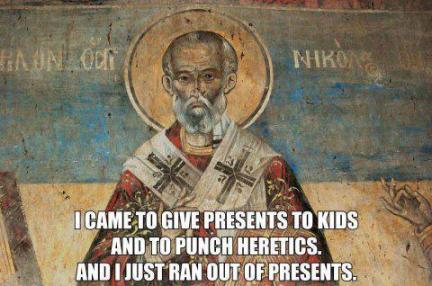 attendance there wherein he confronted the heretic Arias himself and slapped him in the face. The story continues, telling of how Nicholas was initially exiled for his act but later allowed to return after Arianism had been thoroughly acknowledged as heresy. Although it is nearly impossible to know whether this story is historically accurate, there is at least some truth behind the story in that Nicholas was known to vehemently defend the orthodox doctrine of the Trinity.
Nicholas actively opposed prostitution. However, instead of simply condemning the practice, he also gave money to young women in need to keep them from turning to prostitution to feed themselves. Again, this truth served as the basis for a possibly historic legend in which Nicholas learned of three women who were about to turn to prostitution (or be sold into slavery, depending on the account) because they couldn’t pay their dowries in order to be wed. Nicholas is said to have thrown a bag of gold for each young woman through their window so that they could be married instead of sell their bodies. Again, this legend may not be true–but it points to the truth about Nicholas’ life–he gave to those in need and fought against the evils of prostitution. It also points beyond itself towards an ideal.
Nicholas fought against the Pagan practices, which led to his persecution and imprisonment by those angered by his preaching against false idols. Furthermore, his opposition to paganism included working against a number of practices in the pagan world, including abortion. Roman Catholics have continued to spearhead St. Nicholas’ commitment to helping children. A search for “Nicholas of Myra” turns up adoption agencies one after another. Christians have used Nicholas’ example as a call to end human trafficking and slavery. One can see throughout these historical kernels how myth and legend could grow up around this figure–fighting heresy, giving to those in need, and having utmost concern for the innocent were all aspects of St. Nicholas’ life. We don’t necessarily know the extent of his actions in these areas, but we know enough to be inspired.
Therefore, we turn to another part of McKnight’s thought-provoking quote at the beginning of this post:
…all of us lead double lives, a life of our fancy, in a world of things as they should be, or as we should like them to be, and a life in a world of things as they really are. And this is as it should be. We can lift the level of real existence by thinking of things as we should like them to be.
Take a moment to consider what McKnight is saying here: we know there is a realm of absolutes–a way that things should be. We also have a way that we should like things to be. But the way the world “really is” does not often reflect that. Yet we can enact change upon our realm of existence–we can “lift it up”–by focusing on the way that things should be, and living our lives differently because of that. St. Nicholas enacted this in his life, working towards the ideal while living in an imperfect world. The legends of St. Nicholas inspire us to do the same. We are not to focus so much on the critical challenge–which stories are true and which are “only” legends. Instead, we are to focus on St. Nicholas as a story–one which inspires us to change the world around us.
Nicholas’ life was one which fought against poverty, paganism, heresy, prostitution, and idolatry. He incorporated sound doctrine into his life and then lived it. There can hardly be a better example of a Christian life lived than that of St. Nicholas. Yet that is not all there is to the story of the “real” saint. No, his life is one of calling us to live a life for Christ as well. His life is action. It is a life incarnate with truth and the beneficence that comes from the Christian worldview. It is a call to follow Christ.
Sources
James Parker III, “My Kind of Santa Claus.”
Robert Ellsberg, “St. Nicholas, Bishop of Myra.”
George Harley McKnight, St. Nicholas (New York: G.P. Putnam’s sons, 1917). This book is available legally free of charge in a number of digital formats through Open Library.
SDG.
——
The preceding post is the property of J.W. Wartick (apart from citations, which are the property of their respective owners, and works of art as credited) and should not be reproduced in part or in whole without the expressed consent of the author. All content on this site is the property of J.W. Wartick and is made available for individual and personal usage. If you cite from these documents, whether for personal or professional purposes, please give appropriate citation with both the name of the author (J.W. Wartick) and a link to the original URL. If you’d like to repost a post, you may do so, provided you show less than half of the original post on your own site and link to the original post for the rest. You must also appropriately cite the post as noted above. This blog is protected by Creative Commons licensing. By viewing any part of this site, you are agreeing to this usage policy.
Really Recommended Posts 11/30/12
Today’s Really Recommended Posts were honestly really hard for me to select. There are so many good posts out there that I’ve had to prep posts for over a month out so far. Soon I’ll have these things set up for years. Oh well, I guess that will mean the blog will keep going! Anyway, pacifism, literary apologetics, magicians, creationism, Dawkins, and more are featured this week. Like ’em? Let me know!
Pacifism, Matthew 5, and “Turning the other cheek”– Glenn Andrew Peoples is, in my opinion, one of the most lucid and fun bloggers on the planet. I don’t always agree with him, but when I do…. I almost made a tired joke. Anyway, this post is lengthy, but it is worth a thorough read. I can’t wait for his podcast episode to come out on it… sometime.
HP Lovecraft and Christian Thought– Readers, if you have not followed Hieropraxis, let me tell you right now to just go ahead and do it. Holly Ordway’s site is just full of phenomenal posts on cultural apologetics, and the posts are always fascinating. This one discusses HP Lovecraft’s view of the universe and compares it to the theistic picture.
Shouldn’t a magician be a skeptic?– A very insightful post on the distinctions between illusion and the Creator. Can magicians be Christians?
The Toba Super Eruption and the Polar Ice Cores– Some very interesting scientific data which may bring into question a young earth.
Friedrich Nietzsche Was not a Nihilist– Max Andrews argues that Nietzche saw an “abyss” from which he could find no value and thus the development of the übermensch served his need for value and teleology.
Defecting from Darwinian Naturalism: A review of Thomas Nagel’s Mind and Cosmos– does Darwinian Naturalism have an adequate worldview? Nagel argues no, and this look at his fascinating book draws out several reasons why.
Atheist’s Reviews of Dawkins’ The God Delusion– Some fascinating insights into Dawkins’ book from atheists.
Really Recommended Posts 10/12/12
Another great run around the internet today. I noticed that this edition of Really Recommended Posts has a lot on Christianity and Science, Islam, and religious or activist violence. Abortion, biochemistry, the Qur’an, violence in Islam, Mitt Romney, and more are all featured. Check out the posts. If you like them, let me know.
Cataloging the Historical Anachronisms in the Qur’an– Does the Qur’an potray accurately the period that it purports to describe in historical narrative? It does not seem so. Check out some of the anachronisms which crept in.
New peer-reviewed paper in Nature falsifies Darwinian junk DNA prediction– Darwinian Evolution has long used the notion of “junk DNA” as confirmation of its naturalistic processes. However, recent study has confirmed one of the predictions of the Intelligent Design movement: this supposed junk DNA would prove to be useful. I don’t claim to be a scientist at all, but I find this very intriguing. Check out the article.
Hey Atheists, Just Shut Up Please [LANGUAGE WARNING]- I found this article very interesting. An atheist discusses how people can tend to hate the “other” in their over-enthusiastic attempts to refute them. I was pleased with the article in general, but be aware that there is some strong language there. I myself have written about how religion is often used as a mechanism to hate the “religious other.”
Would a Romney presidency boost Mormonism?– Some Christians have come out saying they are afraid to vote for Romney because it would boost Mormonism. A pastor responds briefly to these claims.
Why Abolition Must be Non-Violent– The Abolish Human Abortion blog discusses why we in the pro-life movement must not resort to violence. The struggle is between worldviews, and pro-life persons cannot say they are pro-life while using violence.
Modern Muslims Who Choose the Path of Violence– Nabeel Qureshi discusses violence in Islam and the fact that Islam is not monolithic. The important thing to think about is how and when Islam turns violent. As I have emphasized elsewhere, religion and violence must be analyzed empirically, not with a mind towards demonizing the religious “other.”
Yes, the media does deliberately misrepresent and demonize creationists– Readers of my blog know I do not hold to a young-earth position. However, like Glenn Andrew Peoples I am still offended when the media blatantly misrepresents my Christian brothers and sisters. Check out this thoughtful post.
Really Recommended Posts 9/21/12
There are so many fantastic posts out there it has been hard for me to keep up. I actually have another RRP scheduled with all the backlogged posts I’ve run into. Let me know which posts you’ve enjoyed. I feature here a diverse spread of posts. The necessity of apologetics, atheism, the Gospel of Barnabas (!?), young earth creationism, and resisting sin are all featured. Check ’em!
Sarah Geis provides pointers for constructive debate and disagreement– A creative look at how to debate constructively by showing how not to do so.
Why Apologetics Should Be A Requirement For Every Pastor– Fellow Christians, I hope this post convicts you like it convicted me. We need to be doing apologetics. We owe it to our youths, we owe it to the adults in our congregations, and we owe it to ourselves.
Born Atheists?– Yes, you have heard it somewhere. We’re all born atheists. Really? What is that even supposed to mean? I found this post really excellent and it got me thinking. Check it out.
What is the Gospel of Barnabas?– Some Muslims have been claiming that the so-called Gospel of Barnabas falsifies the Christian doctrine of the Son of God. It is not, however, a serious threat. Check out this post to get some great historical information on this attempt to refute Christianity.
Atheism, Agnosticism, and the New Atheists– It never gets old. What does “atheist” mean? Don’t atheists just believe in one fewer god than believers? I’ve written about this topic myself. Check out this great post on the subject.
A Young Earth Chronometer?– One of my favorite websites has recently taken an intense three-part look at the claim that the amount of salt in the ocean is evidence for a young earth. I highly, heartily recommend the site itself to all my readers, Naturalis Historia.
How to Start a Preemptive Strike on a Sinful Inclination– Another one of my favorite and highly recommended sites, No Apologies Allowed, posted this thought-provoking comic about resisting sin.

 J.W. Wartick - Reconstructing Faith